Showing posts with label Wargame Theory. Show all posts

Wednesday, March 12, 2025

Challenges to an "Authentic" Medieval Wargame

Back in October of last year, I attended one of Georgetown University Wargame Society's ongoing lecture series.  On tap for the October lecture was Robert W. Jones' talk on The Challenges and Pitfalls of an "Authentic" Medieval Wargame.   Dr. Jones, the author of the Medieval wargame rules Blood and Horse Droppings, brought up a number of interesting topics and points to ponder when creating a set of Medieval rules.  While I had planned on offering up a summary of the discussion much sooner, my motivation to re-address the presentation was triggered by a challenge to bring my yet unblooded Wars of the Roses collection to the gaming table.  With what I want in a Medieval wargame and rules of engagement still in the formative stage, I returned to my notes from Dr. Jones' presentation for inspiration and clarity.

Given the title of the talk, I was not surprised or disappointed in seeing Dr. Jones present a list of challenges and pitfalls to designing a Medieval wargame and how to address those challenges in game design.  The central theme of the lecture should not be foreign to any wargame designer.  That theme focused on the tug-of-war between playability and historical simulation.  Let's briefly reconsider the salient points on what Dr. Jones had to say on the topic of Medieval wargame challenges.
Medieval wargaming, like Ancients wargaming, often encompasses large chronological periods.  Medieval rules can cover nearly a millennium of military history from the fall of the Western Roman Empire to the Great Italian Wars.  Universal rules, using a common game engine, tend to categorize troops according to common criteria across several periods.  Players use the same mechanisms and nomenclature regardless of historical context.  Standardization allows players to switch between periods more readily but at the loss historical specificity over convenience and playability.

Having such breadth in Medieval rules suggests a lack of understanding regarding the technological and tactical evolution present throughout the period.  There is no equivalent descriptive label such as "Horse & Musket" or "Pike & Shot" to describe Medieval warfare's dominant military technologies.
The limited and unreliable historical sources available pose problems as well. Medieval chronicles lack tactical detail, exaggerate numbers, and prioritize political or religious narratives over complete and accurate battle accounting.  Administrative records focus on logistics, not battlefield behavior.  Troop types often reflect national myths ("rash" French knights or "unstoppable" English archers) rather than historical nuance.  Rules often impose 18th/19th-century concepts such as drilled units or hierarchical command onto Medieval armies.  Medieval armies often lacked standardized training and the leadership structure was primarily flat.

Finally, the most significant challenge for medieval wargaming is that historically accurate Medieval battles make for tedious games.  Medieval battles were static and chaotic by modern standards, making them less "fun" as games.  The limited command and control, lack of tactical flexibility, and inability to disengage and redeploy units means Medieval battles involve minimal maneuver once lines are engaged.  Commanders had few tactical decisions once battle was joined since they were often fighting in the front lines.  An historically accurate simulation would essentially line up armies, advance to contact, and watch the clash unfold with little player input.

Are these foreseen challenges to designing a Medieval ruleset correct?  Are there other considerations?  Do answers to these challenges depend upon level of abstraction modeled or the player’s role in the game?  Is designing/developing a "fun" set of Medieval rules even possible given these constraints?  Many reckon it is including Dr. Jones!

With the challenges as seen through Dr. Jones' eyes laid out, next I consider solutions and rules.  Something to dive into another time.

Sunday, February 11, 2024

Sticking to Biblicals, for now

This Wargaming Life seems to be returning to pre-holiday (and COVID) levels of activity.  Meaningful painting sessions are becoming more regular and three games are on the docket for this week.  The Lake Trasimene battle sees run-outs on Tuesday and Friday with a Samurai game sandwiched in between on Thursday.  One game is F2F while the other two are remote.  
Following up on the kallipani emerging from The Lead Pile last month (see Biblical Mounted Infantry), painting Biblicals remains in focus.  Off the table today are 22 Wargames Foundry Chaldean archers spread across three units to reinforce recent efforts on fielding a Babylonian/Chaldean/Elamite army.
While WAS/SYW Piedmontese, French, and Hanoverian cavalry will likely muster out next, more Biblicals are in the painting queue.  Expect more Babylonians and Sumerians.  With a Newline Designs' order from the January sale on its way, I need to clear out a little room in The Lead Pile

Up next from the Georgetown University Wargaming Society's continuing series of lectures, is a lecture on
In this workshop, the innovative integration of formal scientific experiments with experimental game mechanics will be explored, focusing particularly on wargames. The discussion will revolve around how traditional wargaming elements can be effectively utilized in scientific settings to enhance experimental outcomes. We will delve into the additional benefits of incorporating game mechanics into formal experiments, what modifications are required in traditional gaming styles to facilitate scientific inquiry, and the potential of this interdisciplinary approach to reshape experimental research.

Rather than applying scientific methods to wargaming in order to improve understanding (such as my simulation studies), this lecture looks to invert my process by using wargaming mechanisms to improve formal, scientific experiments.  It may be worth a listen.  This event is 20 February.  I plan to attend.

Wednesday, October 18, 2023

Thoughts on Re-Fighting History: War in the East

Had I read Dr. Jeremy Best’s bio more closely (see Re-Fighting History), I may have been better prepared for his presentation.  Maybe not.  Actually, re-reading the presentation description and the author’s bio after the webinar, the topic and direction of the presentation become very clear.  Hindsight, as they say, is 20/20.
copyright Dr. Jeremy Best
GUWS 17OCT2023
Dr. Best’s (hereafter “Jeremy”) thesis is concise.  That is, wargames, for all their efforts at accurate simulation, often fail as history.  The focal point for this conclusion is a study of operational wargames on the Eastern Front in 1941.  Now, I picked up a number of parallel themes throughout the presentation including thoughts on game narrative and uncertainty but will try to contain this post to “games as history”.  Well, specifically, Eastern Front wargames as history.

While the topic may be as complex as some of the wargames under study, I make an attempt at summarizing, condensing, and encapsulating some of the key takeaways (of course, in my opinion) of this presentation.  As is often the case, my thoughts raise more questions than answers.
copyright Dr. Jeremy Best
GUWS 17OCT2023
With a focus on WWII operational combat, a selection of wargames with Kiev as the subject are presented.  The games cover nearly forty years of wargames’ development.  Jeremy notes that game innovation relies more upon mechanism evolution over content.  Has content really seen no innovation in forty years?  I reckon much more information and a better understanding of the combatants have surfaced over these intervening years.  Perceptions change with time.  “Facts” as we knew them may have changed as well.
copyright Dr. Jeremy Best
GUWS 17OCT2023
Keeping focus on Eastern Front wargames, two critiques of these games as flawed history are discussed.  One is that warfare is sanitized in wargames. The other is that Eastern Front wargames emphasize the Clean Wehrmacht Myth.  Jeremy argues that these games are flawed because all historical actions are not included.  He cites the Holocaust as an omission in player decision-making cycle. Similarly, the use of Security units in some games diverts these units from their historical, anti-partisan role to the front for use as second line troops.  Does the absence of these actions in a game help to reduce German complicity?  Do wargames fail as history intentionally?

Beginning with the origins of modern wargaming in the 1950s following the conclusion of WWII, is there a connection between the start of the Cold War and wargaming in general (and wargaming WWII on the Eastern Front, specifically)?  Jeremy hints that the two are not unrelated.  Given the move of German scientists to the US via Operation Paperclip and the desire to rearm West Germany, perhaps a connection exists.

On a larger scale, games are often guided by historical benchmarks and objectives.  Having hindsight from a historical perspective, a player knows what worked and what did not work.  This knowledge can affect the games' outcome.  Knowledge can also promote history-altering consequences.  Special game rules further reinforce historical dictates to drive the narrative.  Game play and history, simultaneously, intersect and diverge in wargames.

copyright Dr. Jeremy Best
GUWS 17OCT2023
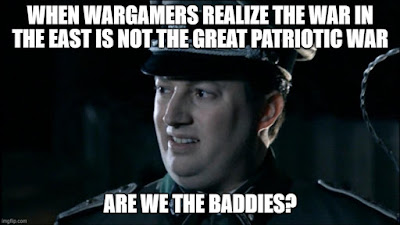
Does a German-centric bias exist in Eastern Front wargames?  It is only the “Eastern Front” to the German Army.  Same applies to naming wargames, “War in the East” or the German operation codename.  Note my meme in the header asks this question.  Jeremy provided a number of game examples whereby a player may get that impression.  Eastern Front maps are labeled in German and much of the accompanying game artwork and imagery focuses on the German Army.

What does it mean to play these games?  If game designs make claims and arguments on only a subset of the war, do these games, then, become an ideological tool?  What do I learn about the world from playing these games?  What does it mean to “want” the Germans to win?

Returning to Jeremy’s thesis, game designs can produce blind spots in their models.  Jeremy highlights some of the possible consequences of such inaccuracies.  Does this automatically lead to a breakdown of wargames, specifically, and understanding warfare, generally?

Are wargames ideological tools?

Tuesday, October 17, 2023

Re-Fighting History: WWII, Boardgames, and War in the East

Georgetown University Wargaming Society (Washington DC) offers a regular series of webinars on different facets of wargaming, military history, wargame design, and assorted other topics.  The quality of the presentations and topics run the gamut of my interest level and attention span.  Tuesday's offering looks especially inviting to me with a focus on the War in the East in WWII.  With the cover of the boardgame Drang Nach Osten! (DNO later reimplemented by Fire in the Eastin the event announcement, will GDW/GRD's Europa series of boardgames be included for discussion?  Perhaps Dr. Best will identify the WWII boardgame(s) that meet the military simulation threshold on value-added as effective simulation tools.  Perhaps none reach this threshold.  Can this discussion and evaluation of WWII boardgames as a simulation value be generalized to other periods and other games?  What about extending to miniature Wargaming?  I look forward to seeing what topics are in store and discovering if any boardgames meet this threshold. 
Description
Jeremy Best will challenge the efficacy of military boardgames as accurate representations of historical conflict.  In his webinar, Dr. Jeremy Best will present early conclusions from his research into the history of military boardgames, the memory of World War II, and the limitations of military simulations for understanding war. The first modern military boardgames emerged in the late 1950s and from the very beginning the war between Nazi Germany and the Soviet Union took center stage. Hundreds of games, thousands of scenarios have been produced – all of them claiming and aspiring to authentically recreate historical conditions. Part of the appeal of these games was that in re-fighting the battles, campaigns, even entire war players could rewrite that history. For all their efforts at accurate simulation, these games often fail as history. In the webinar, Dr. Best will discuss the ways in which games represent the Eastern Front, the blindspots of these representations, and the possible consequences of such inaccuracies. More generally, these insights lead to certain questions about the efficacy of wargames in general for understanding warfare.
 
Bio  
Jeremy Best is an associate professor of modern Europe at Iowa State University with a specific interest in the cultural history of Germany during the nineteenth and twentieth centuries. His current research project is a manuscript in development tentatively titled “Toy Soldiering: West German Rearmament, the Holocaust, and the United States” on the history of tabletop wargaming, Holocaust memory, and the perpetuation of the Clean Wehrmacht Myth in America and West Germany. Heavenly Fatherland: German Missionary Culture in the Age of Empire, his first book, was published by the University of Toronto Press in 2021. That book won the Phi Alpha Theta Best First Book Prize in 2021, was named one of “Ten Outstanding Books in Mission Studies, Intercultural Theology, and World Christianity for 2021” by the International Bulletin of Mission Research, and named to the shortlist for the 2022 Waterloo Center for German Studies Book Prize. In addition to his academic work, Professor Best has worked as a public-facing historian publishing in The Washington Post, The History News Network, and Perspectives on History.
If interested but cannot make this event, GU Wargaming Society content is usually published to YouTube following the event.

Tuesday, September 19, 2023

Back to Biblicals!

The dust had yet to settle over the plains of Ilipa when I received an email from the Society of Ancients.  This email contained an announcement for the upcoming annual convention in October.  Since I am unlikely to attend this year's convention at Madingley Hall near Cambridge, I was only generally curious of the content.  What really caught my eye was the inclusion of Ian Russell-Lowell in the program.  I have gamed with Ian for nearly three years now often seeing him in a weekly remote game.  Ah, the fun of shooting down Snoopy and his long line of succession in aerial dogfights over the fields of Flanders.  Phil Steele will be presenting at the convention as well.  Another of my weekly remote gaming buddies out and on tour.  Joining them this year sure would be fun. 

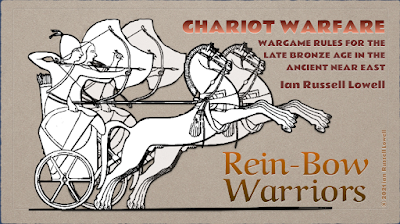
Back to the email.  My gaze was especially focused onto the content on offer.  First, Ian would be discussing the Late Bronze Age.  One of his specialties.  Second, Ian would be running a workshop on the latest incarnation of his Work-in-Progress Late Bronze Age rules, Rein-Bow Warriors (RBW).

Now, RBW is a ruleset that Ian and I have discussed much in the past and even got in a handful of playtests.  I have not seen rules' development since our last work more than a year ago.  Remembering that the rules still had some conundrums left to solve and streamlining to consider from the last playings, I wondered what had changed in the passing year and a half.

A quick email to Ian answered my question.  

Not much!  

Given that presenting a workshop for developmental rules having not seeing action in more than a year might be a challenge, I offered my services to help in refreshing both of our collective memories.  Ian cheerfully accepted!

In what will be the first of (I hope) several playtests, Ian and I will meet this week to discuss the current state of the rules, consult notes made during previous sessions, and push a few troops around my remote table.  Well, remote for Ian.  I will be broadcasting live from my game room.  Ian will be Zooming in from Cornwall.
Hittites ready for action.
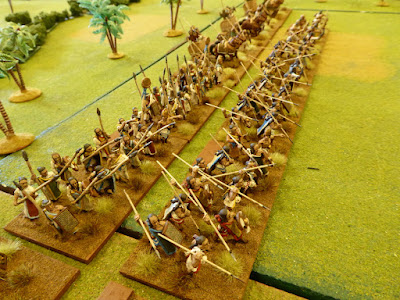
While Biblical armies may be roaming around the table for a while, I figured why not get these armies in a game or two outside of these playtest sessions with Ian.  Why not indeed?  To that end, the plan is to pull Egyptian and Hittite armies from storage boxes and set out a pitched battle or two using Basic Impetvs.  One game is formulating for Monday.

Reject Big Lee recently recounted an occasion where serendipity struck, guiding him gently into a new project (see When Serendipity Strikes).

While I have no pull from a new project, the stars may have aligned to give me a nudge toward fielding my Biblical armies and trumping my move toward a War of Austrian Succession battle.

Why?
  1. Five-inch arid hex system used for 28mm Basic Impetvs is already laid out onto the gaming table from Ilipa.
  2. I started creating more five-inch hexes including hills last week.
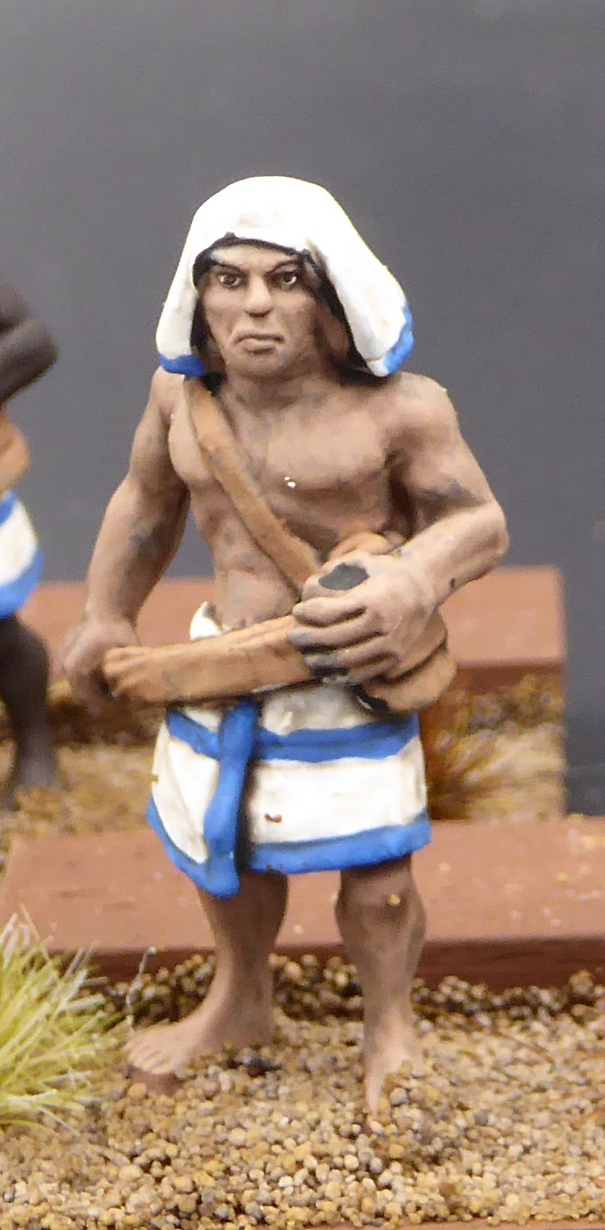
  3. I undercoated a handful of 28mm Babylonian archers even though most of my painting activity has been focused on 15/18mm figures.
  4. Receipt of Society of Ancients convention email.
  5. Correspondence and acceptance with Ian for more playtesting. 
Convinced?

Tomorrow I begin setting out the armies.  He will be watching...

Thursday, March 2, 2023

Double Jeopardy

In one of my recent games with Peter (see Turkish Delight), I was flummoxed by unit activation.  The Turks garrisoning the village, having sustained a few casualties, failed to activate turn after turn.  Incoming small arms fire was steadily directed upon them with no response.  It quickly became a one-sided firefight as the defenders remained silent and immobile.  Even when not receiving fire from the enemy, the Turks in the village remained motionless.
 
In post-game retrospective, I asked if the village defenders ought to be afforded a DRM on activations when deployed within a village (or any substantial protection) to improve their lot for activation.  The rationale for my suggestion centered upon leadership.  I figured that a unit situated within protected terrain ought to see an advantage in command and control responses.  Now, the incoming fire could be sufficient to pin the defenders but would the likelihood of response be no more than that from a unit caught in the open?

To this question, Peter responded by stating that he did not want the defenders to benefit from cover twice: once for reduced hits and once for better activation chance.

Then, Peter quoted a passage from Neil Thomas' Wargaming Nineteenth Century Europe 1815-1878.  The cited quote referenced 'double jeopardy' and states,
“For complex rules tend to suffer from conceptual flaws. The chief of these is what can be referred to as 'double jeopardy', or to be specific, accounting twice for a contingency that should only be considered once. For example, units which are behind cover frequently enjoy a morale bonus in complex rulesets: however, this fails to account for the fact that the role of cover has already been accounted for, given that the unit within would suffer fewer casualties than its more exposed comrades. If the unit behind cover is still suffering sufficient casualties to endure a morale test, then it is clear that the cover is no longer doing its job – and should not therefore confer any morale bonus.”
Thomas, Neil. Wargaming Nineteenth Century Europe 1815-1878. Pen and Sword. Kindle Edition.
Now, Thomas' Wargaming 19C Europe is one of the favorite wargaming books in my library.  I view this important work as a body of design notes with rules and scenarios attached.  Before this exchange, I am not sure I ever read this passage quite so closely or understood the nuance packed into these few sentences.

Double jeopardy?

Thomas' 'double jeopardy' point is an interesting one.  Very interesting.  Even more so after re-reading and giving it more thought.  Is the inclusion of double jeopardy really a conceptual flaw?  Do I even agree with this definition of double jeopardy?  Like many statements, it must be placed in context for it to make sense.  Really, these statements only make sense within a very specific type of game engine.  To me, identifying double jeopardy can be complicated.  What is it?  I suppose, I know it when I see it.

Each game engine is unique with a collection of parts put together to build a particular view of a holistic combat model.  Thomas has generalized this notion of double jeopardy to fit his particular view of how a game engine (or combat model) ought to function.  Some models may adhere to Thomas' philosophy to eliminate double jeopardy and others may violate this principle due to ignorance.  Still others produce combat models that violate Thomas' double jeopardy notion but remain valid combat models, nonetheless.

Who is to assess right from wrong?  The game designer!

Assume we agree on Thomas' definition of double jeopardy.  If double jeopardy occurs during one process in the model (say firing) then that could be open to scrutiny and critique.  Can double jeopardy affect separate processes within the combat model?  Is it a critical flaw to have an attribute affecting one process (say, firing) also affect another process (say, activation)?  Is this truly double counting?   If the perceived double jeopardy surfaces across processes within the combat model, does this still violate Thomas' rule of thumb?  I think every instance must be validated on its own merit and within the totality of any given combat model.  The assessment relies on process and modeling combat.

Let's take a look at Peter's D3 OHW rules (a variant of Thomas' One Hour Wargaming) as a case in point using the example of shooting and activation.

Shooting and Activation are two separate and distinct processes within D3 OHW.  Cover reduces hits.  The fewer the number of hits a unit has sustained, the more likely the unit is to activate.  Good so far.  The process of activation is separate from the process of taking fire.  Does this still fall into a double jeopardy situation?  Are the shooting and activation contingencies a double counting of attributes that should only be counted once?

Suppose two units (one in cover, one in open) have sustained the same number of hits.  What does a failed activation represent?  If it represents a temporary loss of cohesion or resolve to the testing unit then doesn't being within cover offer a Command & Control advantage over being in the open if hits are equal?  If C&C is enhanced by cover then Activation Tests ought to carry a modifier for cover during the Activation Phase.  If C&C remains the same whether in cover or in open then no modifier is needed.  The decision really rests upon the designer's shoulders.  What does the designer want to model and emphasize in his game engine?

In the end, Peter thought that adding a DRM to activation rolls for units in prepared positions (such as a trench) may make sense but not for cover such as villages.  We will see if that change makes it into the rules.

What is my point on double jeopardy?

I guess I am saying that "one size fits all" is not applicable and that, as in most things, "it depends."  Separate processes have less to worry about violating double jeopardy (however it is defined) than do double counting inconsistencies within one process.  The designer must make these decisions on how to model combat.  Not all approaches that contradict Thomas are based upon conceptual flaws.  Sure, some may but it is not universal.

To end for now, when is a perceived double jeopardy not double jeopardy?  Is the concept of double jeopardy avoided when the violation occurs across two or more distinct processes or do these accounting contingencies have memory and carry across multiple game processes and routines?

When I return to this topic, I look at examples of what are and are not double jeopardy, how to assess the difference, and does Thomas violate his own ruling.

Many questions with not as many answers since double jeopardy seems anchored upon situational specifics and personal preference.  As always, I enjoy reading your thoughts on double jeopardy.  Do you agree with Thomas?

In the meantime, I'll take Obscure Wargaming Terminology for $1,000, Alex.

Tuesday, January 31, 2023

Refighting History, In Miniature

In a recent blog post (When is a Historical Wargame Historical?), the author puts forward the question of whether attempting to recreate a historical battle on the wargaming table can attain the desired goal.  As an example, the recent Battle of Auberoche, fought between Peter and myself, was sited.  My account of the battle can be re-read at Battle of Auberoche.  Did this game recreate the battle faithfully?  If not, can this action be classified as an historical wargame?  Refighting Auberoche provided an exciting contest which came down to the wire but was this really Auberoche?  

For those wargamers who enjoy refighting historical battles, the gaming objectives and approaches are many and varied.  I suppose one question to ask is what is the desired goal in refighting a historical battle.  Why do we do it?  Does choice of rules matter?  Does type of game matter when viewed along the Game vs Simulation spectrum?  Do game constraints such as time, space, figures available, number of players,etc. affect these goals?
I admit that my preference leans toward refighting historical battles.  Even given great care in preparation and research, are we still fighting an historical battle once the maneuvers and shooting begin?  For me, these attempts at historical recreations are exercises in decision-making.  Always keep in mind that the historical outcome may be one of a number of possible outcomes.  The historical outcome is singular.  Any historical battle may hinge on a single decision point, a singular battlefield occurrence, or a string of such events.  Same holds for a wargame.

A well-designed, historically motivated wargame attempts to place players into the boots of their historical counterparts.  The wargame may begin from the historical situation (or at least the author's representation of the historical situation) but as the game evolves, so does the narrative.  Must the wargame necessarily follow the historical narrative?  Of course not.  We want to encourage the table general to make his (or her) own decisions without following the choreographed decisions made by the historical counterpart.  If the situation and objectives are set properly, one might expect to see generally, historical results in repeated trials.  That is, if the historical result represented the most likely outcome.

As GM, I want players to consider the choices made within the confines of the historical situation faced on the gaming table in miniature.  When wargaming, I want to make meaningful decisions on the path toward accomplishing the goal laid before me. I want to gain insight from the experience.
Consider as a case in point the game currently on the table.  On the table today is a recreation of the Franco-Austrian War Battle of Montebello.

Each player or team of players received a battle briefing beforehand containing a brief generalization of the situation and a specific assessment of known intel.  The general briefing read,
On 9 May, Austrian FZM Gyulai’s uninspired offensive in Piedmont ground to a halt without ever contacting the enemy.  Concerned that the French would attempt to turn his left flank by advancing upon Piacenza, FML Stadion’s V Corps was ordered (20 May) across the Sesia River and move on Casteggio and Voghera.  This reconnaissance-in-force was determined to discover French dispositions, interdict the Voghera-Piacenza Road, and thwart these perceived threats.

As the Austrians approached Casteggio, they ran into Sardinian cavalry screens.  The Sardinian mission, deployed east of Voghera, was to act as an early warning system to prevent surprise attacks from the Austrians.  The Sardinian light cavalry were to hinder any enemy movements westward buying time for the French army to come up, if needed.  The only means of crossing the River Coppa in this area are via two bridges: the bridge at Casteggio and the railroad bridge to the north of that town.  Running from Genestrello north, the Fossa Gazzo can be crossed everywhere but with difficulty.  The railroad bridge at Casina Nuova and the bridge near Genestrello are the best places to cross the Fossa Gazzo.

Being heavily outnumbered, the Sardinians traded space for time as they slowly gave up ground to the approaching Austrians.  After reports arrived detailing the action earlier in the day and the fall of Casteggio, Forey’s division of the French 1st Corps quickly marched on Casteggio.  In the meantime, Stadion had taken first Montebello and then Genestrello as the Sardinian cavalry retired.

This common background was augmented by battle specifics for each player outlining OBs and force objectives to help steer the players into a recreation of the events driving the historical battle narrative.  In the interests of providing an engaging, multiplayer game, decisions had to be made to accommodate the number of players and the method of play (remote).  In a multiplayer game, having players watching in while they await their command to enter the table as reinforcements would not do.  Reinforcement timetables had to be compressed to allow all players to get meaningful commands into action almost immediately.  Does this change or alter the historical framework?  Perhaps not if the pieces can be molded in a manner to maintain the historical context.

Will this work?  The first gaming session is in the books.  Only time will tell as one more gaming session is needed to fight this battle to conclusion.

How would you answer the question of when is a historical wargame historical?  I look forward to your insights.

Saturday, September 4, 2021

From Pike To Bayonet: A Battle Report

Tuesday's remote game was a return to playtesting Graham's late 17th/early 18th  Century rules.  This time, the battle was set in the 1690s Low Countries where an Anglo-Dutch force faced off against a French force.  The objective was to take control of the bridge separating the two armies.  Troop quality is unknown until contact with the enemy.  How good or how reliable will our troops be on the day of battle?  No one knows with certainty.  

Since I would be commanding the French right wing, I switched webcams from the lead camera view (opening game photo) to better see my troops.  The French Army is attacking from top to bottom with the Anglo-Dutch attacking from bottom to top.  The ruined bridge in the foreground is not a meaningful objective.

How did the battle play? 

Both armies advance toward the bridge
French right-wing horse charge across the river
 and receive an unwelcome volley.
Disordered, French horse charge home as armies close...
and are sent packing back to where they came.
It's a race to find the best defensive ground along the river.
The race continues with volleys exchanged across the water.
The French right charges across.
One clash results in the enemy being driven back.
The other ends in a firefight.
The retreat turns to rout as one Anglo-Dutch
 regiment breaks.
And then a second enemy unit breaks for the rear.
The victorious French follow up.
While the French left is becoming hotly engaged at the bridge,
 clashes continue on my end of the battlefield.
French charge across the river and across the bridge
 into the jaws of the enemy.
My two French regiments are driven back from the river
 while the French left wing drives back its opposition.  The
pursuit of the two broken Anglo-Dutch regiments continues.
At this point, the battle was called due to time.  After about four hours of play, two Anglo-Dutch infantry regiments were in flight and a third regiment was being pushed back.  For the French, two cavalry regiments had fled the battlefield and two infantry regiments were being pushed back.  With neither army broken, Graham declared the battle a draw.  With both armies only approaching the halfway mark to becoming broken, a draw seemed a reasonable outcome given the situation, I thought.

The hard-charging French were not as effective as I hoped and the Anglo-Dutch platoon-firing infantry was more effective than I feared.  With rules in flux, just when one sees workable tactics beginning to formulate and gel, the next rules' iteration throws much of that discovery out of the window.  We begin again from Ground Zero.  Well, not quite Ground Zero but you get the impression.

There are a couple of assumptions in the rules requiring more of my thought.  I am sure these curiosities will be addressed in time but for now, they are puzzling.  In the remainder of this post, I tackle one as I work through the problem.

What is the source of one of the puzzlements?  Initiative determination.  The assignment of initiative at the beginning of each turn has the potential to have an outsized influence on the game.  The turn-starting rule on initiative determination drives the sequence of play.  The player winning initiative has a choice of moving and fighting first in the turn or second.  With that choice, a player could choose to activate second in one player turn.  Then if initiative is won in the next turn, that same player could move first.  This result allows one player the opportunity to activate his army twice in a row.  That is, the army activates second in one turn and then activates first in the following turn.  In Tuesday's battle, the Anglo-Dutch army managed to pull this off twice producing back to back activations two times during the game.  Two sequential activations manifests an advantage; sometimes huge.  An advantage that is difficult if not impossible to counter.

The probability of a double activation is actually increased by the nature of the initiative roll.  The player that loses initiative in one turn is more likely to win initiative the next.  The +1DRM to the initiative loser reduces the likelihood that one side can dominate initiative by allowing the initiative loser a better chance to snatch it away next turn.  True.

All things equal, what the game ends up with is a negative serial correlation to the prior turn's initiative holder.  This seems to violate Newton's First Law of Motion.  In physics, a body in motion tends to remain that way unless an outside force acts upon it.  Given that, an army in motion (holding initiative) ought not be less likely to maintain that motion than its opponent.  Better to have theory on your side, I think.  Taking the initiative should be rewarded; not punished.  

Now that this is identified, what are possible solutions to address this +1DRM Initiative bonus to the prior turn's initiative loser?

First, drop the "+1DRM if lost last initiative."

Since the Initiative Roll already modifies the die roll by commander quality, keep that in place since better generals ought to have a better chance of seizing and maintaining the initiative.  If you want to stop there, that is fine and provides a workable, theoretically sound solution.

Let us not stop there, though.  A more interesting solution is to add,

"+1DRM if moved first last turn."

What does this addition accomplish?

Say, Player 1 wins the initiative and decides to move first.  Player 1 moves first and Player 2 moves second.  Since Player 1 moved first, the initiative rests with Player 1 this turn.  Next turn, the probability of Player 1 maintaining the initiative is increased by +1DRM.

What if Player 1 wins initiative and decides to move second?  Now, Player 2 moves first and Player 1 moves second.  Player 1 has relinquished the initiative to Player 2.  Next turn, Player 2 has an advantage in attempting to hold the initiative with a +1DRM.  Player 1 not only gave up initiative this turn by choosing to move second but has allowed his opponent an opportunity to maintain this initiative next turn (and subsequent turns) with increased probability.

Now, there is a reward for maintaining the initiative and a cost for giving it up.  As a bonus, no Newtonian law is violated in the process.  Of course, the opposing player could still out roll the initiative holding player despite the +1DRM and snatch the initiative anyway.  With no modifiers, the player not holding the initiative will win initiative 15/36 times. With a +1DRM, the player without initiative will win the comparison toss, 10/36 times.  Maintaining the initiative once taken is no sure thing.

I welcome comments on the original Initiative determination scheme as well as my suggested amendments.

I end with a few photos of the Spokane skyline, Lower Falls and Upper Falls snapped during Thursday's ride.  Weather remains perfect.


Friday, March 26, 2021

Situational Awareness on the Wargaming Table

Photo courtesy http://wargaming4grownups.blogspot.com/

Graham, our Master of Ceremonies for a continuing series of 15mm Spanish Civil War games featuring his recently published For Whom the Dice Rolls rules, has been very diligent in providing Game Briefings before the Tuesday night Zoom battles.  This extra effort has been quite useful in preparing for the task at hand.

MC Graham as puppet master moving our troops
This week's offering was no different.  In the battle packet were map, Orders of Battle, and a briefing.

Since one never knows which side will be assigned for play, I typically look over both OBs and briefings beforehand.  Approaching each battle as a puzzle to be solved, I mentally make notes of time/space considerations, relative strengths and weaknesses of each combatant, and potential avenues of attack and lines of defense.  The rules receive a quick skim too.  These pre-game exercises help to focus my attention toward improving my situational awareness on whichever side I land.
Battle map
Pre-Battle Notes:
  • The Nationalists hold a numerical advantage in infantry, armor, and heavier artillery.  Republicans hold an advantage in field guns. Nothing more.  There are no Off-Table Assets in this game.  Wait.  The Nationalists have brought their Off-Table heavy artillery asset on-table!
  • Nationalist terrain objectives are nearer to the Nationalist baseline than are the Republican objectives to the Republican baseline as shown in the two diagrams below:
    Nationalist entries and objectives (yellow)
    Republican entries and objectives (blue)
  • One Nationalist objective is to 'control' the railway.  Does that mean simply to cut the rail line or possess all or parts of it?
  • With numerical superiority and objectives within easier reach, I expect the Nationalists to attack.
  • With inferior numbers, lacking armor, and objectives much farther away, I expect the Republicans will fight a defensive battle. 
Game Night:
On game night, the game was much more well-attended than expected so commands were shuffled around a bit to accommodate seven players.  I think four players were expected.  No matter, Graham quickly allocated commands.

Phil, Will, and the two Richards were promoted to commands within the Nationalist army.  Steve, Ian, and I were plopped into the role of Republicans.  Since I had a copy of the rules, Graham appointed me as CiC for the Republicans with Ian and Steve taking on the role of brigadiers.

Now with only a few minutes to formulate a battle plan, I made some quick time/space calculations.

--------------------- Begin Digression --------------------
OK. Has anyone ever been in a participation game at a convention (or anywhere else) in which the victory conditions are such that units must reach a certain point on the table within a certain number of turns (typically exiting the opposite side of the board) to claim victory?  On occasion, the post-mortem shows that the unit(s) could not have reached the objective under the most favorable conditions.  Well, I have witnessed this situation as well as suffered it. 

Show of hands?   
--------------------- End Digression ----------------------

My quick calculations showed that Republicans moving in the fastest combat-ready posture (skirmish order) would take about eight impulses (three turns) to reach the hills on the opposite board edge.  That is not reckoning on any active resistance from a superior force or having the correct mix of activations to actually perform these required impulses.  With enemy resistance, I figured one enemy battalion could add a delay of three impulses to the timetable.  Given that these games rarely last longer than three turns in the typical three-hour gaming session, I deemed the Republicans unlikely to reach their objective within the given time constraints.  Is that enough to shift the Republican battle plan firmly to a defensive posture?

Perhaps, but there is yet another piece of information to consider.  What about the players, themselves?  While I have only gamed with the Monday Night Gamers for about six months, that is enough time to identify a few, general player profiles tendencies.

Will and Phil seem to be tenacious and aggressive attackers.  I have witnessed both tearing up any opposition standing between them and their objectives.  Ian and Steve, on the other hand, appear more suited to defensive postures.  Calm and capable, these traits I want for commanders in the trenches willing to hold a line.  Of course, I could be very well wrong but this is how I placed today's wager.  With the Nationalists holding the cards in numbers, attainable objectives, and aggression, there was little question in mind that the Nationalists would attack.  The Republicans seemed better suited to take the defense and counterattack if the opportunity presented itself.  

Now, with Graham orchestrating scenario development and player assignments, were these same considerations in play for him too?  Hmm.

How did these quick plans pan out?  Please visit Graham's battle report at The Sunken Road Conundrum to find out.

The gaming session ended at the beginning of Turn 3 with the Nationalists holding initiative but the Republicans poised for counterattack.  Even unopposed, a Republican attack from the start could not have reached the Nationalist baseline before game ended.

Know thy self, know thy enemy, and know thy situation.

Tuesday, August 25, 2020

Steve's Simple Wargaming Q&A for Fields of Honor

Homework time.  Steve's Sound Officers Call blog recently featured a post on the Allure of Simple Wargaming.  In that post, Steve presented a case for simple wargaming and proposed a closer look into that genre of quick to learn, easy to play rules.  A handful of rulesets were identified as likely candidates and a list of post-battle questions posited to apply to each of the games played in his experimental study.

I took up the challenge and applied Steve’s questions to my recent games of Fields of Battle: AWI.  See battle report, Action at Mill Creek Redux for a blow-by-blow presentation of the battle used in completing the following Q&A.
Steve's post-battle questions (and a few of my own) with my responses follow:
  • Rules: Fields of Honor: AWI.
  • Rules' complexity: Simple.
  • Period: American War of Independence.
  • Gridded/Open:  Both GRIDDED and OPEN rules are included.  I used GRIDDED with four inch hexes.  Any conversion between hex and open form is easy.
  • Figure size: 15mm.
  • Table size: Small with a grid of 8x6 4 inches hexes. 
  • Method of play: Solo.
  • Scenario: Action at Mill Creek.
  • Scenario Author:  Derived from Norm's scenario of the same name as found in his Two Flags - One Nation rules.  Modified slightly and transported back into time for the AWI.
  • Victory conditions:  British player must take the bridge and have two regiments on the heights before sustaining 50% units lost. 
  • Game duration: About one and a half hours including note taking and photos.
  • Number of in-game rules' consultations:  Two.  One to check on leader casualty procedure and the second to confirm mechanisms for multiple attackers vs a single defender in melee.  No more than two minutes to find and interpret the answer in each case.
  • Battle victor: American defenders in a closely contested battle that went down to the wire.
  • Contributing factors to victory:  Attacking is hard work especially when only slightly outnumbering defenders in good ground.  The British suffered heavy casualties in the first fire exchange losing one regiment and having two others damaged.  Later, Smallwood's regiment destroyed two regiments in quick succession.  Having the American officer only wounded rather than killed by a sniper may have prevented an American defeat.  Although the British were clearing Rebels from the American right rapidly, it was too little too late. 
  • Game satisfaction (0-None to 5-Complete): 4.
  • Reason for satisfaction score:
    • Pros: Sequence of Play is straightforward without complication.  With nine units per side in this small battle, play was quick.  Only a handful of modifiers needed for each of FIRE/MELEE/MORALE resolution.  Not all modifiers are applicable in every situation and quickly can be committed to memory.  Resolution of each interaction is fast.  Unit quality modifiers highlight the differences between the various troop types.  British line definitely fight with different attributes than do American militia.  Unit attributes easily adaptable by Quality Modifiers to account for a wide variety of troop traits.  Total possible combinations of unique unit qualities is 125 (5x5x5).  Sequencing of the turn phases lends to dynamic game play.  A feel for a tense battle ebb and flow as each combatant takes a turn putting the enemy off balance before the turn reverts to the opponent.  The Events Table adds some uncertainty and creative randomness into the battle.  These events can aid in driving an interesting narrative.  The in-game narrative developed during play was engaging especially with the battle hanging in the balance on every turn.  System uses 1D10 having uniform distribution but in this case, 1D10 variability is no issue since there are no opposed differential computations.  Solitaire suitability very high.  Game was very enjoy as a solo exercise.  Rules work well with my single element BMUs.  
    • Cons: Rules have some ambiguity and are not as complete for all situations but omissions are easily resolved.  Leaders are all rated the same with a +1 DRM for FIRE/MELEE/MORALE CHECKS when attached.  When faced by a high ratio of leaders to units, leaders may become too effective in driving an attack or defense.  With sections of the rules written for both hex/counter and miniatures, there is some confusion and overlap.  Some inconsistency in the tabled values between text and back cover QRS.  
  • Extraordinary, noteworthy, heroic, or cowardly events:  See battle report linked above for a fully detailed examination of the action.  A few notable events include:
    • Pennsylvanians on first turn discover they are low on ammo with a Calamity Event.  They will remain so for the entire battle.
    • With the British left hitting the 7th Penn hard near the bridge with six hits and needing only three hits to destroy the unit, the PA boys shrugged off four of those hits to remain on the battlefield.
    • With the American right reeling under heavy pressure from the attacking British, Smallwood's regiment marches up the hill to plug the gap created by the retreating Americans.  Smallwood then proceeds to scatter the British 9th Foot before descending the hill to destroy the British 4th Foot and retake the bridge.
Having gotten Fields of Honor out onto the gaming table for two games, I plan to keep this easy to play game in my back pocket for days in which I want a light but satisfying gaming experience.  With the Fields of Honor AWI version fresh in mind, I am tempted to use the older and more detailed, colonial version to tackle the Spanish-American War.  I ought to capitalize on the groundwork laid learning the AWI version.