Showing posts with label Wargaming in General. Show all posts

Sunday, December 14, 2025

Journey v. Destination: Commentary

Curious to see the Paradox of Modern Wargaming post return to the Top 10 posts widget after having fallen off the leaderboard, I returned to the post for a refresher.

As a corollary to the tortoise and hare fable, I argue that modern miniature wargaming is caught in a paradox.  That is, wargamers invest huge amounts of time in painting, research, and terrain building, yet increasingly favor fast-play rules and shorter games that can play to conclusion in an hour or two.  The contrast between the long “journey” of preparation with the brief “destination” of modern game duration prompts a question.  That is, does an emphasis on speed and efficiency at the gaming table undermine the depth, narrative, and sense of accomplishment that typically justified all that effort?  Of course, this is a simplification, and both have a place in the hobby.

With more than two score of readers weighing in on the topic, I try to distill this collective wisdom, experience, and insight into a handful of common themes from the many, generous responses.  Taking up a tally sheet, I scored the responses.  A synopsis follows: 

Painting v. Gaming
I’ve noticed a bifurcation in how wargamers approach the hobby. Some clearly see painting as a means to an end. These gamers paint so they can play. They describe themselves as warGAMERS, not painters. Others admit that painting figures and building terrain are satisfying in their own right.  Even if an army never hits the table, there is still get plenty of joy from this facet of the hobby.  I reckon blogging feeds into that too.  Being able to share progress, swap tips, and show off completed projects gives painting its own reward separate from gaming.

Game Length and Complexity
The comments about game length are interesting.  Many of us remember those day‑long (or even multi‑day) games of the old days.  I have had many.  Now, most gamers seem to prefer games that wrap up in two to four hours.  Long enough to tell a story but not so long that they feel like slogging through mud. The sweet spot seems to be rules that flow naturally and don’t bury players under numerous tables and exhausting detail.  A few people pointed out how older “proper” rule sets rarely reached a satisfying finish, while modern abstract systems often feel just as plausible and more fun.  I tend to agree.

Skirmish, Scale, and “Realism”
The boom in skirmish and “big skirmish” games has been fascinating to watch develop.  These results are backed by results from the Great Wargaming Survey.  Some historical periods (Western gunfights, pulp, sci‑fi, modern small‑unit actions) fit this format perfectly. Others, like pike‑and‑shot, maybe not so much. On this topic, there is debate. Personally, I like the idea that “realism” doesn’t have to mean a simulation.  I do enjoy simulations, though.  If the outcomes are believable and the game captures the right flavor of a period, that’s good enough for me.

Time, Focus, and the Modern Hobby
The whole “declining attention span” theory gets thrown around a lot, but some (like Stew, Norm, and JWH) don’t buy it.  As several commenters pointed out, it’s more about life and time than attention.  Most of us, having gamed for decades, simply don’t have the same long afternoons we once did.  Well, until retirement, that is!  Shorter games fit better with real life.  I suspect those players craving detailed simulations may now find that level of detail in computer wargames.  On the tabletop, people seem more interested in enjoying each other’s company and finishing games with a sense of closure.

Variety, Choice, and the Future
If the hobby suffers from anything these days, it’s too much choice.  Every month brings new rules, new scales, and new shiny projects to distract us.  Yet, no one seems particularly worried about the future.  A few long‑time gamers said it flat‑out.  If we are enjoying ourselves now, that is what matters.  Whether historical miniature wargaming thrives beyond our generation isn’t the main concern.  Playing with the right people and finding pleasure and satisfaction in the process, whatever form that takes, is key.

Perhaps there is no paradox in this context at all but a nuanced and individual approach to wargaming.

Thanks to all for contributing your insights to my little study.

Friday, October 24, 2025

Paradox of Modern Wargaming

The paradox?  Speed vs. Journey in the Digital Age.  

As the Palouse Wargaming Journal passes its thirteenth anniversary, these anniversaries often bring up a time of reflection on the past.  Reflections this year saw a return to one particular post I wrote more than two years ago on how battle reports are read (see Reporting from the Front: How are Battle Reports Read).  Besides a perceived change in writing and reading battle reports, has the underlying wargaming landscape, likewise, undergone change in how we participate?  For these reflections, I refer to these perceived changes as "modern" wargaming.

The modern wargaming landscape presents an interesting paradox that hits at the core of wargaming's identity.  We dedicate months, sometimes years, to painting armies, researching historical uniforms, and crafting detailed terrain.  All of these time-consuming preparatory activities result in bringing the efforts to the gaming table in a game that frequently can be completed in under an hour.  This contradiction raises fundamental questions about whether we've lost sight of the journey in favor of quick results, and whether the very tools meant to enhance our hobby experience have inadvertently diminished it.

Rise of the Quick-Play Culture
The trend toward quick-play wargames and rules has become undeniably to the fore in recent years.  This reflects a broader shift in gaming preferences, with players increasingly gravitating toward games that can be completed in two to three hours or less.  The Great Wargaming Survey supports this notion with only 17% of respondents saying that a game longer than three hours is preferred. 
The market has responded accordingly.  Wargames designated as "small footprint" and games designed to be "quick play" have proliferated.  Systems like One-Hour Wargames or the many One-Page rules promise battles that only take about one hour to fight to conclusion. This compression is not only limited to casual, pick-up games.  Even complex historical scenarios are being redesigned for rapid consumption.

The Commands & Colors Revolution

Perhaps no single system better exemplifies this shift than Richard Borg's Commands & Colors series.  I have introduced a number of gamers to historical miniatures gaming through Commands & Colors.  The appeal is clear.  These games provide the feeling of playing a mass battle game while allowing players to refight the entire historical battle in relatively short time.  Often, we can complete four or five games in a single three-hour gaming session.

The genius of Commands & Colors lies in its ability to deliver satisfying tactical decision-making within a streamlined framework.  Players experience interesting tactical decisions despite rules' simplicity.  This combination creates a perfect melding of boardgame and wargame.  Rarely are two games played the same.  With the success of this system, countless other designs have followed a similar path.  Adding miniatures into the mix makes a solid system even better.

The Attention Span Crisis

This shift toward game length brevity may reflect broader changes in human attention patterns.  Research suggests a significant decrease in focused attention.  Decreased attention span is not confined to gaming but surfaces across all digital platforms.  The digital age creates environments where stimuli constantly compete for our attention.  This competition leads to frequent task-switching and cognitive overload.

The push toward shorter duration games leads game designers to create experiences that captivate players without overwhelming them.  Designers must create a balance between engaging gameplay and the brain's need for managing cognitive loads.  This reality suggests that the trend toward shorter games isn't merely preference but an adaptation to fundamental changes in how our brains process extended engagement.

The Painting Paradox
The most striking contradiction in modern wargaming lies in the seeming disconnect between our dedication to army preparation and actual gameplay.  While game size has decreased with an increased tendency toward skirmish games, wargamers continue to invest enormous amounts of time to painting.  Some paint hundreds or even thousands of figures per year.  As supported by the Great Wargaming Survey, for many, painting is the hobby and represents their primary source of satisfaction.
Yet this same community increasingly seeks games that can be completed in a fraction of the time spent preparing armies for battle.  Have the visual and creative aspects of painting and building armies become more important than the gaming experience itself?

The Tournament Mindset
With a move to decreased game length and simplified rules, have we all become tournament players without realizing it?  The emphasis on quick resolution, standardized rules, and efficient gameplay mirrors competitive tournament formats.  Traditional narrative gaming, with its emphasis on story development and immersive experience, requires time and patience.  These attributes seem increasingly scarce.

The tournament approach prioritizes clear winners, efficient mechanics, and reproducible results.  While these aren't inherently negative qualities, they represent a significant departure from the storytelling and narrative-building traditions that historically defined miniature wargaming.  The question becomes whether we're losing something essential in this transition.

Historical Perspective and the Path Forward
Looking at this trend historically, it's worth questioning whether our time constraints are genuinely different from those of previous generations. Wargamers of the 1970s and 1980s faced similar challenges of limited time and competing priorities, yet they typically maintained longer, more involved games. The difference may lie not in available time, but in our expectations and attention patterns.

The solution isn't necessarily to reject quick-play systems.  Many of these innovations represent genuine improvements in accessibility and enjoyment. Rather, we need to consciously preserve space for deeper, more involved gaming experiences that justify the enormous investment we make in army preparation.

Perhaps the answer lies in recognizing that different types of games serve different purposes.  As mentioned about Commands & Colors earlier, quick-play systems excel at introducing new players, providing weeknight entertainment, and exploring new periods or rules.  Quick-play systems, however, should not completely replace the longer, more involved games that allow armies to truly shine and narratives to develop naturally.

The wargaming hobby is broad enough to accommodate both approaches.  What we must guard against is the unconscious drift toward speed and simplicity at the expense of depth and immersion.  The months we spend painting and preparing should lead to gaming experiences worthy of that investment.  We should foster experiences that prioritize the journey as much as the destination, and that create lasting memories rather than merely efficient outcomes.

In the end, the choice between quick results and meaningful journeys isn't binary. Diverse gaming communities will likely embrace both, often in harmony.  
I enjoy both types of games and each has its place.  The purpose of the game and available resources should determine the choice of gaming system.  Our beautifully painted armies deserve nothing less than this thoughtful balance.

Tuesday, September 16, 2025

The Blogging Effect on Battle Reports

Yes, the Palouse Wargaming Journal reaches "Lucky" 13 years on the blogging front.  For stats, PWJ is up to 335 Followers (a number that rarely changes), 1,809 Posts, and 56,964 Comments.  For me, these anniversaries often bring up a time of reflection on what has passed before.  

The blogging landscape has seen change over these past thirteen years, no doubt.  When PWJ began in late 2012, the wargame blogging community was already in full bloom and quite active.  I likely arrived late to the party and, perhaps, unfashionably so.  Still, I pressed on even as trends began to show a shift from blogging to other forms of social media.  Over these thirteen years, wargaming blogs came and went with the balance tipping in favor of those leaving the platform.  After thirteen years, I continue to press on.  How much longer?  Well, that is a good question to occasionally ask myself.

These reflections often bring up a number of lingering questions that regularly circulate through my mind.  One rumination (of many) on this anniversary brought me back to the post I wrote more than two years ago on how battle reports are read (see Reporting from the Front: How are Battle Reports Read). 

Blogging our individual, wargaming journeys can enrich the hobby by documenting research, painting progress, and battle reports, allowing community feedback and camaraderie.  Battle reporting, while only one facet of wargame blogs, has become a significant weapon in the blogging arsenal.  For the PWJ, battle reporting focus can be quantified by the number (and frequency) of battle reports chronicled here.  Yet, as I remarked in my post in the link above, "Almost always, the chronicling of the battle report takes longer than actually playing the game".  This raises potentially troubling questions about priorities: are we playing games and chronicling them for enjoyment or to create content?  Prioritization takes on added importance when many self-confessing readers simply skim or entirely skip a featured battle report.

When the creation of content becomes more time-consuming than the activity itself, we must question whether the tail is wagging the dog.  For some bloggers, playing may feel more like a chore or performance rather than a rich narrative journey.  On one hand, sharing battle reports and game narratives online expands the hobby’s community and can provide motivation for getting figures to the table.  On the other hand, some might argue this sharing encourages a "sound bite" culture, where quick posts, highlights, and visual snapshots overshadow deep engagement and storytelling.  

Does the desire to chronicle our games diminish the lived experience of playing by encouraging players to focus more on photo-ready moments and quick, digestible content rather than deep, immersive play?  Does the pressure to document and share experiences fundamentally alter how we approach gaming?  Are we optimizing battle reports for easily digestible sound bites and visual moments geared toward online consumption rather than personal enjoyment and narrative development? 

This shift toward brevity may reflect broader changes in human attention patterns.  Blogging and social media have played a role in this evolution.  The desire to frequently post crisp and brief highlights may overshadow the contemplation in immersive play and narrative building.  In effect, the attention span of even committed and engaged readers may be shortened unintentionally.  Nonetheless, a number of blogs I regularly visit emphasize detailed battle reports and nuanced storytelling, suggesting that the value placed on the journey is still alive, at least among certain circles.  Personally, this journey value is especially true for those hosting a game wherein players have the flexibility to concentrate on strategy and tactics while the umpire handles the mechanisms of game play, adjudication, and the writing of an unbiased battle account.  To answer an early question, are we playing games and writing about them for enjoyment or to create content?  Perhaps both factors play a role, but I find chronicling battles as a prose narrative an enjoyable pursuit and a way to preserve history.  Hopefully, players and readers agree.  

Saturday, January 25, 2025

What's In A Name?

After seeing the above book mentioned on Peter's blog (see A New Book...) and listening to the authors' podcasts, I placed an order.  Book arrived quickly and was read just as quickly.  I won't repeat the contents of the book since Peter did that and Table of Contents can be seen on Amazon.

What I do want to discuss is the authors' wrestling with the renaming of the gaming aspect of the hobby that we enjoy.  Many of us likely refer to this hobby as miniatures wargaming or playing a miniatures game.  Really, I lump all facets of the hobby simply into the catch-all, wargaming. 

The authors' take a different tack, however.  They state their rationale for first dismissing the use of tabletop games, then dismissing miniatures games, then dismissing miniatures wargames, before settling onto the term of non-discrete miniatures games. 

The name, non-discrete miniatures game is chosen since the authors argue that,
  • Games are not necessarily about war.
  • Spatial relationships between miniatures and terrain are crucial.
  • Any physical object can be introduced into the game and have meaning in game terms (non-discrete components).
  • Movement and positioning are not limited to fixed increments or grid spaces (non-discrete positioning).
Non-discrete is an interesting term to choose and returns me to the days of studying mathematics.  Typically, one sees a bifurcation between discrete and continuous but not between discrete and non-discrete.  I suppose if the term, continuous was utilized as in continuous miniatures game, readers might conclude that we game non-stop!      

Moving on, the authors define these games by their unique spatial characteristics in that,
  • Precise physical positioning matters.  That is, movement and placement are analog (and continuous) and not grid-based.
  • Players can bring any object to the game table and game systems must accommodate an infinite variability of components.
One example given of discrete movement and figure (marker) placement is the game of Monopoly.  A playing piece can only be in one of the grid spaces on the playing board at any one time and not between two spaces.  In a non-discrete game, movement is governed by a measuring device with a miniature able to move anywhere along that vector and stop anywhere short of the maximum move distance allowed.  This non-discrete movement criterion seems to not only explicitly exclude grid-based games from inclusion into non-discrete miniatures game by definition but implicitly as well with the continuous nature of measured movement along a vector. 

In later chapters, the authors relax the condition for non-griddedness.  Games having gridded movement or zoned movement may fit into the structure of building a non-discrete miniatures game as long as the focus on the design remains on the spatial relationships within the game and the infinite variety of components.  Given that discrete positioning and movement criteria are later relaxed, the grid vs non-grid distinction should be dropped from the definition altogether.

With the argument for excluding gridded games jettisoned, what remains the focus of non-discrete miniatures gaming?  What remains constant is the reliance upon the external components brought into the game system.

What distinguishes many boxed miniatures games from the non-discrete miniatures games that the authors describe?  The difference is that the former is self-contained with the rules and all of the components necessary for play while the latter is similar to a toolkit with a programmed game engine requiring any number of external inputs provided by the player(s).  These external inputs could include figures, terrain, army lists, dice, measuring devices, etc.
       
Is the classification still between discrete vs non-discrete miniatures games or is a better fitting distinction between endogenous vs exogenous miniatures games?  I suggest that the latter terminology may be a better fit if one agrees with the authors that the deciding attribute is bringing external inputs into the system.  Still, it is all wargaming to me.

There is much more to be pulled from this book of interest to wargamers and wargame designers whether focusing on non-discrete miniatures gaming or not.  I have only brought up the main thesis of Chapter 1!  With so much to consider, I may non-discretely dip back into this text on occasion.

Wednesday, July 10, 2024

The Turkish Problem and the Cold War

In mid-May, I received an email from Richard L. asking if I would be interested in participating in a multi-player, map-based strategy Zoom game.  Richard would share none of the details beyond saying that there would be six strategic commanders, four ground commanders, and two umpires.  The game would be played on 07 July with an 0600 start time for me on the West Coast.  Richard knows I am an early riser so thought the early start would be no problem.  He was right and I happily accepted the invitation.

On the day of the scheduled game and about an hour before start time, the six remote players received briefing packets describing the situation and their roles in the exercise.  The incident to be gamed was the 1974 Greco-Turkish crisis when a Greek junta-sponsored coup was launched by the Cypriot National Guard.  The goal was to depose Archbishop Makarios III (President of Cyprus) and place Nikos Sampson in his place.

The six Strategic Commanders (Remote Players) would assume the roles of:

  • General Phaedon Gizikis, President of Greece
  • Jim Callaghan, UK Foreign Secretary
  • Archbishop Makarios III, President of Cyprus
  • Bülent Ecevit, Prime Minister of Turkey
  • Andrei Gromyko, USSR Minister of Foreign Affairs
  • Henry Kissinger, US Secretary of State
In the room there are four Ground Commanders playing:

  • Nikos Sampson, Greek Appointed Commander
  • Air Marshal Sir John Aiken, British and NATO Commander
  • Lt. General Dewan Prem Chand, UN and other Commander
  • Lt. General Nurettin Ersin, Turkish Commander
Being the token American in the group, Richard assigned me the role of Henry Kissinger.
Each of the remote players had objectives to attain, the main goal for the USA and USSR was to prevent the situation from escalating into a Hot War while backing the “correct” government.

While the remote players could see the Cyprus map with troops moving around, we could not hear any of the table discussions as dice were rolled, units were picked up and removed, and new units added onto the board.  For the Strategic Commanders it was a bit of a tense guessing game as dispatches flew in Zoom Chat.

Who could be trusted and who was telling the truth?

After overseeing each turn on the operational map, Richard would return to interview one of the Strategic Commanders and provide news and updates.  During the crisis, Richard Nixon was impeached and resigned from office.  Kissinger (me!) was hauled before a Senate Committee on Foreign Affairs to answer questions about what I knew and when did I know it.  In the end, Kissinger kept his position and stayed on under the newly appointed President Gerald Ford.  Whew!
Much of our simulation followed the historical events quite closely.  Uncannily so in many situations and quite surprising.  In the end, the UN deployed troops on the ground to separate the Greeks from the Turks, British nationals were successfully evacuated, the island was partitioned, and order restored.  The USA and USSR did not intervene directly but the USA's reluctance to intervene on behalf of Greece gave the Greek government grist for withdrawing from NATO.

Very interesting game and situation in which Richard handled seamlessly throughout.  With no time to prepare and information coming in as if through a fire hose, the Strategic Commanders were forced to think quickly and live with those decisions.  Under a constant barrage of questions from the press, other governments, and the US Senate Committee, decisions were made without fully understanding the real situation down on the ground.  Immersive game.   

Hats off to Richard for organizing and pulling off such an ambitious endeavor.  Well done and really good fun.  Still in awe of his organizational skills.  Not something I have ever experienced at the wargaming table and something I would enjoy tackling again.  

Wednesday, October 18, 2023

Thoughts on Re-Fighting History: War in the East

Had I read Dr. Jeremy Best’s bio more closely (see Re-Fighting History), I may have been better prepared for his presentation.  Maybe not.  Actually, re-reading the presentation description and the author’s bio after the webinar, the topic and direction of the presentation become very clear.  Hindsight, as they say, is 20/20.
copyright Dr. Jeremy Best
GUWS 17OCT2023
Dr. Best’s (hereafter “Jeremy”) thesis is concise.  That is, wargames, for all their efforts at accurate simulation, often fail as history.  The focal point for this conclusion is a study of operational wargames on the Eastern Front in 1941.  Now, I picked up a number of parallel themes throughout the presentation including thoughts on game narrative and uncertainty but will try to contain this post to “games as history”.  Well, specifically, Eastern Front wargames as history.

While the topic may be as complex as some of the wargames under study, I make an attempt at summarizing, condensing, and encapsulating some of the key takeaways (of course, in my opinion) of this presentation.  As is often the case, my thoughts raise more questions than answers.
copyright Dr. Jeremy Best
GUWS 17OCT2023
With a focus on WWII operational combat, a selection of wargames with Kiev as the subject are presented.  The games cover nearly forty years of wargames’ development.  Jeremy notes that game innovation relies more upon mechanism evolution over content.  Has content really seen no innovation in forty years?  I reckon much more information and a better understanding of the combatants have surfaced over these intervening years.  Perceptions change with time.  “Facts” as we knew them may have changed as well.
copyright Dr. Jeremy Best
GUWS 17OCT2023
Keeping focus on Eastern Front wargames, two critiques of these games as flawed history are discussed.  One is that warfare is sanitized in wargames. The other is that Eastern Front wargames emphasize the Clean Wehrmacht Myth.  Jeremy argues that these games are flawed because all historical actions are not included.  He cites the Holocaust as an omission in player decision-making cycle. Similarly, the use of Security units in some games diverts these units from their historical, anti-partisan role to the front for use as second line troops.  Does the absence of these actions in a game help to reduce German complicity?  Do wargames fail as history intentionally?

Beginning with the origins of modern wargaming in the 1950s following the conclusion of WWII, is there a connection between the start of the Cold War and wargaming in general (and wargaming WWII on the Eastern Front, specifically)?  Jeremy hints that the two are not unrelated.  Given the move of German scientists to the US via Operation Paperclip and the desire to rearm West Germany, perhaps a connection exists.

On a larger scale, games are often guided by historical benchmarks and objectives.  Having hindsight from a historical perspective, a player knows what worked and what did not work.  This knowledge can affect the games' outcome.  Knowledge can also promote history-altering consequences.  Special game rules further reinforce historical dictates to drive the narrative.  Game play and history, simultaneously, intersect and diverge in wargames.

copyright Dr. Jeremy Best
GUWS 17OCT2023
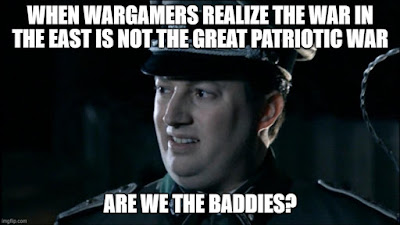
Does a German-centric bias exist in Eastern Front wargames?  It is only the “Eastern Front” to the German Army.  Same applies to naming wargames, “War in the East” or the German operation codename.  Note my meme in the header asks this question.  Jeremy provided a number of game examples whereby a player may get that impression.  Eastern Front maps are labeled in German and much of the accompanying game artwork and imagery focuses on the German Army.

What does it mean to play these games?  If game designs make claims and arguments on only a subset of the war, do these games, then, become an ideological tool?  What do I learn about the world from playing these games?  What does it mean to “want” the Germans to win?

Returning to Jeremy’s thesis, game designs can produce blind spots in their models.  Jeremy highlights some of the possible consequences of such inaccuracies.  Does this automatically lead to a breakdown of wargames, specifically, and understanding warfare, generally?

Are wargames ideological tools?

Tuesday, October 17, 2023

Re-Fighting History: WWII, Boardgames, and War in the East

Georgetown University Wargaming Society (Washington DC) offers a regular series of webinars on different facets of wargaming, military history, wargame design, and assorted other topics.  The quality of the presentations and topics run the gamut of my interest level and attention span.  Tuesday's offering looks especially inviting to me with a focus on the War in the East in WWII.  With the cover of the boardgame Drang Nach Osten! (DNO later reimplemented by Fire in the East) in the event announcement, will GDW/GRD's Europa series of boardgames be included for discussion?  Perhaps Dr. Best will identify the WWII boardgame(s) that meet the military simulation threshold on value-added as effective simulation tools.  Perhaps none reach this threshold.  Can this discussion and evaluation of WWII boardgames as a simulation value be generalized to other periods and other games?  What about extending to miniature Wargaming?  I look forward to seeing what topics are in store and discovering if any boardgames meet this threshold. 
Description
Jeremy Best will challenge the efficacy of military boardgames as accurate representations of historical conflict.  In his webinar, Dr. Jeremy Best will present early conclusions from his research into the history of military boardgames, the memory of World War II, and the limitations of military simulations for understanding war. The first modern military boardgames emerged in the late 1950s and from the very beginning the war between Nazi Germany and the Soviet Union took center stage. Hundreds of games, thousands of scenarios have been produced – all of them claiming and aspiring to authentically recreate historical conditions. Part of the appeal of these games was that in re-fighting the battles, campaigns, even entire war players could rewrite that history. For all their efforts at accurate simulation, these games often fail as history. In the webinar, Dr. Best will discuss the ways in which games represent the Eastern Front, the blindspots of these representations, and the possible consequences of such inaccuracies. More generally, these insights lead to certain questions about the efficacy of wargames in general for understanding warfare.
 
Bio  
Jeremy Best is an associate professor of modern Europe at Iowa State University with a specific interest in the cultural history of Germany during the nineteenth and twentieth centuries. His current research project is a manuscript in development tentatively titled “Toy Soldiering: West German Rearmament, the Holocaust, and the United States” on the history of tabletop wargaming, Holocaust memory, and the perpetuation of the Clean Wehrmacht Myth in America and West Germany. Heavenly Fatherland: German Missionary Culture in the Age of Empire, his first book, was published by the University of Toronto Press in 2021. That book won the Phi Alpha Theta Best First Book Prize in 2021, was named one of “Ten Outstanding Books in Mission Studies, Intercultural Theology, and World Christianity for 2021” by the International Bulletin of Mission Research, and named to the shortlist for the 2022 Waterloo Center for German Studies Book Prize. In addition to his academic work, Professor Best has worked as a public-facing historian publishing in The Washington Post, The History News Network, and Perspectives on History.
If interested but cannot make this event, GU Wargaming Society content is usually published to YouTube following the event.

Tuesday, September 19, 2023

Back to Biblicals!

The dust had yet to settle over the plains of Ilipa when I received an email from the Society of Ancients.  This email contained an announcement for the upcoming annual convention in October.  Since I am unlikely to attend this year's convention at Madingley Hall near Cambridge, I was only generally curious of the content.  What really caught my eye was the inclusion of Ian Russell-Lowell in the program.  I have gamed with Ian for nearly three years now often seeing him in a weekly remote game.  Ah, the fun of shooting down Snoopy and his long line of succession in aerial dogfights over the fields of Flanders.  Phil Steele will be presenting at the convention as well.  Another of my weekly remote gaming buddies out and on tour.  Joining them this year sure would be fun. 

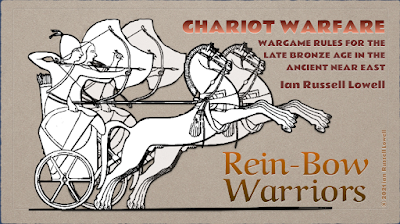
Back to the email.  My gaze was especially focused onto the content on offer.  First, Ian would be discussing the Late Bronze Age.  One of his specialties.  Second, Ian would be running a workshop on the latest incarnation of his Work-in-Progress Late Bronze Age rules, Rein-Bow Warriors (RBW).

Now, RBW is a ruleset that Ian and I have discussed much in the past and even got in a handful of playtests.  I have not seen rules' development since our last work more than a year ago.  Remembering that the rules still had some conundrums left to solve and streamlining to consider from the last playings, I wondered what had changed in the passing year and a half.

A quick email to Ian answered my question.  

Not much!  

Given that presenting a workshop for developmental rules having not seeing action in more than a year might be a challenge, I offered my services to help in refreshing both of our collective memories.  Ian cheerfully accepted!

In what will be the first of (I hope) several playtests, Ian and I will meet this week to discuss the current state of the rules, consult notes made during previous sessions, and push a few troops around my remote table.  Well, remote for Ian.  I will be broadcasting live from my game room.  Ian will be Zooming in from Cornwall.
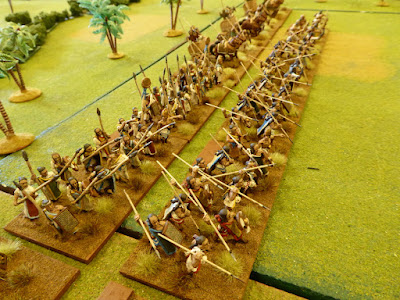
Hittites ready for action.
While Biblical armies may be roaming around the table for a while, I figured why not get these armies in a game or two outside of these playtest sessions with Ian.  Why not indeed?  To that end, the plan is to pull Egyptian and Hittite armies from storage boxes and set out a pitched battle or two using Basic Impetvs.  One game is formulating for Monday.

Reject Big Lee recently recounted an occasion where serendipity struck, guiding him gently into a new project (see When Serendipity Strikes).

While I have no pull from a new project, the stars may have aligned to give me a nudge toward fielding my Biblical armies and trumping my move toward a War of Austrian Succession battle.

Why?
  1. Five-inch arid hex system used for 28mm Basic Impetvs is already laid out onto the gaming table from Ilipa.
  2. I started creating more five-inch hexes including hills last week.
  3. I undercoated a handful of 28mm Babylonian archers even though most of my painting activity has been focused on 15/18mm figures.
  4. Receipt of Society of Ancients convention email.
  5. Correspondence and acceptance with Ian for more playtesting. 
Convinced?

Tomorrow I begin setting out the armies.  He will be watching...

Friday, July 28, 2023

Reporting from the Front: How Are Battle Reports Read?

Among the many cogitations I have on wargaming in general and blogging in particular, battle reporting comes up as a frequent subject in my ponderings.  I know, many more important topics to consider but I wander where my thoughts take me.

Having written many a battle report (the Labels section in the right sidebar shows nearly 300 Battle Reports to date) and read even more, I have plenty of data from which to work. 

Since blogging and the subset of battle reporting is an individually creative venture, I reckon there are as many forms and styles to writing battle reports as bloggers.  Given the frequency of my wargaming and the sheer number of battles chronicled, I have settled on a form and style that works for me.  I enjoy the process and the satisfaction that creating these little battle summaries offers.  As in most undertakings, there are costs and trade-offs.   Almost always, the chronicling of the battle report takes longer than actually playing the game.  Is this time well-spent?  Are battle reports interesting primarily to the players involved in the game?

The writing style that I most often fall into mirrors the writing of history as a prose narrative of events.  A broad-brush prose narrative, that is.  The focus emphasizes retelling a story, briefly, punctuated by supporting game photos.  Rules' mechanics are not often covered nor are specific details on dice rolled, probabilities needed, etc..  Again, this is personal choice since not all readers will be familiar with the rules in play.

So, what is the point?

Well, curiosity prompts me to ask how are battle reports read.  Now, I am interested in how a reader generally consumes and interacts with a battle report but I am specifically curious how my battle reports are read.  As a reader, is each battle report read completely, ignored, or does it fall somewhere in between?  Does this engagement depend upon the topic?  The big question is, are battle reports worth continuing?

To make submitting and collecting data easier, the following scale is provided from which to choose.  I appreciate any feedback received.  Please select the response that best matches your tendency in reading battle reports found on this blog.  Besides your selection, please add in any commentary and observations on the topic.

Here we go (and let's be honest)...
  1. Each battle report is read completely.  I hang on every word and photo to get a grasp of the game and its result.
  2. I read through the report but skim through the photos.
  3. I look at the photos but skim the battle account.
  4. I skim through both battle account and photos.
  5. I scroll through the battle report and read the wrap-up.  If it sounds interesting, I return for another pass through the report.
  6. I scroll through the battle report but stop to read the wrap-up.  
  7. I scroll through the battle report and move on.
  8. Battle reports?  There are battle reports?  
  9. Other.
Whatever your choice, do you read readers' commentaries?

Thank you.

Friday, February 3, 2023

Five Games a Week

When I discovered remote gaming a little over two years ago, the thought of participating in a wargame on a weekly basis was a novelty.  Some weeks would even see two games in one week.  Unbelievable!  Given that I was more accustomed to averaging maybe one game per month, this increase in gaming frequency was astonishing.

Times have changed.

Now, two games per week seems the default.  Having three games is a regular occurrence.  Weeks with four games are slipping in with more regularity.

This week's gaming activities made another step up to a level rarely seen.  I participated in five games.  Five Games!  

As a recap,

Sunday: Battle of Consuegra 1097.
Matt returned to another Reconquista battle using Basic Impetvs on a grid in 28mm.  Two player game.  Although Matt had the chance to score the victory, he opted to call the contest a draw. 
Monday: Battle of Montebello 1859
I hosted this battle using Fields of Honor on a grid in 15mm.  Six-player game.  This is a large battle and will require one more session to fight to completion.  Well, hopefully one more session will wrap it up!
Tuesday: 1944 WWII skirmish using Ambush in 15mm.
Richard hosted this Normandy action as a five-player game.  While the Germans (me!) could not fulfill the objectives, Graham deemed the result a draw as the Americans suffered heavy casualties.  Is it odd that the only American in the game played the only German?  All British players commanded American units. 
Wednesday:  Day of Rest!

Thursday: WWI in Palestine using Peter's OHW variant in 20mm.
Peter hosted this two-player fight.  In a return engagement for this scenario, the Turks threw back the attacking EEF in another stalwart defense.  I will get back to this one in a separate battle report when time permits.
Friday: AWI Battle of Hubbardton in 10mm using Loose Files and American Scramble.
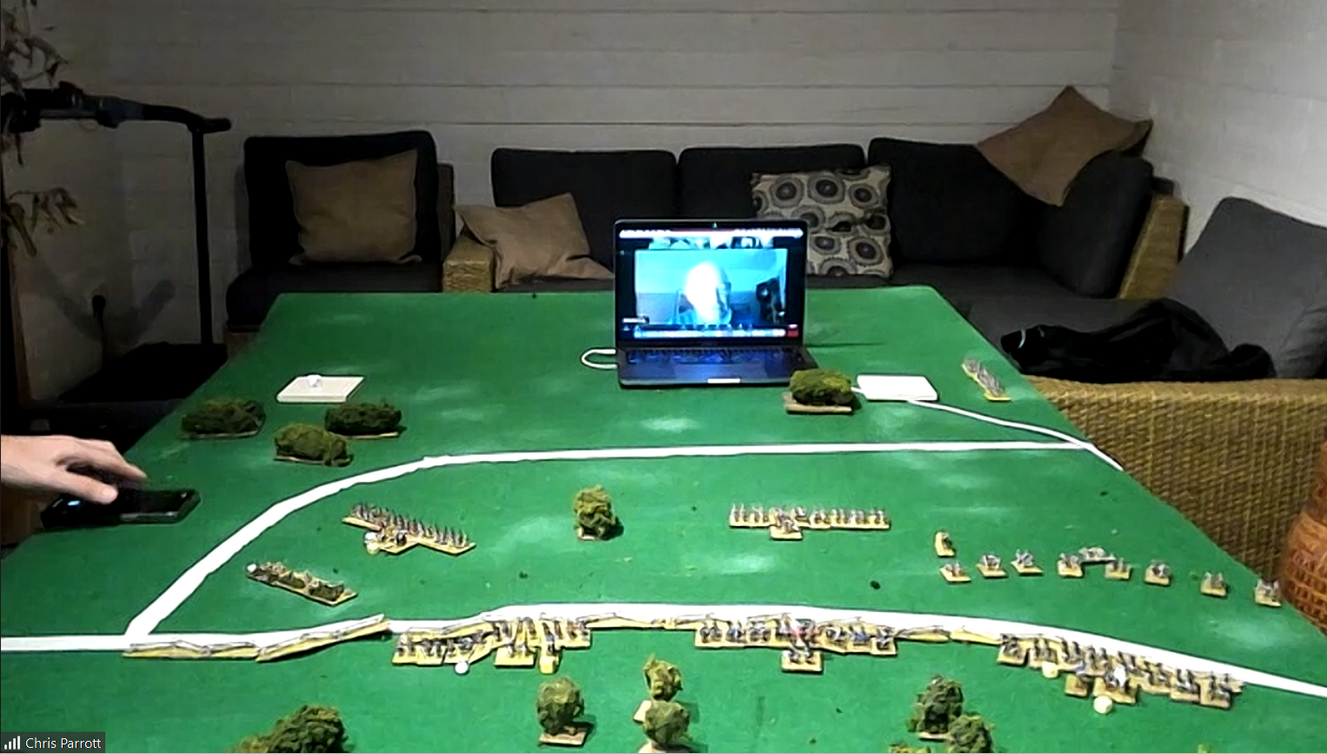
Chris hosted this three-player game where David and I commanded the Rebels against Steve's attacking British.  The Rebels were sent packing following a grenadier charge into skirmishers followed by the turning of the American line.  Sigh.  
There you have it.  A very busy week at the gaming table with games in the USA, Australia, and England.

Have I opened a can of worms?  Perhaps.

Not surprisingly, little activity at the painting desk.  Maybe some time for a meaningful painting session this weekend?  I hope so.

Tuesday, January 31, 2023

Refighting History, In Miniature

In a recent blog post (When is a Historical Wargame Historical?), the author puts forward the question of whether attempting to recreate a historical battle on the wargaming table can attain the desired goal.  As an example, the recent Battle of Auberoche, fought between Peter and myself, was sited.  My account of the battle can be re-read at Battle of Auberoche.  Did this game recreate the battle faithfully?  If not, can this action be classified as an historical wargame?  Refighting Auberoche provided an exciting contest which came down to the wire but was this really Auberoche?  

For those wargamers who enjoy refighting historical battles, the gaming objectives and approaches are many and varied.  I suppose one question to ask is what is the desired goal in refighting a historical battle.  Why do we do it?  Does choice of rules matter?  Does type of game matter when viewed along the Game vs Simulation spectrum?  Do game constraints such as time, space, figures available, number of players,etc. affect these goals?
I admit that my preference leans toward refighting historical battles.  Even given great care in preparation and research, are we still fighting an historical battle once the maneuvers and shooting begin?  For me, these attempts at historical recreations are exercises in decision-making.  Always keep in mind that the historical outcome may be one of a number of possible outcomes.  The historical outcome is singular.  Any historical battle may hinge on a single decision point, a singular battlefield occurrence, or a string of such events.  Same holds for a wargame.

A well-designed, historically motivated wargame attempts to place players into the boots of their historical counterparts.  The wargame may begin from the historical situation (or at least the author's representation of the historical situation) but as the game evolves, so does the narrative.  Must the wargame necessarily follow the historical narrative?  Of course not.  We want to encourage the table general to make his (or her) own decisions without following the choreographed decisions made by the historical counterpart.  If the situation and objectives are set properly, one might expect to see generally, historical results in repeated trials.  That is, if the historical result represented the most likely outcome.

As GM, I want players to consider the choices made within the confines of the historical situation faced on the gaming table in miniature.  When wargaming, I want to make meaningful decisions on the path toward accomplishing the goal laid before me. I want to gain insight from the experience.
Consider as a case in point the game currently on the table.  On the table today is a recreation of the Franco-Austrian War Battle of Montebello.

Each player or team of players received a battle briefing beforehand containing a brief generalization of the situation and a specific assessment of known intel.  The general briefing read,
On 9 May, Austrian FZM Gyulai’s uninspired offensive in Piedmont ground to a halt without ever contacting the enemy.  Concerned that the French would attempt to turn his left flank by advancing upon Piacenza, FML Stadion’s V Corps was ordered (20 May) across the Sesia River and move on Casteggio and Voghera.  This reconnaissance-in-force was determined to discover French dispositions, interdict the Voghera-Piacenza Road, and thwart these perceived threats.

As the Austrians approached Casteggio, they ran into Sardinian cavalry screens.  The Sardinian mission, deployed east of Voghera, was to act as an early warning system to prevent surprise attacks from the Austrians.  The Sardinian light cavalry were to hinder any enemy movements westward buying time for the French army to come up, if needed.  The only means of crossing the River Coppa in this area are via two bridges: the bridge at Casteggio and the railroad bridge to the north of that town.  Running from Genestrello north, the Fossa Gazzo can be crossed everywhere but with difficulty.  The railroad bridge at Casina Nuova and the bridge near Genestrello are the best places to cross the Fossa Gazzo.

Being heavily outnumbered, the Sardinians traded space for time as they slowly gave up ground to the approaching Austrians.  After reports arrived detailing the action earlier in the day and the fall of Casteggio, Forey’s division of the French 1st Corps quickly marched on Casteggio.  In the meantime, Stadion had taken first Montebello and then Genestrello as the Sardinian cavalry retired.

This common background was augmented by battle specifics for each player outlining OBs and force objectives to help steer the players into a recreation of the events driving the historical battle narrative.  In the interests of providing an engaging, multiplayer game, decisions had to be made to accommodate the number of players and the method of play (remote).  In a multiplayer game, having players watching in while they await their command to enter the table as reinforcements would not do.  Reinforcement timetables had to be compressed to allow all players to get meaningful commands into action almost immediately.  Does this change or alter the historical framework?  Perhaps not if the pieces can be molded in a manner to maintain the historical context.

Will this work?  The first gaming session is in the books.  Only time will tell as one more gaming session is needed to fight this battle to conclusion.

How would you answer the question of when is a historical wargame historical?  I look forward to your insights.

Friday, January 21, 2022

Game Room Clean-Up

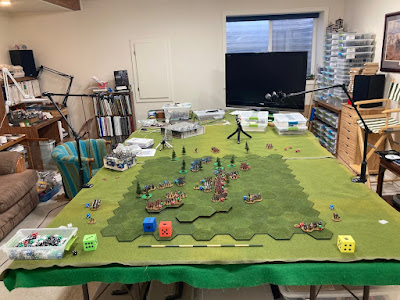
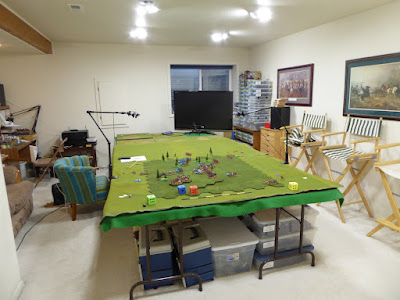
The game table looks reasonably tidy, no?  Trust me, it does not always look like the photo above.  In fact, any unused portion of the gaming table seems to collect all manner of gaming detritus.  This 'stuff' piles up quickly, too, and has a tendency to overtake all empty space.  

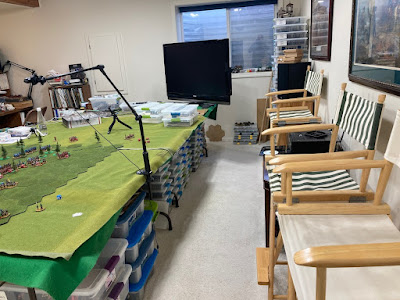
With my focus primarily on hosting remote games of late, I have been trying to limit the playing area to no more than 6' x 8' so that the webcams can capture the entire play from behind each player's side without swiveling cameras during the game.  By utilizing only a portion of the table, the unused table space soon becomes a repository for all sorts of material including a use as a staging area.

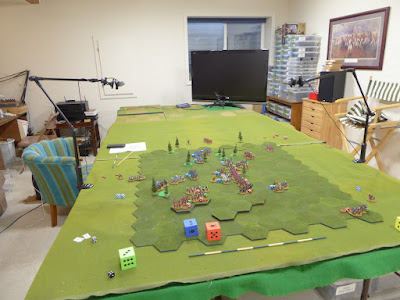
The hex board in the foreground is from the recent Second Battle of Azukizaka and takes up only about 4'x6' footprint.  Perfect size for remote games.  Notice the webcams positioned behind and over each player's side of the table and the 48" TV used as a monitor for coordinating players and webcam views for Zoom games.  That large TV may have become a permanent fixture to the game room and game table.  If I go back to using the entire 12' of the table for larger games, I may have to consider mounting the TV on the wall. 

Where was I?  Oh, yeah.

With stuff piling up on the gaming table, the scatter on the table finally became too much and I made an effort to clean up the mess.  What began as a thought to simply tidy the table soon devolved into a repositioning of a lot of items as the effort gathered momentum.

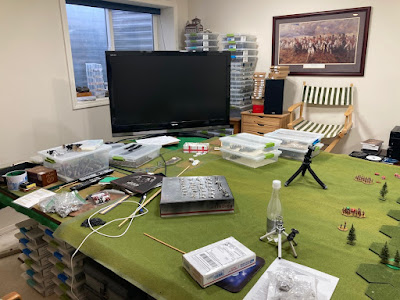
What mess? How bad could it be?  Well, the photos below offer a hint.

Does not look so bad from this end of the table.
Upon closer inspection.
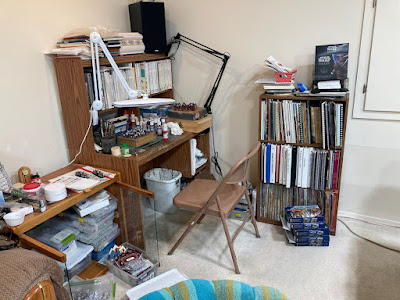
Painting station in the corner.
View from the other side of the table.
Stacks of figures lurk under the table and along the wall.
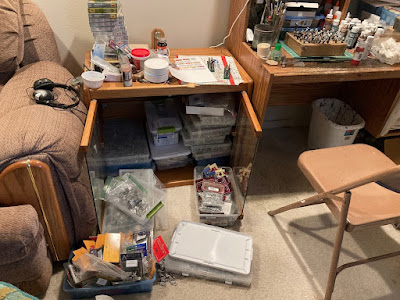
A large portion of The Lead Pile in the cabinet,
some spilling out onto the floor.
Not only did the table get a clean-up but the room saw some adjustments as well.  The small bookcase near the painting station holding mostly rulesets was moved upstairs into my office.  The stereo moved from the opposite wall to behind the painting desk. The 'hideous' barrel chair (Nancy's assessment, not mine) stayed.  This chair was bequeathed from my grandmother, perhaps 30 years ago.  Despite the upholstery, I love it. 

After.
I made no progress on tidying either the painting desk or The Lead Pile.   I will save that for another time.

Saturday, September 28, 2019

A New Convert?

What is the best entry point to draw a potential recruit into wargaming?  The first entry point I consider is always Commands & Colors: Ancients.  Great game providing a relatively easy entry into the hobby.  I had a chance to test this theory during a protracted stay of our recent house guests.

With daughter #1 returning home for a stay while in between house moves, the house has been quite active with four additional people and a dog.  Since the game room is in the basement and the game table must be passed on the way to the downstairs bedroom suite where they were staying, I saw some growing interest from her fiance as he looked over the table having an ECW battle on display. 

Finally having some free time one evening, I suggested we give a light wargame a try.  I suggested an Ancients battle with blocks and he agreed.  I pulled out CC: Ancients, removed the boxes of blocks, and unfolded the map.  Already he was impressed.  We selected the first battle in the scenario book, Bagradas, and deployed the troops.  He really enjoyed the look of the game and mentioned that it a wonder that he has not heard of this series.  He chose to take the Carthaginians in Game 1.  Anyway, on to the real test.
Initial deployments
Game 1 took about two hours as I explained the rules, the cards, and the potential interactions.  While there was frequent hesitation on which card to play and what it means, we completed Game 1 in a closely contested match.  Although my Romans began on a 3-0 banner lead, the Carthaginians came back to tie the game 6-6.  With only one banner to capture for victory, we jockeyed for position to place our battling armies in the best situation for victory.  In the end, Carthage won 7-6.  A victory in his first game is a great motivator!  He was eager to play again.  
Carthage Victory Game #1
The next evening, we again had time to rejoin battle.  We switched sides and I took command of the Carthaginian Army.  This time the battle was not so even.  Carthage struck early with a deck of Center and Line Command activations.  Carthaginian heavy infantry made it up into the front lines early and then a combination of elephants, warbands, and heavy infantry cut the Romans apart.  In the end, Carthage won 7-3.  Still, he is looking forward to more games of CC:Ancients.  This one has potential!  Maybe next time I will bring out the 6mm armies?  Is there a more approachable system as an introduction to wargaming?
No crying over spilt beer
On deck this weekend is a Napoleonic battle featuring Age of Eagles with the regular gaming group.  Should be fun!