Wednesday, December 19, 2012

Musketry Effectiveness on the Early Nineteenth Century Battlefield - Part 1


Several years ago, I completed a course in simulation.  One of the requirements was to craft a project that used simulation techniques.  Topics were unconstrained so with an interest in military science, wargaming, and simulation, I chose to simulate musketry effectiveness on the 19th Century battlefield.  Below is the Part 1 excerpt from that project.  Comments encouraged.  On to Part 1 for motivation and review.
  
From the mid-1750’s through the mid-1850’s, the smoothbore musket was utilized as the principle infantry weapon on the battlefield. The loading and firing of the musket took as many as seventeen, well-drilled steps. To maintain control and overcome the inaccuracies of the weapon, tactics evolved emphasizing volley fire delivered by lines (ranks) of soldiers standing shoulder-to-shoulder and discharging their weapons in unison at the command of their officers. Not only did this deployment provide a sense of confidence and safety to the soldier but also provided the volume of fire necessary to ‘discourage’ an advancing enemy formation from bearing down on his position.

In these firing lines, two ranks of infantry could simultaneously discharge their musket. For example, a British company of 100 men would be drawn up in two ranks, each having a frontage of 50 men. While the company only maintained a frontage of 50 men, firing both ranks yielded a volley of 100 musket balls towards the target. Trained infantry could produce three or four volleys per minute on the parade ground but in battle, only two or three volleys per minute could be sustained in a protracted firefight.

On the battlefield, formations of men maneuvered in accordance to strict regulations. Both rates of advance and maneuvers were drilled to the point of becoming automatic. Each combatant nation maintained several prescribed rates of advance depending upon the situation. Often, these rates of advance were not standardized across nations. During an infantry charge, the attacker would quicken the pace to shorten the length of time needed to cover the ground between themselves and the defender. For the French, this quick pace was called the 'Pas de Charge' and equated to 120 paces per minute. Due to the length of the French pace, this march rate equated to 90 yards per minute.(1)

While many anecdotal accounts support the potential for devastating musketry volleys, little empirical evidence exists. The few field trials conducted during this period were carried out under ideal conditions and without scientific rigor. Three of the more famous musketry trials were conducted by Scharnhorst, Picard, and Muller. In each trial, soldiers lined up facing a target the size of an enemy company and fired volleys into the target at varying ranges.

In Scharnhorst's trials, a company of grenadiers (the most disciplined and trained classification of infantry) fired at a company-sized sheet at different ranges using six different types of muskets. The six columns for Scharnhorst's trials in the accompanying table represent one trial per weapon.(2) Instead of varying the weapon, Muller varied the quality of the firing soldiers between veteran (experienced) and raw (little training and no combat experience).(3) In all three trials, these data show, in general, an inverse relationship between range to target and casualty rates. That is, as the range decreases; the expected casualty rate increases. The results of these trials are detailed in Table 1: Musketry Trials Under Controlled Conditions


Table 1: Musketry Trials Under Controlled Conditions 

Plotting these data points yields the results in Figure 1: Musketry Effectiveness Under Controlled Conditions. Notice that Picard and Muller's (Veteran) results are quite similar while a distinct gap exists between Muller's two trials suggesting that the quality of the soldier firing the weapon was much more important than the quality of the weapon, itself.
Figure 1: Musketry Effectiveness Under Controlled Conditions 

In A Guide to Napoleonic Warfare, Nafziger used the Scharnhorst data as a baseline for his analysis and computed a non-linear regression to these data (this series is labeled, 'Nafziger I'). In order to compute a non-linear regression equation, two artificial data points were added to the analysis: (1) 100% hits at 0 yards and (2) 0% hits at 450 yards. The assumptions are that at 0 yards all muskets will hit a target and at 450 yards, even if a target is hit, no damage will be sustained. Not satisfied with these initial results, Nafziger added one historical data point obtained from an account of the Battle of Gohrde (labeled as the 'Gohrde' volley in the graphics) to the data series and recomputed the regression (labeled as 'Nafziger II').

Since details regarding the effectiveness of an individual volley in the battle are rare, the Battle of Gohrde provides a singular event. During this battle in 1813, a Hanoverian militia battalion sustained 27 casualties at a range of 70 yards fired by 66 French muskets for a hit percentage of 41%.(4) Superimposing the musketry effectiveness curve using the Gohrde point on Figure 1 yields Figure 2. 
Figure 2: Musketry Effectiveness Fit to Nafziger's Analysis 

Using the Nafziger II curve and the following assumptions, Nafziger concluded that four volleys would completely destroy an approaching attacker when both attacker and defender were of equal size. His assumptions were:
  • Two rounds per minute fired. 
  • The attacking infantry marches at its regulated march rate. 
  • The results of the Gohrde volley are typical and average. 
  • The first volley was delivered when the attacker reached 300 yards. 
  • The terrain between the attacker and defender is perfectly flat. 
One must note that Nafziger's conclusions regarding the complete destruction of the approaching enemy were actually computed at a one minute per volley rate rather the two minutes per volley rate in his assumptions. That error implies that casualty rates would be twice as large as stated in his original analysis.(5) 

Historical evidence suggests that the attackers were not typically eliminated while advancing on the defender. Often, the attacker's choices would be to either halt the advance short of contact and enter into a firefight or withdraw from musketry range. For the defender, if musketry volleys failed to persuade the attacker to halt the advance then the defender would withdraw as the attacker closed in on his position. Evidence also suggests that the first volley was usually the most accurate and delivered with the greatest care. After that first volley, muskets were more prone to misfiring and continuous volleys would reduce visibility as smoke choked the battlefield.

The problem, then, is to develop a musketry effectiveness model and simulate (in repeated trials) the expected number of casualties sustained by an attacker while advancing on a defender’s position. In addition, the number of volleys that a defender can deliver before being contacted by an attacking force will also be quantified. Taking these data, contemporary anecdotal accounts, and a number of simplifying assumptions, an event-driven analysis will be examined that models musket effectiveness on the nineteenth century battlefield. The objective of the simulation is to provide insight into the tactics employed and theoretical casualty rates on the early nineteenth century battlefield.

Next Part 2: The Model

  1. Nafziger, A Guide to Napoleonic Warfare, pp.6-7.
  2. Nafziger, pp. 11-12.
  3. Nosworthy, Battle Tactics of Napoleon and His Enemies , pp. 203-204. Nosworthy cites Hughes, Firepower p. 27 who in turn, cites Picard in La Campaigne de 1800 en Allemagne.
  4. Nafziger, pp.14-15. Nafziger draws this account from von Quistorp, B, in Die Kaiserlich Russich-Deutsch Legion, p. 99.
  5. See Nafziger, Table VII. Musketry Hits Based on Gohrde Curve p. 17 to verify computational errors.

Monday, December 17, 2012

Battle for the Bridges - Napoleonic AAR

Scott hosted a Napoleonic game using his beautiful 18mm Napoleonic collection and General de Brigade rules.  The scenario pitted Nordmann's Austrian Advance Guard attempting to hold the bridge and village as Morand's powerful division forced the crossing.  Scott moderated while Kevin commanded the French and I took the Austrians.

Initial positions show the jaeger holding the bridge while Vecsey's division approaches the village.  While the layout was expansive, only the area around the bridges witnessed much activity.
  
French initially have a battery deployed opposite the bridge while reinforcements pour onto the table.  Austrian grenz take up positions defending the village while the hussars pass through town to cover the lower bridge.

To counter the French threat at the lower bridge, Austrian hussars charge catching the French cavalry flat-footed.

French cavalry are sent reeling back across the bridge while a second French light cavalry regiment fords the stream below the bridge.

Morand sends skirmishers and legere to demonstrate against the jaegers in the wood line while major French efforts are made against the lower bridge.  French objective seems to be focused on an indirect approach on the village.

Nordmann's second brigade reaches the village and in an attempt to change orders, Froelich panics and his column back peddles into the third arriving Austrian brigade.  What a mess!  After a little embarrassment and a couple of turns, Nordmann begins to sort out his reinforcement arrival.  Unfortunately, the village has become a major bottleneck. 

Kevin leans, white knuckled, onto the table as the lone Austrian cavalry on the left is tasked with slowing up the entire French column.  In this delaying action, the Austrian cavalry repulse two French charges at overwhelming odds before being scattered.

Overview of the battle mid-game.  Austrians still have a major bottleneck as two brigades attempt to pass through the village simultaneously.  Skirmishing continues along the stream bank as the jaegers hold back the French.

Battle lines are beginning to form on the Austrian left as the French deploy across the stream and Austrians clear their traffic jam.  Austrian guns are brought up and unlimbered to protect the approaches to the village.  Still brash, Froelich crosses the upper bridge in pursuit of the legere.  Froelich's attack on the lone legere regiment ends in failure and consumes resources that could have been useful on the other side of the stream.

French cavalry charge the grenz but the grenz form square before the charge can hit home.  Unable to recall, the French light horse hit the square and are repulsed.

  Attacks go back and forth as opponents struggle to gain the upper hand.  In a bit of bad luck two full strength Austrian regiments fail morale checks and are dispersed. 


After the bloodletting, most formations are called upon to take brigade morale checks.  One after the other, both sides disengage as morale checks are failed.  In the end, the Austrians hang onto the village but both combatants are exhausted with few assets or willingness to continue.

Scott provided an interesting scenario with a few tactical problems for each side.  The Austrian commander faced one major problem and committed one major mistake.

The problem centered on Froelich's command failure and withdrawing his brigade into oncoming reinforcements.  The ensuing bottleneck in the village was a direct result of a tangle of orders and troops.

The mistake was in sending the headlong Froelich over the upper bridge to target one legere regiment.  Froelich's command would have been better employed on the village side of the stream to help shore up the defenses outside of the village.

Thanks, Scott! 

Wednesday, December 12, 2012

15mm Samurai Battles Project Update

Two more units for Samurai Battles have mustered out from the painting table.  This time, one unit of mounted Samurai and one unit of Ashigaru arquebusiers.  Again, the Peter Pig figures are really a pleasure to paint and the double hex basing is pleasing to my eye.

All of my other collections have a dullcote seal but with the Samurai project, I opted for a more matt finish.  To me, Krylon Matt Finish has always appeared too glossy but for these Japanese warriors, the slight gloss is appealing and seems to work.  Perhaps I prefer this matt topcoat on the Japanese because much of their gear was lacquered?  Perhaps, it gives the figures a more Old School look?  Whatever the reason, the lacquer on the helmets, armor, and weapons enhances their appearance.


Next up for the project is a unit of Ashigaru with swords.

As for the game, itself, I began work on reproducing the cards in the game.  Since the cards can't be purchased separately (that I can find), I am experimenting with creating my own set of Command & Colors and Dragon decks.  My thought is to create and then print out the card information and then affix these onto regular playing cards.  This approach solves two problems: obtaining the card decks and making a more durable product.

Monday, December 10, 2012

French & Indian War Action - Part Deux

The game reconvened on DEC 08 and we picked up where we left off on Thanksgiving.  After a prolonged clash at the stream, the natives scatter the survivors of the frontiersmen.  With the frontiersmen eliminated, three of the warbands begin working their way through the woods to envelop the British right.
Earning their moniker, the coureur des bois make a wide sweep around the British left and prepare for a rear attack.  Ever vigilant, the British lights spot the trappers and turn to engage.

The 1st Royals advance to the stream bank and begin exchanging fire with La Reine.  To anchor the British right, one coy of militia advances into the woods unaware of the dangers lurking, therein.
With a whoop, the natives strike into the surprised militia cutting them to pieces.  Massacre!  
Failing to stem the panic, the remaining two coys of militia fall back upon the Royals.  As the militia retreat, only the rangers stand between the Royals' flank and the natives.  Despair grows among the colonial commander.
Continuing volleys between the Royals and La Reine witness bending but no breaking of the lines.  The Royals are able to cycle fresh troops into the firing line while exhausted companies regain their cohesion.

With the sense of catastrophe mounting, the British lights attack and then scatter the courer de bois.  Having eliminated the threat from the rear, the light infantry hustle to counter the native threats.  Failing to surprise the militia, the natives are repulsed and then counterattacked by the light infantry and rangers.  All natives on the British side of the stream are scattered and the immediate crisis is averted.
  

The light coy retraces its path back to the stream and then crosses to threaten the French right.  Order is restored to the regulars and the advance upon the French positions is resumed.

Climbing the hill on the French right, the lights catch one of the La Reine companies in the woods.  Better able to operate within the confines of the woods, the lights eventually succeed in scattering the French.  Victorious, the British commander joins the lights from their vantage spot to direct the advance.  Remnants of the French withdraw back into the safety of the woods.


Thus ended the game.  

The French held the upper hand throughout the early and mid game while the British were completely frustrated by the natives in the woods.  Once the close-order troops pulled back into the clearings, native surprise attacks diminished.  Using the rangers and light infantry in the woods against the natives turned the tide in the game.  Had the French pressed the attack across the stream with their regulars while the Royals were wavering and militia encircled, the game may have ended with one hard push. 

This scenario produced a hard fought battle with both sides believing they were winning one turn and then losing the next.  With terrain dominated by woods, the irregulars become quite powerful when used to their best advantage.  Rapid movement through woods, ability to thwart surprise attacks, and their prowess in woodland close combat all combine to produce tough adversaries.  As the British player discovered, militia in woods are no match for natives.  Likewise, the French player discovered that natives in the open are no match for regulars.  

Although I didn't count the number of turns played, we must have completed at least a dozen turns.  Le Petite Guerre rules worked well and allowed a smooth running game with few questions.  I did make some notes during the game for later consideration and possible adjustments.

While I only moderated this game, it was great fun to deploy the FIW collection on the gaming table and watch the battle unfold.  With very little pre-game preparation needed, hopefully, we'll return to the frontier soon. 

Thursday, December 6, 2012

Battle of Lake Trasimenus AAR

It seems an opportunity wasted to set up the Lake Trasimenus scenario solely for displaying the newly created hex hills.  With an expectation of no interruptions for a few hours, I set about a solo reply of the seemingly, lopsided scenario.  

We first played this scenario during one of our group's game nights.  In that replay, the Roman player thumped the Carthaginian player soundly.  Ersatz Hannibal grumbled quite a bit, only part of which was discernible.  Much of what I did catch revolved around the impossibility of the Romans extracting such a defeat on the Carthaginians and this outcome never could have happened.  That may have been his last game of CCA.  Do I remember the story correctly?

Anyway, I'll tackle this scenario in a solitaire fashion by running each side to the best of my abilities.

Turn 01
Hannibal chooses Order Medium to get both his medium cavalry and warriors closer to the Romans.  Mounted Charge was considered but Hannibal opted for advancing his medium troops first.

Flaminius plays a Line Command to advance his left and center away from the confines of the lake shore.

Turn 02 (1-1 tie)
Hannibal now plays the Mounted Charge card and all medium and light cavalry on the Carthaginian right charge forward into the Roman left.  Charge results are mixed with the light horse both giving and receiving hits without destroying any Romans.  The two medium cavalry concentrate on one of the auxilia and eliminate it after a vigorous pursuit.


Flaminius plays a Double Time card and four units in the center close quickly with the two slingers.  In combat, one of the slingers is destroyed while the other takes 50% casualties.  The combination of playing both Line Command and Double Time really improves the Roman position.

Turn 03 (2-2 tie)
Wanting to keep pressure on the Roman left, Hannibal orders a Mounted Attack.  The medium cavalry without leader attacks the medium infantry causing two hits and taking one.  The other medium cavalry, with leader attached, causes three hits on the light infantry.  The light cavalry are quite ineffective in their attacks suffering more than they give.  The four light horse units barely manage to destroy the Roman auxilia. Ouch!

Flaminius plays the "I Am Sparticus" card and activates two medium and one light.  With Flaminius leading, the medium infantry in the center attacks the weakened slinger and destroys it.  Advancing, Flaminius attacks the Carthaginian auxilia with leader and each suffer two hits but neither retreat.

Turn 04 (4-3 Flaminius)
Hannibal orders Two Units Right and activates the medium cavalry.  The medium cavalry attacks and destroys the weakened light infantry and then advances to battle the medium infantry. The Roman infantry is pushed back.

Flaminius orders Three Units Center and chooses to move his medium cavalry, heavy infantry, and medium infantry.  Heavy infantry hits the Carthaginian auxilia giving three hits and taking one.  Medium infantry, with Flaminius attached, attacks the weakened auxilia.  Auxilia are destroyed.  Following up, Flaminius attacks the auxilia that his heavy infantry nearly destroyed.  These auxilia, too, are destroyed.   
  

Turn 05 (5-3 Flaminius)
Hannibal plays a Double Time card and launches a wave assault with the warriors.  The first warrior attacks the medium infantry backed up against the lake and each take one hit.  The second warrior attacks the medium infantry with attached leader and suffers two hits while giving none.  The third warrior attacks the heavy infantry giving two hits but being eliminated in the battle back.  Tough luck!  


With Flaminius poised to pick off one more unit, Hannibal concedes the battle and withdraws from the field.

Another interesting game that the Roman managed to win.  Favorable card play for the Roman and poor attack dice by the Carthaginian probably aided in the result.  Flaminius was very lucky to get both a Line Command and Double Time to begin the game.

I find CCA almost as good in solo play as with an opponent.  Elegant system with much replay value.  Time well-spent!

Tuesday, December 4, 2012

Samurai Battles: Test Units Completed

After seeing Jake's 15mm Samurai figures, I could not resist the temptation to paint a few for myself.  With a quick turn-around from Brookhurst Hobbies, I held in-hand a number of Peter Pig Samurai packs.  Two packs from my order are on back order as often happens with orders placed through Brookhurst.  Oh well, I have plenty of figures to paint in the meantime.  The Peter Pig Samurai range is much better sculpted than the photos on both Brookhurst Hobbies and Peter Pig websites suggest.  Detail on the figures is crisp and the figures are well-proportioned. 

What begins as a small set of test figures often spirals out of control into a new project. Well, that may be the result of my samurai figure test.  The figures are excellent and produce a very colorful army en masse.  It would give me great pleasure to field an opponent against Jake's hordes.

Off the painting table are two units based for Samurai Battles and compatible for use on a four inch hex map.  While Jake used a two inch by four inch base for each of his units, I didn't have any bases that size.  I chose to improvise using two 50mm Litko hexes glued together to make a double hex base.  The double hex base has a footprint that is slightly less than than four inches in length and about 2.25 inches in width at the hex apex.  This double hex base should fit within the four inch map hex.  As a bonus, the double hex basing allows me to use my two inch hex map for use with Samurai Battles.  Of course, the double hex base will span two hexes rather a single hex.


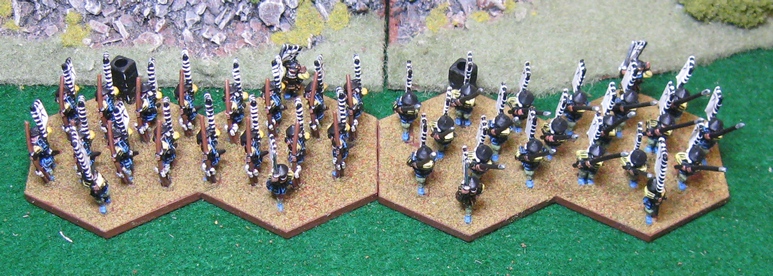
As seen in the photo above, I kept Jake's original basing scheme of two ranks for missile troops and three ranks for shock troops.  I increased the figure density for both shock troops (21 figures including two officers and one standard bearer) and missile troops (19 figures including two officers and one standard bearer).  To me, the figure density looks about right but actual number of figures per stand is irrelevant for game play.  Notice the black receptacle on the back right of each base.  These will be used to accommodate Jake's nifty, interchangeable banners.

Ashigaru spear
   
Ashigaru bow


06DEC2012: Added two photos of the bow and spear taken on a white background.  Is the white background preferable to the landscape background?


Monday, December 3, 2012

15mm Second Italian War of Independence Project

While working towards a project goal, it is useful to occasionally take stock of progress on a visual basis.  Having an order of battle as a project guide and logging completed units into a database may be sufficient but may not be complete.  For completeness, I may decide to pull all units out of their boxes and deploy the troops onto the table just to confirm progress made.  My 1859 project has reached this point of needing to gauge completeness.

Setting up the figures on the table top shows the relative strengths of the combatants.  Since the project, thus far, has been focused on the San Martino battle, few French have been completed.

By my count, there are 605 Austrians with 11 guns, 348 Sardinians with 6 guns, and 134 French with 2 guns.  Austrian FML Benedek's 8th Corps is virtually complete with two Sardinian divisions not far from finished.  By adding five battalions of Austrian infantry in November, Italian infantry should be the next painting focus.  Stands are organized at the battalion level with figures grouped and based into battalions, squadrons, and batteries with each figure representing 50 men. 

A more detailed snapshot for each of the combatants is illustrated below.


Sardinians

Austrians


French
As painting totals near the San Martino goal, it really is time to begin seriously considering rules for gaming the battle.  Since the maneuver unit (MU) is at the battalion level and I prefer whole stand removal my thoughts are pointed towards Field of Honor, Thomas' 19th Century rules, Weigle's 1859, or a derivative of my standard combat effectiveness model.  Perhaps, I'll consider bits of all three and see what surfaces.