Monday, November 12, 2012

Action at Brawner's Farm - Walk

A brief photo journal of a visit to the Second Manassas battlefield
The Battle of Second Manassas began with the action at Brawner's Farm where elements of Jackson's wing interrupted the redeployment of King's Division east along the Warrenton Pike.

A snapshot of the action is given in Figure 1 showing relative troop dispositions (map from http://en.wikipedia.org/wiki/Second_Battle_of_Bull_Run).
Figure 1 Battle map of Brawner's Farm
To put my battlefield walk in context, a handful of reference points were placed on a Google Earth map to help associate photos to the battlefield.  As the fight progressed both combatants kept extending their lines from Brawner's Farm to the east.

Both photos (1) and (2) show the Brawner house in its restored condition.  Vehicle access to the Brawner Farm is no longer available along the old Brawner lane from the Warrenton Pike.  Instead, the Park Service has cut in an access road from Pageland Lane and terminates just west of the Brawner Farm in a parking lot.  A trail heading nearly due east connects to the Brawner house.
(1) Brawner Farm

(2) Brawner Farm
North edge of Brawner Woods
    
From the Brawner Farm, head east to the artillery positions at (3).  Photo (3a) shows the gun positions looking towards the NE while (3b) is taken of the battery from the NE looking back towards the area of Brawner's Farm.
(3a) Artillery position from SW

(3b) Artillery position from NE
Continuing the walk to the NE, in (4) can be seen the artillery positions of S.D. Lee.  From this position, Lawton attacked the 7 WIS.  Lawton's attack would have approached from the left towards the right of the picture and almost directly towards the photographer.
(4) Lawton's counterattack

Two photos showing Confederate gun line atop the ridge at (5).  From this position, Lee disrupted Porter's attack at the Deep Cut on 30AUG1862.  Photo (5a) doesn't provide a sense for the dominating position of these guns but from (5b), the ground can be seen dropping off just beyond the guns.  With only a ribbon of trees and brush along the creek separating these heights from Porter's assault, Federal soldiers were raked under the guns along much of their advance.
(5a) S.D. Lee's artillery position

(5b) S.D. Lee's artillery position
  

Sunday, November 11, 2012

French & Indian War in 28mm

Some of our Thanksgiving guests are gamers so my plan is to host a small game following dinner.  For the game I wanted to use 28mm figures and not to tax the players with a large scenario and complicated rules.  The goal is to have the game played to completion within about two hours.

After a bit of thought, I decided to set the scenario during the French & Indian War.  By choosing this period, my FIW collection makes it to the tabletop; something that hasn't happened in a very long time.  Several companies of 1st Corps and Crusader figures have never been in battle.  A small battalion level action with two battalions (or equivalents per side) should be quite manageable within the two hours game allotment.

Although my FIW version of Ironsides has been successful in the past, I wanted game mechanisms that were even less complex than the already straight forward Ironsides mechanisms.  Participants, besides under the influence of a heavy meal, are not all gamers with the potential that one may have never gamed before.  With that in mind, I came up with simple rules that combine ideas from both Ironsides, MacDuff to the Frontier, and adds in a bit of my own ideas.  The result is a QRS that fits on one side of an 8-1/2 by 11 inch sheet of paper.  A formal Turn Sequence is discarded and Actions regulate activities.  Each unit may perform one action per activation with possible choices including Move, Charge/Melee, Fire, Rally/Fallback and Rally, Hold Fire/React.  Movement is variable with most units having both a fixed and random move component.  Since much of the battle will be fought in woods, spotting or field craft rules are included.

For combatants, one regular and one irregular battalion will be fielded per side with the British likely to field colonial militia and rangers as their irregulars while the French will be aided by native warbands  and coureur des bois.

The British:
British forces overall


1st Royal Regiment

47th Regiment

55th Regiment

Colonial militia

Roger and Gorham rangers


The French and Indians:
French forces overall

de la marine regiment

Voluntaire Estranger Fusiliers

de Bearn Regiment

La Reine Regiment

Natives

Massacre Marker


Thursday, November 8, 2012

28mm BTD WWII Germans

28mm WWII Project:
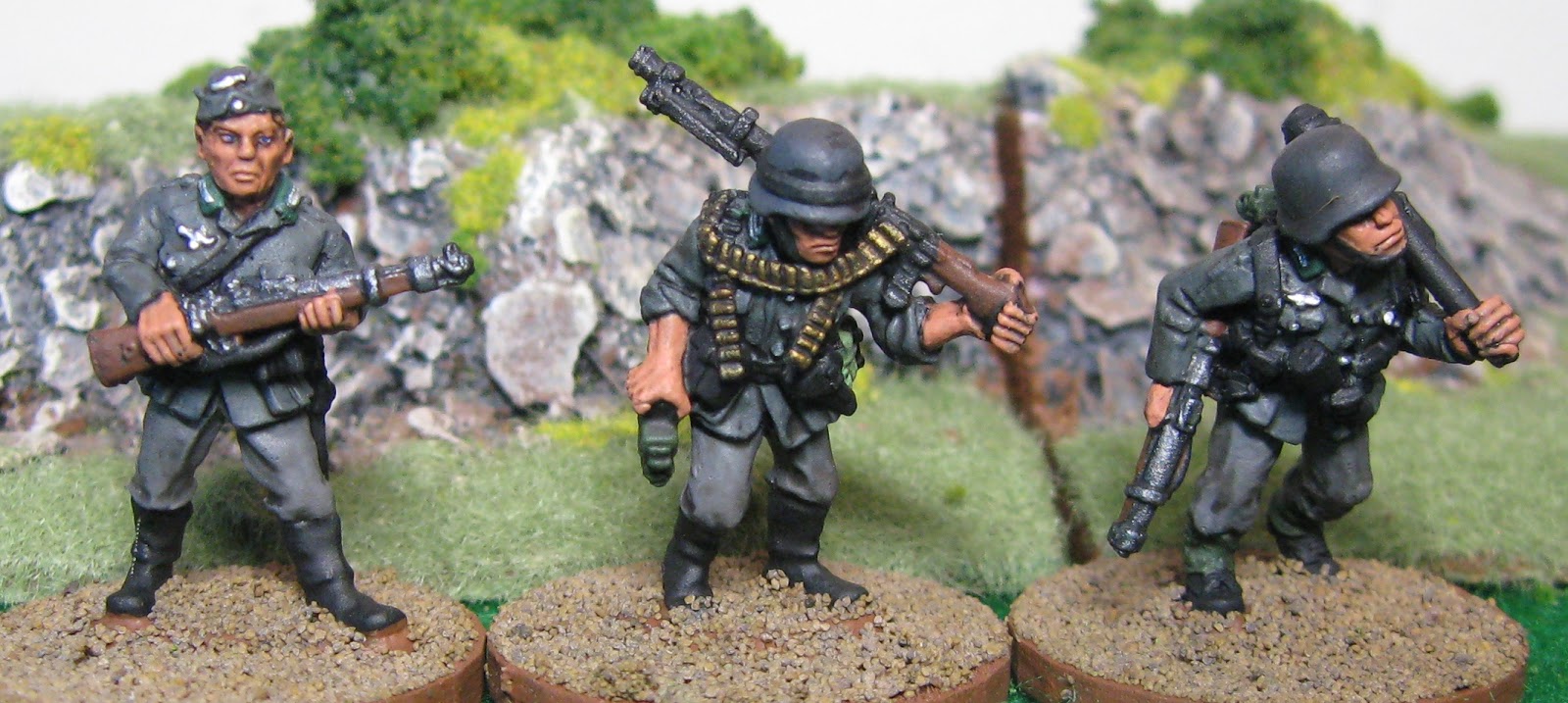
Making it off the painting table are a dozen Black Tree Designs' WWII German infantry.  These 12 figures include a mix of riflemen, SMGs, and LMG.
BTD Germans are an easy on the eyes diversion from more intricate, 15mm figures such as Napoleonics or SYW.  I have been enjoying the slow build of this project and I have more than enough British and Germans for a small game.  My plan is to game at a 1:1 level but rules still elude me.  Perhaps, some derivative of the western gunfight rules, The Rules With No Name (TRWNN) would work?  I recently downloaded Leahy's Company Commander from the Yahoo group but have yet to read through the rules.  Company Commander is geared towards 1:1 fights so it fits the game level.  Using CC over TRWNN would eliminate the need to convert/create rules mechanisms from scratch.  I like that idea.

Below are close up photos of threesomes from the 12 figures shown in the above group photo.   


Saturday, November 3, 2012

Kevin's WIP: Hill Fort

At the conclusion of my Command and Colors' Zama games with Kevin last Saturday,  Kevin took me down to his workshop to show-off his latest creation.  Kevin enjoys building custom terrain layouts and the large piece on the workbench shows his knack for building interesting pieces.  While I believe he may have plans to use this fort in northern Africa, I could see this as a perfect Afghan hill fort from which to launch raids upon the invading English (or Russians).  Many similar hill forts are described in both Anderson's The Afghan War and Robson's Road to Kabul.  Very handsome and imaginative game focal point.  Sized to fit 25/28mm figures.  Now this is a work-in-progress but I would be happy to use this piece in its unfinished state shown in the photos below.   


Friday, November 2, 2012

Projects Update and Command and Colors

I joined Kevin on Saturday for an impromptu game of Command and Colors Ancients using my 6mm figures.  With only a couple of free hours, we completed two games of Zama. Kevin commanded the Carthaginians in both games. As a refresher, below is a photo of the Zama battlefield laid out on the game map.


In game one, the Romans began the game with a line command moving all infantry forward towards the Carthaginians.  In response, the Carthaginians led an attack with their elephants.  As we've seen in prior games, the elephants suffered great losses by splitting attacks against both medium and light troops.  With elephants reeling, Rome pressed the attack on the wings and managed to compromise both Carthaginian flanks.  Rome won the battle 8-3.

In game two, the game began similarly to game one with the exception that the Carthaginian cavalry were much more effective against Roman cavalry.  After neutralizing Roman cavalry, Carthage played a succession of Center command cards allowing heavy infantry to advance into the van of the army.  Although trailing in banners, Kevin pushed his heavy foot into contact with the Roman medium foot.  With an attached leader, the heavy foot was able to destroy two foot units over each of the next two turns.  Carthage won this confrontation 8-6.

15mm Second Italian War of Independence Project:
Progress continues with the 1859 project with two units being completed in October.  Actually, base flocking wasn't completed until 01 NOV but I am counting both into the OCT painting totals.

First up are 24 figures for the Sardinian 9th Line Regiment.  Each base represents one battalion and these two bases muster out as the 3rd and 4th battalions.  Figures are  Mirliton in advancing pose.


These two battalions complete the 9th line regiment and join battalions 1 and 2.  Like battalions 3 and 4, the first two battalions are also Mirliton Italians, advancing.  For those taking notes, I know that only the 2nd battalion of Sardinian line regiments carried colors but I prefer to give each battalion a flag.  The 9th line is found in the Regina infantry brigade under Cialdini.

Second up are four squadrons of Austrian dragoon regiment, Kaiser Franz Joseph (KFJ).  The KFJ dragoons were part of the Holstein cavalry brigade under Mensdorff's reserve division cavalry division.


 On the painting table are six Austrian guns with four crew each.  These artillery pieces will be tackled after I finish work on a dozen BTD WWII Germans.  An effort is being made to sort through a number of bags of figures (both Old Glory and Mirliton) and apply primer to enough figures to finish 2012 with an emphasis on the 1859 project.

Fresh off the boat from a Chinese vendor is the Osprey Essential History of the Second War of Italian Unification 1859-1861.  Initial scan suggests that this volume contains an overall history of the conflict with brief battle reports on Magenta, Solferino, and San Martino.    

Monday, October 29, 2012

Review: Thomas' Wargaming 19th Century Europe

Neil Thomas' WARGAMING NINETEENTH CENTURY EUROPE 1815-1878

Having an interest in 19th Century warfare in general and the Second Italian War of Independence in particular, I recently bought Thomas' book.  Wargaming 19th Century Europe is my first Thomas wargaming book so I didn't know what to expect.  Existing reviews are lacking the detail needed to make an informed decision but I plunged ahead anyway on the road to discovery.

Although the book covers a wide span of history (some might argue too large since weapons and tactics evolved throughout this period), Thomas justifies his position by reminding the reader that the mindset of commanders during this period remained practically unchanged.  That is, commanders continued employing Napoleonic tactics over this 60-year span.  This same argument could be made for the American Civil War as well.  

Thomas provides a comprehensive examination from a wargaming perspective.  Thomas breaks the book into a number of manageable chunks.  These components include sections on:
  • Historical background
  • Design notes
  • Wargame rules
  • Generic scenarios
  • Army lists
  • Historical scenarios
  • Appendices listing bibliography, scales and figure discussion, and wargame related vendors
The rules, themselves, only take up eight pages and cover,
  • Units and Formations
  • Basing
  • Sequence of Play
  • Changes of Formation
  • The Charge Sequence
  • Movement
  • Firing
  • Hand-to-Hand Combat
  • Morale
The rules' mechanisms lean decidedly towards the simple end of the wargame complexity scale and Thomas defends this approach throughout his design notes chapter (entitled, Nineteenth-Century Wargaming).  Thomas emphasizes the "simple" rules' design approach to allow players to focus on the game rather than the rules.  The rules have no specified time or figure scale. 

All units of the same type are the same size regardless of historical doctrine.  Unit size is,
  • Infantry - four bases
  • Skirmishers - two bases
  • Cavalry and Dragoons - four bases
  • Artillery - one base
Basing guidelines are provided but any basing scheme should work as long as both combatants are based similarly.  

One interesting step in the Sequence of Play is that formation change is a separate step and that infantry may not move in line.  The result is that infantry may only charge to contact while in column.  Only infantry and artillery may change formation.

In the Charge Sequence, Thomas provides a matrix for easily determining whether a charging unit may contact a defending unit.  Conditional charges are allowed provided that the charging unit outnumbers the target.  If attacked frontally, defenders may fire at the attacker before hand-to-hand combat is resolved.  

In the Fire Phase, firing units throw a number of dice per stand dependent upon unit type (rate of fire).  Ranges are singular per weapon type with the exception that smoothbore guns have both a short and long range, and skirmishers add 8cm to weapons' range.  Hits are cross-referenced with respect to firing unit and target.  For example, an infantry unit firing in line against an infantry in close order line needs 4-6 on each D6 to score one hit.  Each base may take four hits before removing one base.  Saving throws are allowed for provided the target unit is either in cover (woods or towns) or armed with breechloading weapons.  The rationale for the breechloading saving throw is to model the tendency for breechloading armed troops to "go to ground" when under heavy fire.     

In Hand-to-Hand Combat Phase, each unit totals the number of dice it throws against its opponent with each stand receiving a set number of dice dependent upon the attacking and defending unit types.  Like fire, saving throws are allowed for units in woods or towns.  The side taking the largest number of hits retreats after Hand-to-Hand. 

During the Morale Phase, only three conditions trigger a morale test.  These conditions are:
  • Losing a base through fire combat
  • Charging cavalry takes fire from defending target
  • Losing Hand-to-Hand combat
Notice that in the case of a cavalry charge, the defender does not necessarily have to cause casualties to trigger this morale test.  Thomas argues that the process of taking fire during a cavalry charge was often enough to cause 'extreme' disorder within the charging cavalry's ranks.  Units are rated in five distinct morale classifications.  These are, 
  • Fanatic
  • Elite
  • Average
  • Levy
  • Rabble
with each classification given a set range of values on 1D6 for passing the morale test.  Fanatics fail only a on a roll of '1' while Rabble fail on any roll other than a '6'.

To me, the most interesting portion of Thomas' book is contained in his design notes in chapter 2.  This chapter allows the reader insight into Thomas' rationale for designing the rules as written.  Some thought provoking ideas are surfaced within and prompts me to consider some of my own gaming designs.  Thomas' rules definitely possess the flavor of classic, Old School wargames as handed down from the pioneers of Featherstone, Grant, Wesencraft, and Morschauser.

Thursday, October 25, 2012

Battle of Cedar Mountain Walk

A brief photo journal of a visit to the Cedar Mountain battlefield


Although the battlefield of Cedar Mountain (09Aug1862) remains mostly as it was at the time of the battle, it has not been preserved as some of the better recognized ACW battlefields.  The battlefield remains largely in private hands and a farming complex occupies the Federal lines along the old Mitchell Station Road.

An aerial view of the main Federal attack shows the major features of the battlefield including "The Gate" and the wheatfield.


As seen from Google Earth, the farming complex is plopped in the middle of the battlefield.  At the time of the battle, the James Madison Highway was not present and, thus, did not bisect the battlefield.

"The Gate" closed off the Crittenden Lane (today SR657) from the Old Culpeper Road (General Winder Rd).  The Old Culpeper Road would have continued east along the rail fence.  The photo below is taken where the 1862 gate would have barricaded the Crittenden Lane.


Another view of the Old Culpeper Road looking east out across the wheatfield towards Federal lines.

From The Gate, the Crittenden Lane heads south towards the Crittenden farm.  Along this line, Confederate batteries were deployed.

A second view of the treeline along Crittenden Lane to the intersection with James Madison Highway.  Confederate artillery and Taliaferro's brigade were deployed along this line.  Photo from the wheatfield looking southwest.

Standing just outside the rail fence line looking south, Cedar Mountain can be seen in the distance.  Ewell's artillery was deployed on the shelf and Crittenden farm is seen at the base of Cedar Mountain.  Augur's division attacked across this field (then in corn) from left to right towards Crittenden Lane.


Garnett's brigade deployed on the western edge of the wheatfield in the woods.  The photo below shows the right of Garnett's position, forming line north, perpendicular to the Old Culpeper Road.

The view from Garnett's position looking east across the wheatfield.


Crawford attacked across the wheatfield from right to left up this undulation before seeing the Confederate line held by Garnett.

Cresting the undulation, Crawford's men would have been faced with Garnett's position at the treeline.

On Crawford's right, Gordon attacked out of the woods towards Confederate lines.


Finally, a few regimental markers are scattered around the wheatfield.  The main grouping of Federal markers is near the eastern boundary of the wheatfield.

These set of historical markers commemorate the 7th Ohio, 66 Ohio, 109 Penn, Best's artillery, and the 1st Penn Cavalry.  Information suggests that markers are placed near where the units deployed but these infantry were under Augur.  Augur's division attacked out of the cornfield to the south and not in the wheatfield.  I wonder if these markers were moved from their original cornfield placements into the wheatfield for preservation purposes? 

Below is the "Stonewall" marker although I do not remember where this marker was located.  Does this mark the Stonewall brigade or Jackson, himself?  


Following the battle, a number of hastily buried dead were exhumed and moved to the National Cemetery in Culpeper.