This weekend past saw a return of Commands & Colors Ancients (CCA) in 6mm with a LIVE opponent! That's right. I managed a F2F game of CCA after many months of no in-person gaming. A major milestone, I think. I set the game up outside on the patio table in the evening shade of the house.
The battle fought was Pharsalus, a contest between Caesar and Pompey in 48 BCE during the Roman Civil Wars. Since the historical battle was fought on 09 August, the game this weekend represented an "anniversary edition" of the famous contest.
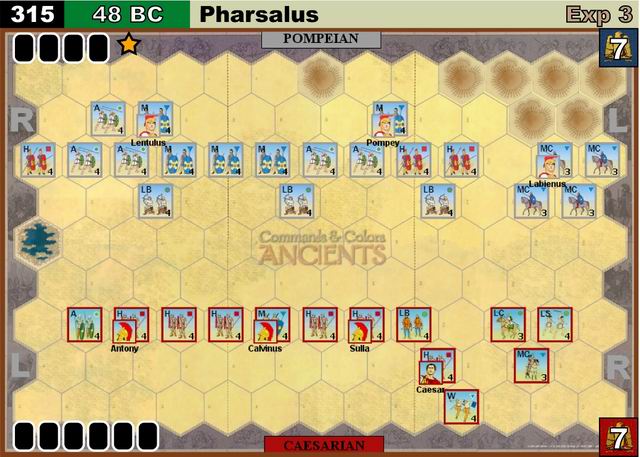
The battle deployment using the CCA scenario is illustrated below with Caesar's army at the bottom and Pompey's army at the top. Each side requires seven banners to win. Pompey holds four Command Cards while Caesar holds six. Pompey moves first. The Julian Legions Rule is in effect for both armies. This rule allows Medium and Heavy infantry to conduct ranged combat. Also, the Julius Caesar Rule is in effect allowing a unit attached to Caesar extra capabilities.
 |
CCA version of Pharsalus
|
My version of the battle deployments converted to 6mm figures rather than blocks is shown below:Kevin chose to command the Caesarians and we launched into battle.
My Pompeian battle plan was grounded on the notion that the Pompeians hold a numerical and qualitative superiority in cavalry on the Pompeian left. I would try to overwhelm the Roman cavalry on the Roman right, expose that flank, and then roll up the Roman line. I would need to accomplish this task before Caesar's superior Heavy infantry defeated the Pompeian Medium infantry.
One note on the troops differentiation between the Caesarians and Pompeians. Caesar's legions were superior to the Pompeian legions. To account for this qualitative difference, the game assigns most of the Caesarian infantry as Heavy and the Pompeians are mostly rated as Medium. In game terms, Caesar's infantry battle with five dice while the Pompeians will battle with four dice. This is an effective and simple way to distinguish troop quality. Neat.
Back to the game. This seemed a reasonable plan until I drew my four Command Cards. None of the cards drawn were applicable for the Pompeian cavalry wing. OK. Toss that plan out and begin an advance on the Pompeian right since I had at least two cards for that sector. Perhaps I could launch a cavalry attack later? Well, that was not to be. At no time during the battle did the Pompeians draw a card that would activate their cavalry wing. Rats.
What Pompey did was to attack on the right with great force. Caesar lost a unit or two and then fell back having suffered heavy casualties in that sector. Pompey pressed on. While Caesar fell back on his left, he advanced in the center leading from the front when required. Units were exchanged during this phase of the battle but Pompey managed to break the Roman left. The banner count at mid-game was 6-4 to Pompey. Leading from the front, Caesar with a heavy infantry legion struck into the Pompeian center. Two Pompeian legions fell in quick succession. The Pompeian center was in shambles. With banner count tied 6-6, Pompey attacked a weakened legion near the Roman base line destroying it for the win, 7-6. A very close contest that went down to the final banner.
At the end of the battle, the field looked like this:
 |
End of Game
|
This was a very fun contest and a real pleasure to game again against a live opponent. A very bloody affair; over in about 45 minutes. Caesar will expect a rematch.