|
| Battle of Oswegatchie from Gridded Wargames |
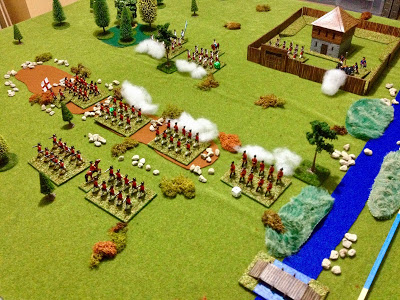
With the severe mauling of the French at the battle of Oswegatchie and the death of Rigaud from wounds suffered during the battle, the remnants of Rigaud's force retreat into the woods. Unfortunately, the militia having sustained heavy casualties have had enough and disband. For details on this hot engagement, please visit Peter's Gridded Wargames, FIW Campaign Game 20.
Still reeling from the heavy losses at Oswegatchie, the French choose to roll on the Command Table to set their forces into motion. The result? No French activations! A band of Algonquin join the French cause and move to join the retreating Regulars from Oswegatchie but no French forces respond. The loss of Rigaud and Oswegatchie must have been a hard blow for the French. A hasty retreat back to Montreal seems the only option for the defeated survivors of Rigaud's force.
 |
| Heavy French losses at Oswegatchie |
The loss of any French activations provides the British with a chance to take a double move. The British could play it safely and opt for a guaranteed single activation or choose to roll on the Command Table. The British choose the latter and roll three activations for June.
 |
| British maneuvers in June |
With Braddock threatening Fort Niagara in the west, Amherst blocking any attempts to gain access to the Mohawk Valley at Fort Stanwix, Fort Isle aux Noix under threat, and both Quebec and Montreal under British control, the French government sees the writing on the wall and seeks terms of surrender. Of course, the British accept. The war is over.
Well! This campaign game has yielded much more enjoyment and many more interesting battles than I imagined when first conceived back in February. In February, I never expected the campaign to command six months activity. In that time, Peter has fought 20 battles on his gridded gaming table while the operational situations were conjured up by me using Rob Markham's DTP game, Montcalm & Wolfe. While I became very familiar with Markham's operational design, Peter honed his own gridded, tactical rules. I enjoyed seeing Peter's rules evolve over the course of the campaign. Seeing his troops battle it out on the table was always a joy.
What began as a response to Peter's desire for campaign context for his gridded battles, this Montcalm & Wolfe campaign blossomed to develop an interesting and captivating narrative punctuated by Peter's tabletop battles. While the campaign would draw up the forces and location for each battle, Peter crafted the terrain and tactical situation to reflect the context of the campaign. Sometimes the battle outcome was expected; sometimes it was not.
Montcalm & Wolfe presents difficult challenges for the campaigner. Due the nature of the terrain and harsh attrition rules, movement is channeled through only a few corridors protected by forts within one month's march. Those few corridors such as the Mohawk and Hudson Valley drainages saw much action during the campaign. How many times were battles fought over Forts William-Henry, Stanwix, or Oswego? Many! Those landscapes became quite familiar territory to the follower of this campaign as the reader was treated to Peter's tabletop renditions of the terrain.
The French have a difficult time in Montcalm & Wolfe. A war of attrition cannot be won with the uneven reinforcement schedule. To do well, the French must strike early and often before British troops begin pouring into America. When the balance of power changes, the French must adapt quickly. Having played through one complete campaign game, I have a very good feel for the play and design of Markham's game. Perhaps a review and thoughts on the game, itself, will follow at a later time?
Until then, tremendous thanks go out to Peter for diligently tackling every battle thrown up against him. His battle resolution gave an extra dimension to the game and added tension as I awaited publication of each battle's outcome. Twenty games played out on the table for a campaign is a feat not easily duplicated. Peter, I hope you enjoyed this experiment as much as I. Chapeau to you!
Montcalm & Wolfe presents difficult challenges for the campaigner. Due the nature of the terrain and harsh attrition rules, movement is channeled through only a few corridors protected by forts within one month's march. Those few corridors such as the Mohawk and Hudson Valley drainages saw much action during the campaign. How many times were battles fought over Forts William-Henry, Stanwix, or Oswego? Many! Those landscapes became quite familiar territory to the follower of this campaign as the reader was treated to Peter's tabletop renditions of the terrain.
The French have a difficult time in Montcalm & Wolfe. A war of attrition cannot be won with the uneven reinforcement schedule. To do well, the French must strike early and often before British troops begin pouring into America. When the balance of power changes, the French must adapt quickly. Having played through one complete campaign game, I have a very good feel for the play and design of Markham's game. Perhaps a review and thoughts on the game, itself, will follow at a later time?
Until then, tremendous thanks go out to Peter for diligently tackling every battle thrown up against him. His battle resolution gave an extra dimension to the game and added tension as I awaited publication of each battle's outcome. Twenty games played out on the table for a campaign is a feat not easily duplicated. Peter, I hope you enjoyed this experiment as much as I. Chapeau to you!