Showing posts with label Events. Show all posts

Wednesday, October 18, 2023

Thoughts on Re-Fighting History: War in the East

Had I read Dr. Jeremy Best’s bio more closely (see Re-Fighting History), I may have been better prepared for his presentation.  Maybe not.  Actually, re-reading the presentation description and the author’s bio after the webinar, the topic and direction of the presentation become very clear.  Hindsight, as they say, is 20/20.
copyright Dr. Jeremy Best
GUWS 17OCT2023
Dr. Best’s (hereafter “Jeremy”) thesis is concise.  That is, wargames, for all their efforts at accurate simulation, often fail as history.  The focal point for this conclusion is a study of operational wargames on the Eastern Front in 1941.  Now, I picked up a number of parallel themes throughout the presentation including thoughts on game narrative and uncertainty but will try to contain this post to “games as history”.  Well, specifically, Eastern Front wargames as history.

While the topic may be as complex as some of the wargames under study, I make an attempt at summarizing, condensing, and encapsulating some of the key takeaways (of course, in my opinion) of this presentation.  As is often the case, my thoughts raise more questions than answers.
copyright Dr. Jeremy Best
GUWS 17OCT2023
With a focus on WWII operational combat, a selection of wargames with Kiev as the subject are presented.  The games cover nearly forty years of wargames’ development.  Jeremy notes that game innovation relies more upon mechanism evolution over content.  Has content really seen no innovation in forty years?  I reckon much more information and a better understanding of the combatants have surfaced over these intervening years.  Perceptions change with time.  “Facts” as we knew them may have changed as well.
copyright Dr. Jeremy Best
GUWS 17OCT2023
Keeping focus on Eastern Front wargames, two critiques of these games as flawed history are discussed.  One is that warfare is sanitized in wargames. The other is that Eastern Front wargames emphasize the Clean Wehrmacht Myth.  Jeremy argues that these games are flawed because all historical actions are not included.  He cites the Holocaust as an omission in player decision-making cycle. Similarly, the use of Security units in some games diverts these units from their historical, anti-partisan role to the front for use as second line troops.  Does the absence of these actions in a game help to reduce German complicity?  Do wargames fail as history intentionally?

Beginning with the origins of modern wargaming in the 1950s following the conclusion of WWII, is there a connection between the start of the Cold War and wargaming in general (and wargaming WWII on the Eastern Front, specifically)?  Jeremy hints that the two are not unrelated.  Given the move of German scientists to the US via Operation Paperclip and the desire to rearm West Germany, perhaps a connection exists.

On a larger scale, games are often guided by historical benchmarks and objectives.  Having hindsight from a historical perspective, a player knows what worked and what did not work.  This knowledge can affect the games' outcome.  Knowledge can also promote history-altering consequences.  Special game rules further reinforce historical dictates to drive the narrative.  Game play and history, simultaneously, intersect and diverge in wargames.

copyright Dr. Jeremy Best
GUWS 17OCT2023
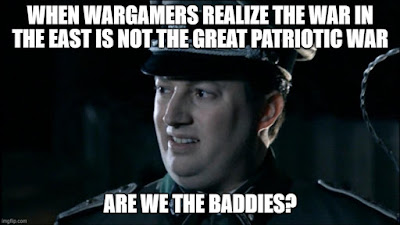
Does a German-centric bias exist in Eastern Front wargames?  It is only the “Eastern Front” to the German Army.  Same applies to naming wargames, “War in the East” or the German operation codename.  Note my meme in the header asks this question.  Jeremy provided a number of game examples whereby a player may get that impression.  Eastern Front maps are labeled in German and much of the accompanying game artwork and imagery focuses on the German Army.

What does it mean to play these games?  If game designs make claims and arguments on only a subset of the war, do these games, then, become an ideological tool?  What do I learn about the world from playing these games?  What does it mean to “want” the Germans to win?

Returning to Jeremy’s thesis, game designs can produce blind spots in their models.  Jeremy highlights some of the possible consequences of such inaccuracies.  Does this automatically lead to a breakdown of wargames, specifically, and understanding warfare, generally?

Are wargames ideological tools?

Tuesday, October 17, 2023

Re-Fighting History: WWII, Boardgames, and War in the East

Georgetown University Wargaming Society (Washington DC) offers a regular series of webinars on different facets of wargaming, military history, wargame design, and assorted other topics.  The quality of the presentations and topics run the gamut of my interest level and attention span.  Tuesday's offering looks especially inviting to me with a focus on the War in the East in WWII.  With the cover of the boardgame Drang Nach Osten! (DNO later reimplemented by Fire in the Eastin the event announcement, will GDW/GRD's Europa series of boardgames be included for discussion?  Perhaps Dr. Best will identify the WWII boardgame(s) that meet the military simulation threshold on value-added as effective simulation tools.  Perhaps none reach this threshold.  Can this discussion and evaluation of WWII boardgames as a simulation value be generalized to other periods and other games?  What about extending to miniature Wargaming?  I look forward to seeing what topics are in store and discovering if any boardgames meet this threshold. 
Description
Jeremy Best will challenge the efficacy of military boardgames as accurate representations of historical conflict.  In his webinar, Dr. Jeremy Best will present early conclusions from his research into the history of military boardgames, the memory of World War II, and the limitations of military simulations for understanding war. The first modern military boardgames emerged in the late 1950s and from the very beginning the war between Nazi Germany and the Soviet Union took center stage. Hundreds of games, thousands of scenarios have been produced – all of them claiming and aspiring to authentically recreate historical conditions. Part of the appeal of these games was that in re-fighting the battles, campaigns, even entire war players could rewrite that history. For all their efforts at accurate simulation, these games often fail as history. In the webinar, Dr. Best will discuss the ways in which games represent the Eastern Front, the blindspots of these representations, and the possible consequences of such inaccuracies. More generally, these insights lead to certain questions about the efficacy of wargames in general for understanding warfare.
 
Bio  
Jeremy Best is an associate professor of modern Europe at Iowa State University with a specific interest in the cultural history of Germany during the nineteenth and twentieth centuries. His current research project is a manuscript in development tentatively titled “Toy Soldiering: West German Rearmament, the Holocaust, and the United States” on the history of tabletop wargaming, Holocaust memory, and the perpetuation of the Clean Wehrmacht Myth in America and West Germany. Heavenly Fatherland: German Missionary Culture in the Age of Empire, his first book, was published by the University of Toronto Press in 2021. That book won the Phi Alpha Theta Best First Book Prize in 2021, was named one of “Ten Outstanding Books in Mission Studies, Intercultural Theology, and World Christianity for 2021” by the International Bulletin of Mission Research, and named to the shortlist for the 2022 Waterloo Center for German Studies Book Prize. In addition to his academic work, Professor Best has worked as a public-facing historian publishing in The Washington Post, The History News Network, and Perspectives on History.
If interested but cannot make this event, GU Wargaming Society content is usually published to YouTube following the event.