Showing posts with label Ramblings. Show all posts

Saturday, May 2, 2026

Battlefield Lull

While it has been a busy week, not a tremendous amount of progress on the hobby front.  With nature throwing a switch, temperatures have climbed dramatically in the last week.  What that sudden change in atmosphere triggers is that my workload flips from indoor activities to outdoor activities.  Yardwork jumps to the fore as the garden and lawn spring back to life.  Infrastructure such as sprinkler systems and lawn maintenance equipment need adjusting and a general clean-up is required after putting everything away back in October and forgetting about it.  Cycling back on the roads is seeing a marked increase as well as I test out both body and bike for the upcoming campaigning season.  With that shift in direction, wargaming has seen a bit of a lull. 
Heavy fighting at Casteggio
There was one game on the week's docket.  That remote game, on Tuesday, saw a four-player refight of Montebello.  Tuesday's Montebello witnessed the fourth playing of the scenario, and it was another good one.  With experience from the previous three games and having increased player numbers, I figured the battle might be fought in two sessions.  Well, we managed to fight to conclusion in one long four-and-a-half-hour session.  Everyone was likely exhausted after that mini marathon.  The fellas in England certainly endured a late night.  I finished curating the game photos this morning.  Hopefully, I can sit down and tap out a battle report in the coming days.
On the painting desk, I did manage to produce a second Russian infantry regiment of two battalions for the 1799 project.  Like the Russian regiment produced earlier, these figures are AB Miniatures.
These two, thirteen figure battalions march out as Musketeer Regiment Dalheim.  As expected, the AB sculpts are marvelous.  On the painting desk is a third Russian regiment.  The third regiment will muster out as a grenadier regiment with its short mitre hats.
Painting output was down in April compared against the first three months of the year.  Without going back to painting seasonality analysis and tendencies, I suspect that seeing a drop in April is normal.  We will see if painting ticks up in May.

The lead photo captures a snapshot during the Montebello game with the French attack on Casteggio in the foreground and the detritus of the game room in the background.  The large screen in the background monitors the game in session.

Tuesday, April 7, 2026

Big Round Numbers and Reflection


Easter Sunday witnessed the PWJ tick past two mileposts.  One is meaningful, the other not so much.  The first, and less important milepost was that the blog saw over 100,000 page views in one day.  In the early days of blogging, this achievement might be hailed with much fanfare.  Today, with AI dominating search and consumption, 100,000 page views in one day does not carry the same weight.  The other, and more important milestone is that the blog surpassed 60,000 comments.  Yes, I realize that half of the commentary is mine, but reader commentary is an important if not vital aspect of sharing the hobby.
Blogger stats: 06 APR 2026
When I publish a new post, whether a battle report, an analysis, or photos from my latest unit marching out from the painting desk, I never quite know how it will land.  While I write primarily to record my thoughts and achievements, I also write to share the wargaming hobby that has fascinated me for most of my life.  Once I click "publish," there’s a pause and, often, a little apprehension.  Will anyone care enough to read let alone respond with a comment?  When a comment appears, I breathe a sigh of relief.

For a wargamer, blogging is often a solitary pursuit that mirrors the hobby itself. We spend long nights painting miniatures, building terrain, or researching obscure campaigns to create scenarios or rules.  From a personal perspective, these are satisfying efforts.  This type of self-exploration, while satisfying, is shaped by appreciation and dialog.  The byline on my blog bio states that,

It is not enough to accomplish. You must share those accomplishments.

Reader comments help turn this solitary focus outward.  When a reader writes "the figures look great" or "Great battle report," these comments remind me that the hours of effort are not only just mine.  The blog allows these efforts to become something shared.

Besides turning a mostly solitary activity outward, comments deepen a sense of community.  Wargaming may center on fighting battles in miniature, but through blogging, conversations turn toward tactics, history, craftsmanship, and battles won and lost.  The comment section becomes a virtual battlefield of ideas through a mutual respect for the hobby.

To me, every comment is like adding another painted figure into a collection.  The comment may be small and unique, but a single comment is important to the overall goal.  Each comment builds momentum as others weigh-in turning a collection of posts into an ongoing campaign of thought and dialog.  Without these responses and feedback, blogging can start to feel like a battle dispatch sent off into a destination not known.

I suggest that we keep in mind that when a reader takes the time to type a few words in response to a post, that even a simple response can carry more meaning than the reader might realize.  These responses remind me why I write.  I write not only to post battle reports or document progress at the painting desk.  I write to connect with others who find the same joy in miniature armies and tabletop exploits on the field of battle.  In a sense, each comment carries the same power as a post-game handshake across the table after a hard-fought game.  In a comment, you share acknowledgment, camaraderie, and respect.

I mark this occasion as a way to thank everyone who has mustered the courage to leave a comment or two over these first 60,000 comments.


Thank you.

Thursday, March 26, 2026

Thoughts on Montebello

All is quiet on the battlefield of Montebello.  In fact, the table has been dormant for the past two weeks with no activity at all.  Well, besides figures and sorting projects piling up on it.  That will soon change, though.  Richard has agreed to a rematch from our earlier game (see No Duke of Montebello).  For the next episode, we will swap sides and refight the battle from a different perspective.
Birdseye view of battlefield.
Before that game hits the table, time for a little reflection on the battle, its historical counterpart, and the rules.

Looking back at the battle report linked above, the game offered a tense battle as the French Army under Lannes scraped out a dramatic last‑minute victory.

Game Recap
Against the odds, Watrin’s French division assaults O’Reilly’s advanced position at Rivalta through the tall rye fields surrounding the village.  Initial attacks are repulsed, but repeated assaults eventually break O’Reilly after brutal fighting south and north of the village.  The Austrian jaegers are finally compelled to give up their defense of Rivalta.  As the French push on to the west, Vogelsang brings up his reinforcements to Cascina il Giardina while Schellenberg reaches Montebello.  Ott tries to form a defensive line as the Austrian army falls back toward Casteggio.
Attack on Rivalta.
To the south of Rivalta, the 28th Line ejects Austrians from Cascina il Giardina after repeated attempts to take the strongpoint.  Lannes then leads his hussars in a devastating charge that destroys an Austrian infantry battalion and overruns a retiring battery.  Unfortunately, Lannes falls in the confusion.  The Austrians are not done yet.
Lannes leads the charge!
Austrian dragoons countercharge and scatter the depleted French cavalry.  Seemingly out of nowhere, a third hussar unit strikes unsupported Austrian infantry.  With the combat raging and both formations on the brink of collapse, the Austrian infantry are scattered and Vogelsang's Division breaks.  With O'Reilly and Vogelsang broken, Ott is compelled to quit the field.  Lannes gains victory with a razor-thin margin.  It could have tipped the other way.
The destruction of Vogelsang.
Post-Game Thoughts
Montebello offers challenges to both players and scenario design.  With both armies arriving piecemeal and a tight timeline to clear the highway, the French are forced into attacking at unfavorable odds.  When Watrin first attacks Rivalta, the defenders hold about a two-to-one advantage.  As the fighting builds with fresh reinforcements reaching the field, the battle emphasizes a measurable quality‑versus‑quantity dynamic as well as trading space for time.  A situation that Ott and Lannes, themselves, faced.  Players faced the same conundrum.  That is, how best to utilize the forces at hand.

With Lannes' qualitative advantage and ability to pick and choose the place and timing of attacks, as Ott, I fell into a similar trap.  When Watrin's initial attacks were repulsed, O'Reilly made the decision to stand and fight at Rivalta.  Only as more French reached the battlefield did he realize his mistake.  By the time Vogelsang approached from the west, it was too late for O'Reilly.  His formation was wrecked and in retreat everywhere.  Vogelsang tried to bring his division up and hold Cascina il Giardina but that stronghold could not be held after repeated attacks.  In the vicious fighting around that stronghold, Vogelsang's Division was wrecked.  With two of his three formations broken, Ott was forced to yield the field of battle.

The flow of the tabletop battle broadly followed the historical battle.  While the fighting may have played out with variation, the end result was the same.  That is, Ott's command was forced to retire from Montebello and head back to Alessandria to lick its wounds.  Five days later fighting would resume at Marengo.

Now, scenario design and often rules' writing remain as works-in-progress.  This refight offers similar thoughts on amending scenario details.  Having realized the historical result in the first outing, how much really needs to be tweaked?  While Victor/Chamberlhac played a role in turning the battle historically, in this playing Chamberlhac barely reached the field.  Same can be said for Schellenberg on the Austrian side.  
Schellenberg arrives.
While providing a good-sized game for two players, Montebello presents a more difficult path for multiplayer games since reinforcements arrive throughout the game.  This might lead to players not getting into the action right away.  Meeting engagements offer unique challenges for multiplayer games.  To steer the game toward this end, the next refight will see game duration lengthened from 8+ turns to 10+ turns while unit arrival times will see some compression.  The caveat, here, is that reinforcement compression may alter the already finely balanced arrivals to match the historical situation.  Do you come down on the side of history or player engagement?  Should arrival times be adjusted based upon the number of players present?  That is, keep historical times in a two or three player game but compress arrivals for larger multiplayer games so that everyone is involved within a turn or two?

Before I take command of the French Army in the next game, there is much to consider.

Monday, March 16, 2026

Wargaming as an Escape

Keith Flint, in his Wargames, Soldiers, and Strategy #137 essay on wargaming as an escape (see WSS#137 Let's Escape pp 62-63) offers an interesting perspective covering several topics.  Some of his brief thoughts on this topic can be read on his blog at In Which I Became a Global Influencer.

To briefly summarize the escapism portion of Keith's essay, Keith highlights a quote that he has heard from wargamers that,

Wargaming allows me to escape everyday life, and it allows me to be someone else for a while.

Now, I have never heard anyone utter similar words and if they did, I would take such claim in a figurative and not a literal context.

Given this statement's literal weighting, Keith argues that we should reject the notion of hobby escapism that allows one to step away from everyday stresses, work, or reality.  Keith posits that this thinking is misguided since one cannot truly escape the real world.  The wargaming hobby is an extension of the real world and an extension of who we are.  Framing the hobby as an escape tends to discredit both daily life and the hobby.  A more wholesome approach is to view hobby time as a constructive shift between different and complementary aspects of life.

How does this tie back to the Great Wargaming Survey?

In an earlier analysis, I examined the question of why we wargame.  In Why We Wargame: A Closer Look, survey results show that when the top three choices are aggregated across all respondents that "Fun and escapism" contributes only about 13% of the top choices. "Fun and escapism" comes in at Rank #5 of 7.
Figure 1
Figure 2
Now, "escapism" is lumped in with "fun" so separating the two is impossible from the 2025 survey.  If this question is asked again, perhaps, "fun" and "escapism" ought to be separated to identify those seeking escapism solely? 

A related question that examines the role of the hobby as an outlet for stress is present in the 2025 survey.  That question asks, 

Would you agree that wargaming helps you forget about the stresses of daily life?

The results are overwhelmingly one-sided.  Figure 3 illustrates that 62.1% of respondents entirely agree that wargaming helps forget about stresses of daily life.  Fully 93% either somewhat agree or entirely agree with this statement.
Figure 3
Rather than looking at the wargaming hobby as a literal escape, perhaps, wargaming ought to be viewed as a relaxing, constructive shift between our different aspects of life? I think Keith would agree. Keith, thank you for offering up some food for thought!

Do you view the hobby as an escape from real life?

Tuesday, January 20, 2026

On Wargaming and Blogging: Thinking Aloud

In Norm's 14 JAN 2026 post on his Commanders website, his essay Thinking Aloud and a Reduction in Output may strike a familiar chord with other bloggers.  The post certainly got me to thinking.  In Norm's diary entry linked to above, he offers a reflection on the value and sustainability of blogging within the wargaming community.  For those having followed Commanders and its sister blog, Battlefields & Warriors, these ruminations are not new.  Since neither site offers the ability to comment, I offer my thoughts on Norm's post here.

The recurring theme of Norm's Thinking Aloud post centers on the tension between pouring significant effort into creating thoughtful, detailed blog content and seeing minimal interaction or feedback in return.  This one-way communication leads to questioning whether maintaining a wargaming blog (two in Norm's case) continues to be worthwhile.  When compared against simply enjoying gaming without the increased overhead of writing about gaming, the answer to this question, to some, becomes clear.

This diary entry argues that blogging has evolved from simply a means of sharing our enthusiasm for wargaming into another hobby of blogging about wargaming. This sub-hobby demands time, energy, and emotional investment often without reciprocal engagement from readers.  This lack of encouragement may lead to a sense of fatigue and a recalibration of priorities.

Norm concludes that disillusionment about the current state is not the major driver of these reflections but one of reorientation.   Perhaps reorientation allows a reclamation of the undistracted joy of gaming, itself?  There may be times in which each of us asks similar questions.   The answers may be different for each of us, but the theme may rhyme.   Responses likely depend upon why we share our wargaming adventures through blogging and what motivates each of us to continue.

In the end, should wargaming be a private pleasure rather than a public performance?  Do you share Norm's concerns and frustrations?

The floor is open for discussion.

Sunday, January 4, 2026

What Have I Done?

I suppose I have held a lifelong interest in WWI aerial games.  Beginning with Milton Bradley's Dogfight in the '60s, play moved to The Avalon Hill Game Company's Richthofen's War in the '70s and '80s.

The '90s saw me take to the air with miniatures using Canvas Eagles (CE).  I have vague recollections of a campaign game or two using these rules besides many one-off contests.  Having played CE, who can ever forget the stat sheet for each aircraft?  We really played CE a lot and I began building models so that I could take to the air.  I only maintained a small assortment of 1/72nd kits but I was always on the lookout for more.

Aircraft stat sheet
Meikraft Models of a German Pfalz DIIIa
While Canvas Eagles remained a staple when games took to the air, the late 2000s saw playtesting of Watch Your Six.  I wonder whatever happened to that ruleset?  Even more models were purchased as opportunities arose but the pile of unbuilt kits was not so great.
OK, maybe I exaggerate a bit.  There were probably more models than realized once I began discovering bargains on eBay.  I even managed to buy small chunks of large collections.

By the time COVID disrupted everyone's lives in 2020, WWI aerial combat had transitioned to remote play with players from far-flung reaches of the globe.  A long-running campaign was fought using Richard Lindley's Knights of the Sky which was perfectly suited to remote play via Skype, Zoom, or Google Meet.  In one of these campaigns, my pilot made it all the way through the war only to be met with disaster on the last sortie of the war.  Curses!

All along the way of this journey, newly acquired unbuilt kits were added into the tubs in which these models were placed for storage.  By this time, there were two such large tubs.  Oh, and a few that would not fit.  Did I expect to build and see these kits in a game?  Of course.
Knights of the Sky via Skype
Baron von Freitag's last flight
Where does this rambling trip down Memory Lane lead?

Well, to gain a sense of the scale of the number of models tucked away, I brought the two tubs out of the storage room and emptied their contents out onto the gaming table.  Stacking them up in a quasi-sort by size and manufacturer, I made a count.
Plastic Pile of WWI Aircraft
Now, many of these models are long out of production.  Some go back to the '60s.  How many are there?  More than 140 kits.  Some of the kits have more than one model and were counted as one unless I could verify.  I noticed several bagged kits had more than one model.  Such an interesting assortment of planes and manufacturers.  I had no idea the size of this collection.

What have I done?  Well, bought more models than I can possibly build or use.  Will all of these models ever get built?  Almost certainly not by me.  One resolution for the New Year is to grab a model or two out of the pile and build it just to remember the joy (and frustration) of putting these kits together.  Who knows, perhaps I will take to the skies in 2026?  At least, all of these kits actually made it out onto the table.

Sunday, December 14, 2025

Journey v. Destination: Commentary

Curious to see the Paradox of Modern Wargaming post return to the Top 10 posts widget after having fallen off the leaderboard, I returned to the post for a refresher.

As a corollary to the tortoise and hare fable, I argue that modern miniature wargaming is caught in a paradox.  That is, wargamers invest huge amounts of time in painting, research, and terrain building, yet increasingly favor fast-play rules and shorter games that can play to conclusion in an hour or two.  The contrast between the long “journey” of preparation with the brief “destination” of modern game duration prompts a question.  That is, does an emphasis on speed and efficiency at the gaming table undermine the depth, narrative, and sense of accomplishment that typically justified all that effort?  Of course, this is a simplification, and both have a place in the hobby.

With more than two score of readers weighing in on the topic, I try to distill this collective wisdom, experience, and insight into a handful of common themes from the many, generous responses.  Taking up a tally sheet, I scored the responses.  A synopsis follows: 

Painting v. Gaming
I’ve noticed a bifurcation in how wargamers approach the hobby. Some clearly see painting as a means to an end. These gamers paint so they can play. They describe themselves as warGAMERS, not painters. Others admit that painting figures and building terrain are satisfying in their own right.  Even if an army never hits the table, there is still get plenty of joy from this facet of the hobby.  I reckon blogging feeds into that too.  Being able to share progress, swap tips, and show off completed projects gives painting its own reward separate from gaming.

Game Length and Complexity
The comments about game length are interesting.  Many of us remember those day‑long (or even multi‑day) games of the old days.  I have had many.  Now, most gamers seem to prefer games that wrap up in two to four hours.  Long enough to tell a story but not so long that they feel like slogging through mud. The sweet spot seems to be rules that flow naturally and don’t bury players under numerous tables and exhausting detail.  A few people pointed out how older “proper” rule sets rarely reached a satisfying finish, while modern abstract systems often feel just as plausible and more fun.  I tend to agree.

Skirmish, Scale, and “Realism”
The boom in skirmish and “big skirmish” games has been fascinating to watch develop.  These results are backed by results from the Great Wargaming Survey.  Some historical periods (Western gunfights, pulp, sci‑fi, modern small‑unit actions) fit this format perfectly. Others, like pike‑and‑shot, maybe not so much. On this topic, there is debate. Personally, I like the idea that “realism” doesn’t have to mean a simulation.  I do enjoy simulations, though.  If the outcomes are believable and the game captures the right flavor of a period, that’s good enough for me.

Time, Focus, and the Modern Hobby
The whole “declining attention span” theory gets thrown around a lot, but some (like Stew, Norm, and JWH) don’t buy it.  As several commenters pointed out, it’s more about life and time than attention.  Most of us, having gamed for decades, simply don’t have the same long afternoons we once did.  Well, until retirement, that is!  Shorter games fit better with real life.  I suspect those players craving detailed simulations may now find that level of detail in computer wargames.  On the tabletop, people seem more interested in enjoying each other’s company and finishing games with a sense of closure.

Variety, Choice, and the Future
If the hobby suffers from anything these days, it’s too much choice.  Every month brings new rules, new scales, and new shiny projects to distract us.  Yet, no one seems particularly worried about the future.  A few long‑time gamers said it flat‑out.  If we are enjoying ourselves now, that is what matters.  Whether historical miniature wargaming thrives beyond our generation isn’t the main concern.  Playing with the right people and finding pleasure and satisfaction in the process, whatever form that takes, is key.

Perhaps there is no paradox in this context at all but a nuanced and individual approach to wargaming.

Thanks to all for contributing your insights to my little study.

Monday, November 10, 2025

FPW Prussian Dragoons and Winter Prep

With frost on the ground in the mornings and daylight hours decreasing, time to really think about laying in a winter's supply of black, undercoated figured.  In between various winter prep tasks (actually, prepping and priming figures ought to be added to my list of tasks), the Ready-to-Paint (R2P) box saw a measurable increase in the number of units ready to paint.  The decision of what to prep for winter is always a bit challenging because I must come upon a plan.  This year, the winter theme seems to center around what collection was out on table last.  That would be the Reconquista.  With the recent Zallaqah game, a deep dig into The Lead Pile pulled up enough figures to field several units for both armies.  Do I need more?  Of course not!  Prepped and primed, these handfuls of figures nearly exhaust the tally of unpainted figures remaining in the bins.  Rough count points to about 75 figures plopped into the R2P box.  Also getting attention are several handfuls of figures to expand the Biblical collections.  Of course, some more FPW 15s are heading into the R2P box as are more 18th Century 15s.  The painting queue is getting quite long.
Besides laying in a supply of figures for winter, the painting desk saw some action this weekend too.  The first of these efforts is a 12-figure regiment of Prussian dragoons.  These fellows are from the 7th Dragoon Regiment. 
Figures are Old Glory from 19th Century Miniatures.  With December fast approaching, it is almost time for 19th Century's annual Christmas sale.  I better dig and sift through The Lead Pile to see what I may need to include in my annual restock.  In my recent excavation, I uncovered a number of figures, some from long lost, dormant, or forgotten projects.  Some of these discoveries I set aside for possible Paint'em or Purge'em decisions.  Others, I simply threw back into the hole and reburied to rediscover later.   

Friday, October 24, 2025

Paradox of Modern Wargaming

The paradox?  Speed vs. Journey in the Digital Age.  

As the Palouse Wargaming Journal passes its thirteenth anniversary, these anniversaries often bring up a time of reflection on the past.  Reflections this year saw a return to one particular post I wrote more than two years ago on how battle reports are read (see Reporting from the Front: How are Battle Reports Read).  Besides a perceived change in writing and reading battle reports, has the underlying wargaming landscape, likewise, undergone change in how we participate?  For these reflections, I refer to these perceived changes as "modern" wargaming.

The modern wargaming landscape presents an interesting paradox that hits at the core of wargaming's identity.  We dedicate months, sometimes years, to painting armies, researching historical uniforms, and crafting detailed terrain.  All of these time-consuming preparatory activities result in bringing the efforts to the gaming table in a game that frequently can be completed in under an hour.  This contradiction raises fundamental questions about whether we've lost sight of the journey in favor of quick results, and whether the very tools meant to enhance our hobby experience have inadvertently diminished it.

Rise of the Quick-Play Culture
The trend toward quick-play wargames and rules has become undeniably to the fore in recent years.  This reflects a broader shift in gaming preferences, with players increasingly gravitating toward games that can be completed in two to three hours or less.  The Great Wargaming Survey supports this notion with only 17% of respondents saying that a game longer than three hours is preferred. 
The market has responded accordingly.  Wargames designated as "small footprint" and games designed to be "quick play" have proliferated.  Systems like One-Hour Wargames or the many One-Page rules promise battles that only take about one hour to fight to conclusion. This compression is not only limited to casual, pick-up games.  Even complex historical scenarios are being redesigned for rapid consumption.

The Commands & Colors Revolution

Perhaps no single system better exemplifies this shift than Richard Borg's Commands & Colors series.  I have introduced a number of gamers to historical miniatures gaming through Commands & Colors.  The appeal is clear.  These games provide the feeling of playing a mass battle game while allowing players to refight the entire historical battle in relatively short time.  Often, we can complete four or five games in a single three-hour gaming session.

The genius of Commands & Colors lies in its ability to deliver satisfying tactical decision-making within a streamlined framework.  Players experience interesting tactical decisions despite rules' simplicity.  This combination creates a perfect melding of boardgame and wargame.  Rarely are two games played the same.  With the success of this system, countless other designs have followed a similar path.  Adding miniatures into the mix makes a solid system even better.

The Attention Span Crisis

This shift toward game length brevity may reflect broader changes in human attention patterns.  Research suggests a significant decrease in focused attention.  Decreased attention span is not confined to gaming but surfaces across all digital platforms.  The digital age creates environments where stimuli constantly compete for our attention.  This competition leads to frequent task-switching and cognitive overload.

The push toward shorter duration games leads game designers to create experiences that captivate players without overwhelming them.  Designers must create a balance between engaging gameplay and the brain's need for managing cognitive loads.  This reality suggests that the trend toward shorter games isn't merely preference but an adaptation to fundamental changes in how our brains process extended engagement.

The Painting Paradox
The most striking contradiction in modern wargaming lies in the seeming disconnect between our dedication to army preparation and actual gameplay.  While game size has decreased with an increased tendency toward skirmish games, wargamers continue to invest enormous amounts of time to painting.  Some paint hundreds or even thousands of figures per year.  As supported by the Great Wargaming Survey, for many, painting is the hobby and represents their primary source of satisfaction.
Yet this same community increasingly seeks games that can be completed in a fraction of the time spent preparing armies for battle.  Have the visual and creative aspects of painting and building armies become more important than the gaming experience itself?

The Tournament Mindset
With a move to decreased game length and simplified rules, have we all become tournament players without realizing it?  The emphasis on quick resolution, standardized rules, and efficient gameplay mirrors competitive tournament formats.  Traditional narrative gaming, with its emphasis on story development and immersive experience, requires time and patience.  These attributes seem increasingly scarce.

The tournament approach prioritizes clear winners, efficient mechanics, and reproducible results.  While these aren't inherently negative qualities, they represent a significant departure from the storytelling and narrative-building traditions that historically defined miniature wargaming.  The question becomes whether we're losing something essential in this transition.

Historical Perspective and the Path Forward
Looking at this trend historically, it's worth questioning whether our time constraints are genuinely different from those of previous generations. Wargamers of the 1970s and 1980s faced similar challenges of limited time and competing priorities, yet they typically maintained longer, more involved games. The difference may lie not in available time, but in our expectations and attention patterns.

The solution isn't necessarily to reject quick-play systems.  Many of these innovations represent genuine improvements in accessibility and enjoyment. Rather, we need to consciously preserve space for deeper, more involved gaming experiences that justify the enormous investment we make in army preparation.

Perhaps the answer lies in recognizing that different types of games serve different purposes.  As mentioned about Commands & Colors earlier, quick-play systems excel at introducing new players, providing weeknight entertainment, and exploring new periods or rules.  Quick-play systems, however, should not completely replace the longer, more involved games that allow armies to truly shine and narratives to develop naturally.

The wargaming hobby is broad enough to accommodate both approaches.  What we must guard against is the unconscious drift toward speed and simplicity at the expense of depth and immersion.  The months we spend painting and preparing should lead to gaming experiences worthy of that investment.  We should foster experiences that prioritize the journey as much as the destination, and that create lasting memories rather than merely efficient outcomes.

In the end, the choice between quick results and meaningful journeys isn't binary. Diverse gaming communities will likely embrace both, often in harmony.  
I enjoy both types of games and each has its place.  The purpose of the game and available resources should determine the choice of gaming system.  Our beautifully painted armies deserve nothing less than this thoughtful balance.

Wednesday, August 13, 2025

Dog Days of Summer

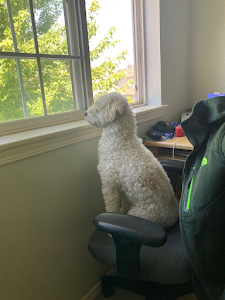
Yes, the Dog Days of Summer are upon us here in the Pacific Northwest and temperatures have been hot.  Even the dog seeks refuge from the heat.

The latest addition to the household, Milo, tends to hang out with me when I am downstairs in the game room whether painting, reading, or studying the game laid out on the table.  Now, I tend to think he likes the company but it could simply be that he enjoys the coolness of basement.

Anyway, I stood up from the painting desk one afternoon and looked all over for the dog.  He had been on the couch earlier.  Well, he was there last time I noticed, anyway.  He was nowhere to be found.  Then, I heard a faint rustle coming from under the game table.  I walked around to the end of the table and looked between the boxes lining both sides of the table.  I see two eyes and a white curly head peeping up over one of the boxes from under the table's dark underbelly.  In the few seconds it took to grab the camera, he jumped up onto one of the boxes and walked over to me.  Clearly climbing over my boxes of figures was no concern to him.  The box he is padding across is the one containing my 1/72 WWI aircraft collection.  Funny dog.

Given that we are in the throes of the heat of summer, my attention turned to a little retail therapy from the comfort of the couch in the game room.  Besides a small order to Lancashire Games for FPW Prussians and Bavarians, Pat Smith's Volume 3 of Setting the Scene arrived in my post box.  Looking forward to diving into this work with thoughts of returning to Norway for an early WWII game.  That game may wait until winter when the snow flies.
Also in the mail was an order from Jerry's Artarama for a fistful of Rhapsody Kolinsky Sable brushes that were on deep discount.  Rhapsody brushes are a regular staple in the brush arsenal along with Winsor & Newton Series 7 Kolinsky Sables.  Why not stock up?  Exactly!
On the gaming front, this week is a busy one with games on Monday (in a conclusion to the Quistello battle with the Rejects) and Tuesday with Peter (see ECW Siege Battle Report).  On the schedule are two more games on Friday, and Saturday.  Four games in a week is a lot!  Hopefully, I can carve out some time to chronicle many of these games.  For now, though, it is time to walk the dog.

Saturday, July 12, 2025

Spinning My Wheels

Spinning both figuratively and literally!
Upper Falls split by Canada Island.
The literal wheel spinning gives a nod to an increase in mileage out on the bike.  While not up to the mileage of old, I am pushing an average of about 150 miles per week.  This is much better mileage than logged during the winter and early spring months of indoor training.  Good to get out in the pleasant weather before the daytime temperatures nudge the thermometer up into the 90s.  Doubly good to get the roadwork in before the hazards of negotiating crosstown traffic make the journey a bit stressful until I can get out onto the relative safety of the bike path and relax.
Upper Falls, South Channel
Saturday morning's ride saw me stopping on the Post Street Bridge for a brief snack break in the middle of downtown.  Breakfast consisted of downing a couple pieces of sushi while I enjoyed the pleasant view of the Upper Falls before making the long and hot climb back up the South Hill and home.  With no measurable rain for more than a month and the mountain snowpack long gone, the Spokane River is running low with both Lower and Upper Falls showing their mid-summer, natural state of exposed rock and reduced water flow. 
Lower Falls under Monroe Street Bridge
The figurative wheel spinning is happening on the hobby front.

Following the series on Mortimer's Cross battles and the chronicling of those very enjoyable games, returning to the keyboard and painting table has been difficult.  After wrapping up a series of battles, I am frequently distracted by what might occupy the table next.  That research continues.  After suggestions, a return to the 18th Century may be in the cards.  Early candidates include War of Austrian Succession and War of Polish Succession battles.  Which one to tackle first is still undecided.  
Another distraction is that Nancy and I brought a new dog into the family.  We all are adjusting quickly and this fellow has every hint at being a very good dog.  His calm and friendly disposition is unmatched by any dog we have had before.  The animal shelter says he is a poodle (mix?) but when I conducted an image match, a Spanish Water Dog came up as a close look-a-like.  Time (and possibly a DNA test) will tell, I suppose. 
Lee delivering a bow rake into Steve after I softened him up!
Finally, I did get a game in this week!  Reject Richard hosted another of his superbly directed playtests for the Age of Sail rules he is designing and developing.  Game ran smoothly and Lee and I came away with a victory.  Great fun!
Jon delivering a stern rake into Dan to seal the deal!
Richard's account of battle can be read at Naval Playtest 4 - Nearly There!

Next time, maybe some new units to parade?  By the way, the dog is asleep at my feet as I type, snoring...

Sunday, May 18, 2025

Chasseurs de Fischer

Activities on the hobby front continue winding their way through the month of May in the seasonal downturn mentioned in an earlier post (see A Few Spanish and a Seasonal Funk).  Contributing to this stall and recent lack of posts was my week away in California.  Nine days between posts is likely the biggest gap in more than a dozen years.  Returning sees even more work to catch up with on the home front.  Hopefully, I will be back to normal operations soon.  The forced hiatus presents one interesting fallout.  Having not posted in more than one week, I find it challenging to actually restart the blogging routine.  I considered holding off for even a few more days needing a little recovery time to collect my thoughts.  Once jostled out of a routine and regular habit, I am a little surprised how easy it would be to either slow down or stop altogether.  
Anyway, back to today's offering.

Mustering out earlier in the month are the French Chasseurs de Fischer.  This body of 15 light infantrymen are added into the French Army for the 18mm SYW collection.  Figures are Old Glory.  Still a number of units awaiting their turn at the photo booth.  With luck, I will return to the painting desk soon and the next post with not be nine days away.

Until next time.

Saturday, January 25, 2025

What's In A Name?

After seeing the above book mentioned on Peter's blog (see A New Book...) and listening to the authors' podcasts, I placed an order.  Book arrived quickly and was read just as quickly.  I won't repeat the contents of the book since Peter did that and Table of Contents can be seen on Amazon.

What I do want to discuss is the authors' wrestling with the renaming of the gaming aspect of the hobby that we enjoy.  Many of us likely refer to this hobby as miniatures wargaming or playing a miniatures game.  Really, I lump all facets of the hobby simply into the catch-all, wargaming

The authors' take a different tack, however.  They state their rationale for first dismissing the use of tabletop games, then dismissing miniatures games, then dismissing miniatures wargames, before settling onto the term of non-discrete miniatures games

The name, non-discrete miniatures game is chosen since the authors argue that,
  • Games are not necessarily about war.
  • Spatial relationships between miniatures and terrain are crucial.
  • Any physical object can be introduced into the game and have meaning in game terms (non-discrete components).
  • Movement and positioning are not limited to fixed increments or grid spaces (non-discrete positioning).
Non-discrete is an interesting term to choose and returns me to the days of studying mathematics.  Typically, one sees a bifurcation between discrete and continuous but not between discrete and non-discrete.  I suppose if the term, continuous was utilized as in continuous miniatures game, readers might conclude that we game non-stop!      

Moving on, the authors define these games by their unique spatial characteristics in that,
  • Precise physical positioning matters.  That is, movement and placement are analog (and continuous) and not grid-based.
  • Players can bring any object to the game table and game systems must accommodate an infinite variability of components.
One example given of discrete movement and figure (marker) placement is the game of Monopoly.  A playing piece can only be in one of the grid spaces on the playing board at any one time and not between two spaces.  In a non-discrete game, movement is governed by a measuring device with a miniature able to move anywhere along that vector and stop anywhere short of the maximum move distance allowed.  This non-discrete movement criterion seems to not only explicitly exclude grid-based games from inclusion into non-discrete miniatures game by definition but implicitly as well with the continuous nature of measured movement along a vector. 

In later chapters, the authors relax the condition for non-griddedness.  Games having gridded movement or zoned movement may fit into the structure of building a non-discrete miniatures game as long as the focus on the design remains on the spatial relationships within the game and the infinite variety of components.  Given that discrete positioning and movement criteria are later relaxed, the grid vs non-grid distinction should be dropped from the definition altogether.

With the argument for excluding gridded games jettisoned, what remains the focus of non-discrete miniatures gaming?  What remains constant is the reliance upon the external components brought into the game system.

What distinguishes many boxed miniatures games from the non-discrete miniatures games that the authors describe?  The difference is that the former is self-contained with the rules and all of the components necessary for play while the latter is similar to a toolkit with a programmed game engine requiring any number of external inputs provided by the player(s).  These external inputs could include figures, terrain, army lists, dice, measuring devices, etc.
       
Is the classification still between discrete vs non-discrete miniatures games or is a better fitting distinction between endogenous vs exogenous miniatures games?  I suggest that the latter terminology may be a better fit if one agrees with the authors that the deciding attribute is bringing external inputs into the system.  Still, it is all wargaming to me.

There is much more to be pulled from this book of interest to wargamers and wargame designers whether focusing on non-discrete miniatures gaming or not.  I have only brought up the main thesis of Chapter 1!  With so much to consider, I may non-discretely dip back into this text on occasion.

Wednesday, January 15, 2025

Bavarians and the Current State

While I cannot speak for others, I occasionally fall into a period where there is so much on my wargaming plate that thoughts explode on possibilities and works pile up. Without concentrated focus, the wheels of progress wind up spinning with limited traction.  Anyone else suffer from too many ideas and not enough time or energy to tackle them all?

I notice this sense of falling behind correlates closely on the heels of hosting a game and tapping out a long battle report.  Both require a lot of work.  These two efforts can leave my energy levels depleted for a few days.  Last week's Agnadello game with Richard (see Agnadello, Rematch) is the latest such example.

Before I had a chance to catch my breath, another Agnadello battle played out on the table in a rematch on Tuesday.  Another interesting and exciting battle whose tale is yet to be told.
Battle of Agnadello
After today's task of clearing the gaming table of Great Italian Wars, the plan is to pull out the Old West gunfighters for a game or two.  Now, these figures have not seen action in more than 20 years.  
I will dig up my playtest copy of Bryan Ansell's The Rules With No Name to see what I remember from hosting gunfights all of those years ago.  I have been making character cards and a QRS and should be prepared to host a few remote games in a week or two.  Rather than historical, big battle scenarios, we will try our hands at something more lighthearted and Hollywood.  Tentatively, the plan is to host a few cross-group remote games.  I think it will be a fun change of pace for all involved.  Hopefully, I can get up to speed on the rules quickly enough to present a seemingly smooth game.
Besides gaming, there are two GWS2024 analyses in work.  Preliminary data wrangling is complete.  Now, just need to write up the findings.
Among the books arriving in-house over the holidays, one title delivered last week was Ford and Hutchinson's, The Fundamentals of Tabletop Miniatures Game Design.  While weighing-in at 241 pages, the book is a quick read containing a number of interesting ideas and thought-provoking commentary.  For me, the first section, Miniatures as Medium, especially deserves further exploration and counterpoints before delving into the remaining two sections.
What about Bavarians?  Oh yeah!  I ended 2024 with a satisfying flourish of painting activity that will be detailed once I get around to the Year in Review painting round-up.  Figures are stacking up at the photo booth but I managed to push out a 23-figure regiment of Bavarian infantry today.
Foot figures are Lancashire Games led by a Eureka mounted colonel.  Lots more SYW/WAS units mustering out soon including British, French, and Spanish.

Until next time...