If asked to choose my favorite 15mm figures to paint, I might pick these Austrian infantry from Lancashire Games' 19th Century European 1860-1880 range. Having painted hundred of these little chaps, I never tire of pulling several dozen from The Lead Pile and sending them straight into the painting queue. The figures are relaxing to paint and colorful when drawn up in rank and file.
These two battalions, of 18 figures each, muster out as the 3rd and 4th battalions of Infantry Regiment #32. Checking in the figure bins, enough Austrian infantry remain to field, perhaps, four more battalions from the Lancashire stash. One or two battalions' worth of Old Glory Austrians remain in inventory as well. How many painted Austrian infantry can I field for battle? Well, a quick summing of the Painting Log shows a count of 897 Austrian infantry. Not bad!
Besides the growing backlog of painted units awaiting a turn at the photo booth, what is on the painting desk? Napoleonic French infantry for two different projects and two different scales are currently in work as are two more Feudal Japanese units. One thirty figure bag of 25mm SAW Spanish infantry are seeing service too.
While this may sound like a lot of activity on the painting front, painting sessions have been short and infrequent. One nifty little game that has captured my attention over the last several evenings is a mini solitaire game by Decision Games entitled, Merrill's Marauders. Like Salem Church before, Merrill's Marauders is a small game on a 11'' x 17" map it is perfect for play at the kitchen table. Having played through three games, it is a solitaire system that actual works. Expect a review at some point.
Tuesday, February 4, 2020
Saturday, February 1, 2020
Size Matters But To Whom?
In a continuation of reporting on the 2019 survey results from WSS' 2019 The Great Wargaming Survey, Jasper highlights some of the survey results on figure size (see: 2019 GWS - size matters). Jasper focuses on the trend from 2014 through 2019 of 25mm, 28mm, and 28mm Heroic figures losing ground to the smaller figures sizes. He makes a further observation that these sizes are losing ground not only to the smaller figure sizes but to airplane/ship/spaceship gaming. For the latter shift, Jasper proposes that this shift may be due to an increased interest in product specific games such as Cruel Seas and Star Wars. Time will tell.
In a follow-up to Jasper's commentary, I examine figure size from the perspective of a gamer's primary interest (see: GWS 2019 - Digging into the numbers: size matters to whom?). Keep in mind that survey respondents may choose more than one figure size when completing the survey. Respondents could choose every figure category if they wished. I posit two conclusions from this analysis. They are:
To recap the counts on figure size and primary interest, the table below quantifies this distribution.
MCA: Figure Size vs Primary Interest
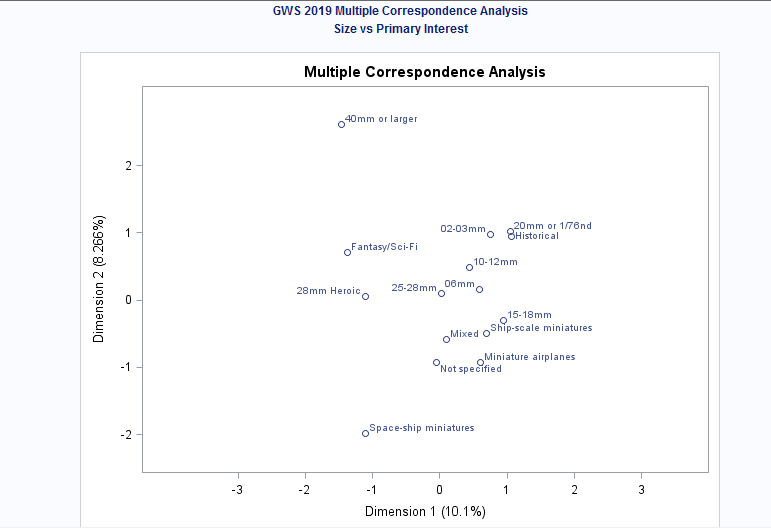
Taking the data from the above table, correspondence analysis yields the following graphical representation.
First, let's lay out boundaries in which little or no discrimination is possible. In the graphic below, the attributes within the colored bands show little distinction within a given dimension. For Dimension 1 (x-axis), there is no separation between primary interests of Mixed, Not Specified, and figure size of 25-28mm. Claiming 25-28mm as preferred figure size is shared by many. Respondents having primary interests of Mixed/Not Specified tend to be catch-alls with preferred figure sizes spanning all categories.
In a follow-up to Jasper's commentary, I examine figure size from the perspective of a gamer's primary interest (see: GWS 2019 - Digging into the numbers: size matters to whom?). Keep in mind that survey respondents may choose more than one figure size when completing the survey. Respondents could choose every figure category if they wished. I posit two conclusions from this analysis. They are:
- Airplane/ship/spaceship gaming represent crossover genres. That is, they appeal to gamers with a mix of interests. Both primarily historical and fantasy/sci-fi gamers can find something of interest here.
- Historical and Fantasy/Sci-fi gamers diverge on preferred figure size. Historical gamers tend toward figure sizes 25-28mm and smaller. Fantasy/Sci-fi gamers tend to prefer figures sizes 25-28mm or larger.
To recap the counts on figure size and primary interest, the table below quantifies this distribution.
MCA: Figure Size vs Primary Interest
Taking the data from the above table, correspondence analysis yields the following graphical representation.
What can be distilled from this graphical representation of relationships between figure size and primary gaming interest?
First, let's lay out boundaries in which little or no discrimination is possible. In the graphic below, the attributes within the colored bands show little distinction within a given dimension. For Dimension 1 (x-axis), there is no separation between primary interests of Mixed, Not Specified, and figure size of 25-28mm. Claiming 25-28mm as preferred figure size is shared by many. Respondents having primary interests of Mixed/Not Specified tend to be catch-alls with preferred figure sizes spanning all categories.
What else can be inferred? Well, next focus on two points that appear as outliers and far from each other. Those two figure size attributes are 40mm or larger and Space-ship miniatures. This distance in Dimension 2 suggests these two attributes are almost mutually exclusive. A respondent choosing one most likely does not also choose the other.
Similarly, there is clear separation between primarily Historical and primarily Fantasy/Sci-Fi gamers. A gamer with a primary interest in historical gaming does not venture into the fantasy/sci-fi world, it seems. See graphic below:
Finally, if we consider who plays what, the data suggest that there are clearly defined clusters of attributes based upon primary interest (see graphic below). Fantasy/Sci-Fi gamers gravitate toward 28mm Heroics. If 02-03mm or 20mm-1/76 are played, these will be chosen by Historical gamers. While 10-12mm, 15-18mm, airplane, and ship gaming fall within the Historical sphere of play, their tie to historical gaming is not linked as tightly as 20mm-1/76.
Do these results reinforce common knowledge or anecdotal notions on the hobby? Are there any surprises? For someone in my age group, the binding of 20mm-1/76th figure size to historical gaming makes perfect sense. Even though I no longer have any 20mm collection, I grew up pouring over articles in Wargamer's Digest showing many HO scale WWII battles among its pages. Remember the multi-issue fight for Tobruk? One of my favorites. Likewise, battles in 20mm or HO scale across all periods were a frequent sight within its pages. Ah, those were the days.
The more I study these survey results, the more I am convinced the results paint a reasonable portrait of the hobby. What do you think?
Tuesday, January 28, 2020
Ashigaru Spear in 15mm
I never tire of painting Peter Pig's 15mm Samurai figures. That is a good mindset to have since a small order arrived two weeks ago! Taking advantage of a year-end sale, the order was packed and shipped quickly. Even accounting for increased holiday shipping traffic, the small package arrived within a fortnight. Always great service from Peter Pig.
The slightly chunky figures hold fine detailing. The built-in sashimonos, when painted, add a burst of color to the unit. The chunkiness and fine sculpting lend a certain charm to the figures. Clustered in formation, the result is a handsome playing piece.
This unit of ashigaru spear is clad in russet-lacquered armor. The russet armor is a nice change from the more predominant black or red lacquered armor of many of the units in the collection.
While the iron was hot and motivation high, two more units for this project were pushed into the painting queue. One more unit of mounted Samurai and another unit of ashigaru teppo will be working their way through the production line. Before those emerge from the production line, a small mountain of Assyrians for the 25mm Assyrian Wars project will debouch from the workbench. At last count, seven units will be making an entrance over the next few weeks.
Saturday, January 25, 2020
Salem Church: East of Chancellorsville
The wargame, Salem Church: East of Chancellorsville (2013) is one of Decision Games' (DG) entries into the Quick Play Musket & Saber series. The battle is fought over an 11" x 7" map using only 40 counters. Scale is 352 yards per hex with 90 minute turns. Units represent brigades. With many units having either five or six movement points, this is really a battle of maneuver. Although locking EZOCs exist, flanking maneuvers are easily accomplished unless great care is taken in building a cordon of interlocking EZOCs.
After reading Norm's replay and review of Salem Church (see Salem Church 1863), I was intrigued and ordered myself a copy of the game. I encourage a diversion to Norm's blog to read his battle report and thoughts on Salem Church. A longtime fan of The Gamers' Civil War Brigade (CWB) series, I looked forward to giving this DG brigade series a try. Having a small footprint and only a few pages of rules, Salem Church seemed a good entry point. The CWB has a different time and ground scale with 30 minute turns and 200 yards/hex.
The game follows an IGO-UGO sequence with,
- First Player Movement
- First Player Combat
- Second Player Movement
- Second Player Combat
Within this sequence, there is no interaction between players with the exception that a non-phasing player's unit that was adjacent to a phasing player's unit, not attacked during combat, may launch a counterattack at double its printed strength. This is an interesting rule! Not attacking all adjacent enemy units can carry heavy retribution. Norm makes the comment in his review linked to above as, "it prevents a player making ‘silly attacks, just because they can'." I say it does the opposite in that the counterattack rule encourages silly attacks from the attacker to prevent a possible devastating counterattack! Norm reinforces this notion of encouraging silly attacks when he retells the account of Wilson at Salem Church launching an attack to pre-empt such a counterattack. There are a number of similarly interesting rules in both the System Rules and Scenario rules.
To attain a Major Victory, the Federal player must exit the Federal train and hold either Banks' Ford or the entry to Fredericksburg. For the Confederate player, he must hold Bank's Ford and the entrances to Fredericksburg or capture the Federal train. For any other outcome, the decision is decided on points. As for tallying Victory Points for lost steps, the rules do not state if points are tallied at game end or accrued throughout the game as steps are lost. As lost steps can be returned as reinforcement later, this can have an impact on the Victory Conditions.
Another interesting rule is the functioning of the Federal Army. On the morning of the second day of battle (May 4) and all subsequent turns, the Federal player must roll for initiative. This is a Draconian measure for the Federal commander and does much to snuff out the offensive capability of Federal forces on Day 2 of the battle. Each turn, the Federal player rolls for initiative. On a 1-2, Federal forces operate under Full Initiative. On 3-6, Federal forces operate under Low Initiative. When under Low Initiative, only a Federal stack with a leader may enter into an EZOC. To do so, the leader must pass a morale check. If he passes, he may enter the EZOC. If not, well, he cannot. To even further stall Federal attacks, once in an EZOC, the primary attacking unit must make a morale check. If failed, the attack is called off. Harsh! If the Federal Army wants to win the battle, it better get moving and try to make good progress on Day 1. On Day 2, a sustained effort is much more difficult if not impossible.
Leaders are important in Salem Church. Leaders may increase movement of units stacked with him and disrupted units may enter EZOCs when stacked with a leader. A leader's Morale Rating can aid one unit to which he is stacked. A leader may add his Combat Factor to a unit to which he is stacked and disrupted units are not halved in combat. Leaders are very useful pieces!
Artillery is important in this system as well. Artillery is the only ranged weapon. Artillery has the ability to fire at a four hex range without worry of retribution. Artillery bombardments, alone, or in combined arms attacks with infantry offer opportunities to soften the enemy and perhaps drive it from its position without much effort.
Combat is based upon a Combat Factor differential between the attacker(s) and defender. The CRT ranges from '-5 or less' to '+10 or more' with seven gradients in between. The CRT is relatively bloodless. Results rarely result in a loss although exchanges are possible but rare. Some results carry a secondary result. If the loser takes a morale check and fails, the primary result is in effect. If the morale check is passed then the secondary result is in effect. The secondary result often requires a second morale check. The construction of the CRT does not lend itself to easy memorization. A little clumsy, I think. Even after two games, I still needed to carefully consult the CRT and results' description to resolve the combat.
The loser of a combat often has the choice to either become disrupted or retreat (for less severe results) to taking a loss or retreating disrupted for more severe results. Losses are taken in steps. Most infantry units have two steps. Artillery and a few detachments have one step only. With the ability to replace two steps per turn, each side will be able to replace most attrition suffered during a turn. Replacements can return to their parent if outside of an EZOC or at one of the designated board edges.
Moving and fighting in woods is interesting. Movement through light woods is one Movement Point the same cost as open terrain. Units and entire divisions can pass through woods with little difficulty. An attacker is halved in value when attacking into light woods from across a clear hexside but no penalty when attacking from light woods to light woods. My interpretation of this is that firefights, wholly in woods, are undertaken at much closer range. Therefore, neither combatant holds any tactical advantage. Now, the halving for attacks across clear hexside into woods could be debated.
Even with the most current Errata and Clarifications in hand, the rules left several holes to plug. In addition to gaps, many of the rules could use a careful rewording to bring clarity from confusion. For example, in Disruption Recovery, a unit may recover from disruption "if not in an EZOC and not eligible for march movement." How about "if it remains at least two hexes from an enemy unit" as a simplification?
Given the large movement values and no hindrance to movement through woods, Salem Church is a game of maneuver and flanking. If interlocking EZOCs do not extend across the map, outflanking an enemy position is not a difficult task to accomplish. Given that enemy replacements may return behind your lines, no position is ever unassailable or secure.
Does this system feel like one is fighting an ACW battle? Not to me at Salem Church. Seems more akin to a small unit tactical game rather than BMUs of brigades. Perhaps, I need to reread the historical account? After that reading, I may change my tune. With low loss rates and generous replacements, Salem Church offers a surprisingly balanced game.
Having fought through two playings of Salem Church, I will recap one of those replays next time.
Thursday, January 23, 2020
Dyve's Regiment of Foote
The King's Army receives a reinforcement in the form of Dyve's Regiment of Foote. These 27 figures are from my dwindling stockpile of Renegade Miniatures figures. The Renegade figures are some of my favorites and they fit well with the bulk of my Redoubt Miniatures ECW armies. While painted in November of 2019, only now are these lads making their way to the photo box.
The problem is that Redoubt figures are difficult to find after the company stopped producing. I found 80 of the unpainted foot figures two years and snapped them up (see An Unfinished "Finished" Project). With the box of figures counted, I figured three regiments of foote could be built. Dyve's Regiment represents the second regiment to muster off from the painting desk in this tranche.
With enough musket and pike figures to build one more regiment, I discovered that I was lacking command for the unit. Having no more Renegade figures in The Lead Pile, Regiment #3 will likely be led by Redoubt officers. While I prefer keeping Renegade integrity in the unit, Redoubt officers will have to do. I have not ordered from Redoubt Enterprises since it changed hands a few years ago. Hopefully, I can still order a handful of figures. We will see.
On the painting front, I have been able to hobble down into the basement for short painting sessions this week. A number of units are in work and sitting at the workbench is not too painful for short periods. This afternoon with my wife's help in taking figures from the basement to the garage, I was able to DIP some figures. Two activities I have not been able to find a solution to in my current state is spray primering and dullcoating figures. With snow and ice everywhere, venturing out into the yard on crutches to spray is not recommended. I wonder if I could convince Nancy to take on these tasks? Hmmm. Probably not.
Sunday, January 19, 2020
First Impressions: IGaBC
Hot on the heals of Graham Evans’ To Ur is Human, a second set of rules emerges from his rules’ backlog. Sticking to the road less traveled, Graham turns his attention to the New World and the 1879-1884 South American conflict know as the War in the Pacific.
The author has a penchant for tackling obscure conflicts and the War in the Pacific is no different. How does one develop an interest in such an obscure theater of warfare? Well, like me, travel can be the catalyst for a new project. For Evans, a trip to Peru was that igniter for inspiration. I came away from my Peruvian adventure with thoughts of modeling various conflicts too but, for me, those thoughts passed. Not for Graham. The result of that spark of motivation led to his It’s Getting a Bit Chile (IGaBC).
While IGaBC states that it is a set of Tabletop Wargame Rules for the Land Conflict in the War of the Pacific 1879-1884, it really is much more than that. IGaBC is almost a complete package in the tradition of a wargamer’s guide. At 76 pages in length, this represents an impressive work. Rules comprise the bulk of the book but typeface is large and easy to read. In addition to the core rules, topics include, a brief history and chronology of the conflict, figure availability, painting guide, and a useful bibliography. Really, IGaBC provides enough information to get going on a new project straight away.
On to the rules. IGaBC is an Igo-Ugo system played on a grid. Options are available and described for non-grid play. Basic Maneuver Unit (BMU) is the infantry battalion, cavalry squadron, and artillery battery. Ground scale is 250 yards per square. An infantry BMU consists of four bases with cavalry and artillery BMUs comprising two stands. There is no figure/base removal for casualties except in unusual circumstances. Entire units are either on table or removed from play when ineffective. This is how I like it. I prefer figures and units to remain on table as long as possible. It takes effort to build a collection. No reason to have the figures put out on the table and then put back into storage boxes almost immediately upon receiving the first casualties.
The Turn Sequence is typical of many Igo-Ugo wargame rules. The sequence is,
What is the essence of the gaming engine for IGaBC? If I strip away all but the essential elements, the rules can be distilled down to three important concepts. Those are Formation, Support, and Disorder (FSD for short). Since only infantry may have support, I will focus on the infantry aspects of FSD.
Infantry can be in one of seven formation stances within a square. Well diagrammed within the rules, each has its own attributes for deployment, density, support, advantages and disadvantages. Each unique, diagrammed stance shows, at a glance, the attributes of the BMU. This is a clever visual concept and reminds me somewhat of Weigle’s 1870 series of rules. What can be gleaned from a BMU’s stance are facing, the number of firing stands, the number of support stands, unit density, and target type.
Besides unit formation, the two key components of a BMU’s attributes are Support and Disorder. Disorder represents a unit’s loss of combat effectiveness as it sustains punishment from fire or close combat. Disorder is incremental. As a unit takes punishment, disorder may accrue if not rallied off. With no Disorder markers, a unit fights with 1D8. With one Disorder marker, a unit fights using 1D6. With two Disorder markers, a unit fights using 1D4. When a unit accrues three Disorders, it may not fire but fights with 1D4 in hand-to-hand. Any more and the unit either retires, retreats, or routs. This method of disorder accrual reminds me of Santa Anna Rules and its method of modeling the effects of straggling. Perhaps, rather than having absorbed Disorder markers placed under the support base, IGaBC could take a page out of Santa Anna Rules and rotate a support base to the rear to denote an absorbed Disorder Marker thus eliminating a need to place Disorder markers under a support base? Once rallied off, the support base would return to its normal attitude.
Supporting bases may mitigate disorder. Some infantry formations offer support; others do not. Support represents a unit’s ability to absorb friction from combat. Absorption of disorder by a supporting base is temporary. Changing formation from a more dense to less dense stance allows a unit to ignore disorder too. That is another interesting twist.
What about combat in IGaBC? Depending upon the number of participating stands, level of disorder (remember throwing either 1D8, 1D6, or 1D4 per stand), Target Type, and a handful of column shift modifiers, an attacker sums all of the attack dice and scores one disorder for each multiple of the target’s To Hit Multiple. If a target’s To Hit Multiple is ‘8’ and the attacker’s attack dice total is ‘10’ then the defenders receives one Disorder Marker. Fractions are ignored.
While the Chilean Army fielded the better quality troops carrying better weapons than her adversaries, Evans’ warns against playing the ratings too literally. Top Quality troops with New rifles will likely easily overwhelm Poor Quality troops with Old rifles. As he says, “It may be realistic but it might not be much of a game...”
Does this combat engine model the situation on the ground? I cannot say but it offers a number of interesting twists to a typical combat engine. Having multiple, different sided dice (D8,D6,D4) are not something I enjoy. I understand the rationale for its inclusion but it seems too fiddly to me and ripe for error. All in all, it looks like it would work despite my personal reservations.
Production quality is good. While a few typos and errors crept into the final copy, these did not distract from the work. The rules are well diagrammed to illustrate a number of the key concepts. Examples of play are numerous too. One of the inclusions that I appreciated in To Ur is Human and continued here is a comprehensive QRS printed onto the back cover. This should be a standard practice unless QRS’ are printed separately, detachable, and included in the rules.
Alan Curtis’ painting guide to the war is a very useful addition to IGaBC. My only complaint is that while the Chileans are listed as having adopted French style uniforms, no mention of the uniform cut for either Bolivia or Peru. When I ordered IGaBC, I also ordered Esposito and Pinto’s The War of the Pacific. While not listed in the bibliography, this is an excellent book covering the war, the armies, and uniforms. Filled with a number of color uniform plates, I wonder how this 170 page work compares with Esposito’s Osprey?
Has this tempted me into a new period? The jury is still out on that one. Armies tend to be small and colorful. Graham has mentioned that FPW French and ACW figures could be pressed into service to field most of the combatants. This could be an interesting research project to find alternative figures outside of the figures produced by Outpost Wargames Services in 15mm. That might be worth the effort in and of itself. This work has piqued my interest.
In conclusion, IGaBC is comprehensive piece of work for a little gamed period. Keep in mind, my First Impressions are just that; first impressions of the rules, themselves. I have yet to try the game in practice.
Well done and thank you, Graham, for opening my eyes to a new frontier!
The author has a penchant for tackling obscure conflicts and the War in the Pacific is no different. How does one develop an interest in such an obscure theater of warfare? Well, like me, travel can be the catalyst for a new project. For Evans, a trip to Peru was that igniter for inspiration. I came away from my Peruvian adventure with thoughts of modeling various conflicts too but, for me, those thoughts passed. Not for Graham. The result of that spark of motivation led to his It’s Getting a Bit Chile (IGaBC).
While IGaBC states that it is a set of Tabletop Wargame Rules for the Land Conflict in the War of the Pacific 1879-1884, it really is much more than that. IGaBC is almost a complete package in the tradition of a wargamer’s guide. At 76 pages in length, this represents an impressive work. Rules comprise the bulk of the book but typeface is large and easy to read. In addition to the core rules, topics include, a brief history and chronology of the conflict, figure availability, painting guide, and a useful bibliography. Really, IGaBC provides enough information to get going on a new project straight away.
On to the rules. IGaBC is an Igo-Ugo system played on a grid. Options are available and described for non-grid play. Basic Maneuver Unit (BMU) is the infantry battalion, cavalry squadron, and artillery battery. Ground scale is 250 yards per square. An infantry BMU consists of four bases with cavalry and artillery BMUs comprising two stands. There is no figure/base removal for casualties except in unusual circumstances. Entire units are either on table or removed from play when ineffective. This is how I like it. I prefer figures and units to remain on table as long as possible. It takes effort to build a collection. No reason to have the figures put out on the table and then put back into storage boxes almost immediately upon receiving the first casualties.
The Turn Sequence is typical of many Igo-Ugo wargame rules. The sequence is,
- Charge Declaration
- Movement
- Rally
- Firing
- Hand-to-Hand Combat
What is the essence of the gaming engine for IGaBC? If I strip away all but the essential elements, the rules can be distilled down to three important concepts. Those are Formation, Support, and Disorder (FSD for short). Since only infantry may have support, I will focus on the infantry aspects of FSD.
Infantry can be in one of seven formation stances within a square. Well diagrammed within the rules, each has its own attributes for deployment, density, support, advantages and disadvantages. Each unique, diagrammed stance shows, at a glance, the attributes of the BMU. This is a clever visual concept and reminds me somewhat of Weigle’s 1870 series of rules. What can be gleaned from a BMU’s stance are facing, the number of firing stands, the number of support stands, unit density, and target type.
Besides unit formation, the two key components of a BMU’s attributes are Support and Disorder. Disorder represents a unit’s loss of combat effectiveness as it sustains punishment from fire or close combat. Disorder is incremental. As a unit takes punishment, disorder may accrue if not rallied off. With no Disorder markers, a unit fights with 1D8. With one Disorder marker, a unit fights using 1D6. With two Disorder markers, a unit fights using 1D4. When a unit accrues three Disorders, it may not fire but fights with 1D4 in hand-to-hand. Any more and the unit either retires, retreats, or routs. This method of disorder accrual reminds me of Santa Anna Rules and its method of modeling the effects of straggling. Perhaps, rather than having absorbed Disorder markers placed under the support base, IGaBC could take a page out of Santa Anna Rules and rotate a support base to the rear to denote an absorbed Disorder Marker thus eliminating a need to place Disorder markers under a support base? Once rallied off, the support base would return to its normal attitude.
Supporting bases may mitigate disorder. Some infantry formations offer support; others do not. Support represents a unit’s ability to absorb friction from combat. Absorption of disorder by a supporting base is temporary. Changing formation from a more dense to less dense stance allows a unit to ignore disorder too. That is another interesting twist.
What about combat in IGaBC? Depending upon the number of participating stands, level of disorder (remember throwing either 1D8, 1D6, or 1D4 per stand), Target Type, and a handful of column shift modifiers, an attacker sums all of the attack dice and scores one disorder for each multiple of the target’s To Hit Multiple. If a target’s To Hit Multiple is ‘8’ and the attacker’s attack dice total is ‘10’ then the defenders receives one Disorder Marker. Fractions are ignored.
While the Chilean Army fielded the better quality troops carrying better weapons than her adversaries, Evans’ warns against playing the ratings too literally. Top Quality troops with New rifles will likely easily overwhelm Poor Quality troops with Old rifles. As he says, “It may be realistic but it might not be much of a game...”
Does this combat engine model the situation on the ground? I cannot say but it offers a number of interesting twists to a typical combat engine. Having multiple, different sided dice (D8,D6,D4) are not something I enjoy. I understand the rationale for its inclusion but it seems too fiddly to me and ripe for error. All in all, it looks like it would work despite my personal reservations.
Production quality is good. While a few typos and errors crept into the final copy, these did not distract from the work. The rules are well diagrammed to illustrate a number of the key concepts. Examples of play are numerous too. One of the inclusions that I appreciated in To Ur is Human and continued here is a comprehensive QRS printed onto the back cover. This should be a standard practice unless QRS’ are printed separately, detachable, and included in the rules.
Alan Curtis’ painting guide to the war is a very useful addition to IGaBC. My only complaint is that while the Chileans are listed as having adopted French style uniforms, no mention of the uniform cut for either Bolivia or Peru. When I ordered IGaBC, I also ordered Esposito and Pinto’s The War of the Pacific. While not listed in the bibliography, this is an excellent book covering the war, the armies, and uniforms. Filled with a number of color uniform plates, I wonder how this 170 page work compares with Esposito’s Osprey?
Has this tempted me into a new period? The jury is still out on that one. Armies tend to be small and colorful. Graham has mentioned that FPW French and ACW figures could be pressed into service to field most of the combatants. This could be an interesting research project to find alternative figures outside of the figures produced by Outpost Wargames Services in 15mm. That might be worth the effort in and of itself. This work has piqued my interest.
In conclusion, IGaBC is comprehensive piece of work for a little gamed period. Keep in mind, my First Impressions are just that; first impressions of the rules, themselves. I have yet to try the game in practice.
Well done and thank you, Graham, for opening my eyes to a new frontier!
Thursday, January 16, 2020
Old Glory 10s - Federal Infantry
In a continuing effort to draw down the 10mm ACW figures in The Lead Pile, 150 Federal infantry were pushed through the production line in December. This tranche of figures makes good headway in reaching that goal.
What I have here today are 5 x 30 figure regiments of Federal troops ready to take to the field. Figures are Old Glory 10s. Molded in strips, the shoulder-to-shoulder stance allows for really close formations; something not possible with individually cast figures. Details may not be as crisp as other figures but en masse, I think they look good. A bunch of unpainted Zouaves remain in stock along with a large number of guns and some cavalry. After painting about 400 of these little fellas over the last two months, I may hold off on pushing the Zoauves into the painting queue. After all, I only recently finished painting 36 15mm Algerian Turcos. A guy can take only so much. I need a rest.
Subscribe to:
Posts (Atom)