Sunday, June 19, 2016

Action at Brawner's Farm, August 1862 - Scenario

Stonewall Brigade Lies in Wait near Brawner's Farm
After laying in wait all day for an opportunity to strike the Federals, Jackson got his chance as King's division marched along the Warrenton Turnpike towards Centreville where Pope's army was massing.  Letting King's lead brigade pass by unmolested, Jackson finally ordered his troops to empty the unfinished railroad cut and attack the second of King's brigade as it passed through Brawner's Woods.  That second brigade was Gibbon's soon to be acclaimed Iron Brigade.  This is the Iron Brigade's baptism of fire.
Brawner's Farm Map Looking from South
Although Jackson's forces outnumbered the Federals by almost three to one, Jackson never managed to bring this overwhelming force to bear.  Jackson's troops would attack in piecemeal fashion while Gibbon and Doubleday's brigades would hold onto the field until darkness halted the battle.  This scenario recreates that action in the late afternoon of August 28, 1862.  For an account of the battle, visit The Civil War Trust's website.
Brawner's Farm OB
Rules: Regimental Fire and Fury
Game area: 6' x' 6'
First Player: Confederate
Game Start: 5:15pm beginning with Confederate Turn, Confederate Offensive Fire Phase
Game End:  8:30pm
Twilight at 7:45pm

At 5:15pm, only Baylor's brigade, Alleghany, Danville, and Staunton batteries are present on table for the Confederates.  Union troops in column along Warrenton Turnpike with Gibbon's brigade in the van and Doubleday following up about half mile behind.  4-US-B battery begins along Warrenton Turnpike near Dogan's house.  Other Federal batteries dispersed throughout column.

Key Positions: Brawner's Farm, Dogan's House
Heavy Casualties: Federal = 34; Confederate = 47

Confederate Reinforcements:
6:15pm: Jackson, 26 GA, 60 GA
6:30pm: Maryland, Courtney batteries at railroad cut near Stony Ridge, Rockbridge battery at railroad cut northwest of Brawner Farm.
7:15pm: Ewell, Trimble with brigade at railroad cut near Stony Ridge; Lawton and brigade at railroad cut near copse of trees north of Brawner's Farm.
8:00pm: W.B Taliaferro, A.G. Taliaferro and brigade at woods northwest of Brawner's Farm.
Initial Troop Deployments
While details may change as I playtest the scenario, the above provides enough detail to get the scenario into motion.  Just as Jackson delayed his attacks and missed an opportunity to hit King hard, the Federals fed troops into the fight in a piecemeal fashion as well.  Gibbon only committed regiments to the fight as Jackson threatened to outflank his position in the woods and around Brawner's Farm.  Constraints may have to be added to Federal movements and reactions.  Troops present are only those actively present in the historical fight.  Starke's large brigade of Louisianans are absent but could be added for play balance if needed.

Friday, June 17, 2016

Conrad's Viskovatov Translations In Print!

Being a longtime user and peruser of Alexandr Vasilevich Viskovatov's seminal works on the Russian army during the Napoleonic Wars, I was surprised when the regular flyer from On Military Matters, contained a listing for eight volumes of Mark Conrad's English translation that have been a staple reference for years.  To me, these are the definitive sources for researching the Russian Napoleonic army in general and the early 1796-1801 Russians in particular.
Produced by the Italian publisher Soldiershop Publishing (www.Soldiershop.com), I immediately brought up Soldiershop's website to confirm.  Sure enough!  Not only are these works available in paperback print editions but the series is available in an eBook Kindle format as well.
From the series description on The Soldiershop's website, it summarizes the Viskovatov works as,
Compiled at Saint Petersburg during the year from 1837 and 1851, the Historical Description of the Clothing and Arms of the Russian Army has had an enormous impact and great importance for the study on the history of Russian costume and uniformology development over the past centuries . There is various ancient editions of the work, Mark Conrad’s translation is the first and the better to remain true to the original structure and essential style of the text. Conrad’s comprehensive translation is an indispensable resource for today's historian, strategists, and scholars. The Viskovatov’s enormous work is based on a great quantity of archival documents and contains four thousand colored and b/w illustrations. It is composed by 30 or 34 volumes (1st edition 1-30, St. Petersburg, 1841-62, and 2nd edition Vols. 1-34, St. Petersburg - Novosibirsk - Leningrad, 1899-1948). The topics discussed start from the early czars until the late nineteenth century. Soldiershop edition add at this important work several new enriched and colorful plates, which together with the unedited publication in English make this collection extremely interesting !
Russian organization and uniform changes are difficult to identify and follow without Conrad's translation of Viskovatov.  Difficult?  I say almost impossible.  Conrad clarifies much of the nuanced Regulation changes implemented especially during the early Napoleonic period.
With Conrad's English translations and Viskovatov's uniform plates available on the internet, what do these editions add to warrant purchase?  For one, the reader obtains the Russian organization, uniform information and plates collated into an individual volume.  On the internet, Conrad's translations are separate from the hundreds of uniform plates.  This separation makes it cumbersome to match the information to the plate. 
Second, the reader has two choices in which to receive this information.  The choices are either hard copy in paperback or digitally in Kindle format.  As a sample, I ordered the digital version of Volume 1 via Amazon.com.  Instantaneously, I have this wonderful work available on my tablet for reference.
Third, are the uniform plates themselves.  Rather than the black and white illustrations in the internet version of Viskovatov, many of the Soldiershop's plates have seen colorization and enhancement, all having English descriptions.
If interested in the Russian Army during the Napoleonic Wars and do not wish to trudge through Viskovatov and Conrad on your own, these offerings from Soldiershop are highly recommended.

Monday, June 13, 2016

Austrian 1st Dragoon Regiment in Bicorne

Back to the 18mm 1799 project for a brief spell with the forming up of the 1st Kaiser Dragoon Regiment.  Unlike its earlier mustered compatriot, the 14th Dragoons (see: 14th Dragoons) in green jacket, the 1st Dragoons wear the white jacket.  Although proscribed for retirement in the 1798 Regulations, the 1st defiantly continues to wear the bicorne.
Figures are the excellently sculpted AB Miniatures from the Austrian Revolutionary War range.  Words cannot describe these little, AB Austrian gems.  Fantastic!  A third regiment of these horsemen in bicorne are on the painting desk soon to go under the brush.
One of my 2016 painting goals was to augment the 1799 project with cavalry and artillery.  In 2016 to date, 104 foot, 72 horse, and 6 guns (with crew) have been added to the collection.  Good progress in my book!
Before a third dozen AB horsemen can take center stage on the painting desk, a dozen Russian dragoons for the 25mm Great Game project are in work. 

Friday, June 10, 2016

TAG Italian Arquebusiers

Straggling along as a follow up to the TAG Italian pike block (see: Italian Pike Block), two skirmish stands of arquebusier muster out from the painting desk.  Based for Impetvs, these two, four-figure stands will lend some firepower to the defense of the large Italian pike block.

As the TAG pikemen before them, these TAG handgunners are nicely sculpted and take painting and staining well.  Slightly more slight than the Old Glory and Foundry figures, TAG Renaissance figures fit in well with the other two.  Would they mix within the same unit?  I have not tried but could be considered.  Foundry and TAG would match more easily within the same unit than Old Glory but the proof is in the pudding.  I ought to give it a try to satisfy my own curiosity.  A few TAG crossbowmen remain in The Lead Pile but more of these fine figures ought to be considered.  Not having seen the TAG cavalry, perhaps a few should be on order as a sample? 

Painting output has slowed in recent days due to other time constraints and the mid summer-like weather in the Pacific Northwest.  With intermittent showers expected to descend upon Spokane for the weekend, perhaps attention can return to the painting desk?  A second regiment of Austrian dragoons for the 1799 project are nearing completion with a dozen Russian lancers for the Great Game project to follow.

As another diversion from the painting desk, study has begun on formulating a scenario for the Action at Brawner's Farm.  As a catalyst for the Second Battle of Manassas in 1862, the plan is to refight this engagement at the regimental level using Regimental Fire and Fury and my 10mm ACW collection.  Preliminary work suggests the engagement area will fit within a 6' x '6 playing area so only half of the game table will need to be cleared of hobby detritus before setup can begin.

The 10mm ACW collection has been a long time in storage boxes.  High time to bring them out for study and a game.  Brawner's Farm scenario will pit five Confederate brigades in a surprise encounter against two Federal brigades.  In this action, Gibbon's famous Iron Brigade gets its moniker.  Will history repeat itself?  

Wednesday, June 8, 2016

Cycling The Palouse

Bike passage across Lake Coeur d'Alene
With summer temperatures arriving early, Nancy and I loaded up the bikes and set off for a Sunday afternoon spin across Lake Coeur d'Alene.  Yes, across Lake Coeur d'Alene.  Today's route would take us from Plummer, ID to Harrison, ID along the Trail of the Coeur d'Alene's (TCdA) bike path.  The TCdA is a marvelous facility having a trail head in Plummer and then heading east for about 70 miles first across Lake Coeur d' Alene and then meandering along the Coeur d'Alene River through Idaho's Silver Valley.
Sunday's cycling route
TCdA is fashioned on an abandoned railway bed so inclines are gradual.  One of the focal points of the ride from Plummer to Harrison is the trestle bridge crossing the lower portion of the lake.  
Converted railroad bridge crossing Lake Coeur d'Alene
From the trail head outside of Plummer, the trail descends for about seven miles along Plummer Creek Canyon before spilling out at lakeside.  From there, the trail crosses the lake via the old railway bridge and then hugs the eastern shore until turning inland at the small community of Harrison.
Lake Coeur d'Alene looking south
with bridge in distance
View across lake from Harrison
Rather than beginning at the Plummer trail head, we began at the small marina on the western shore only a few hundred yards from the trestle bridge.  We would cross the lake and then head north along the shore to Harrison for a stop and bit of refreshment before retracing our path back to  the marina.  Round trip distance from marina to Harrison is about 17 miles.
Harrison Marina
Even though the trial along the lake is virtually flat, the terrain is not.  A number of deep railroad cuts dot the landscape.  Beautiful country!
Railroad cut along the lake
After returning to our starting point following a leisurely ride, we loaded up Nancy's bike onto the car rack and I set off for an eight mile uphill time-trial to the Plummer trail head.  Nancy would then meet me at the trail head and we would make the 45 minute drive back to Spokane.
Route up Plummer Creek Canyon
from Marina to Plummer Trail head
With temperatures in the low 90's F, by the time I reached the trail head having pushed my body up the never yielding slope, I was drenched in sweat and ready for a long cool drink.
View from Harrison looking north
Although less in both distance and effort from my regular daily rides, this was an enjoyable half-day spent on the bike with my wife.  Hopefully, this is only the first of many such joint, summer biking excursions.  To compensate for my expected, reduced effort on the bike, I diligently put in 20 miles on the stationary bike at an early morning gym workout before the day's lake excursion.  

Monday, June 6, 2016

ICE ICE Baby - Manassas

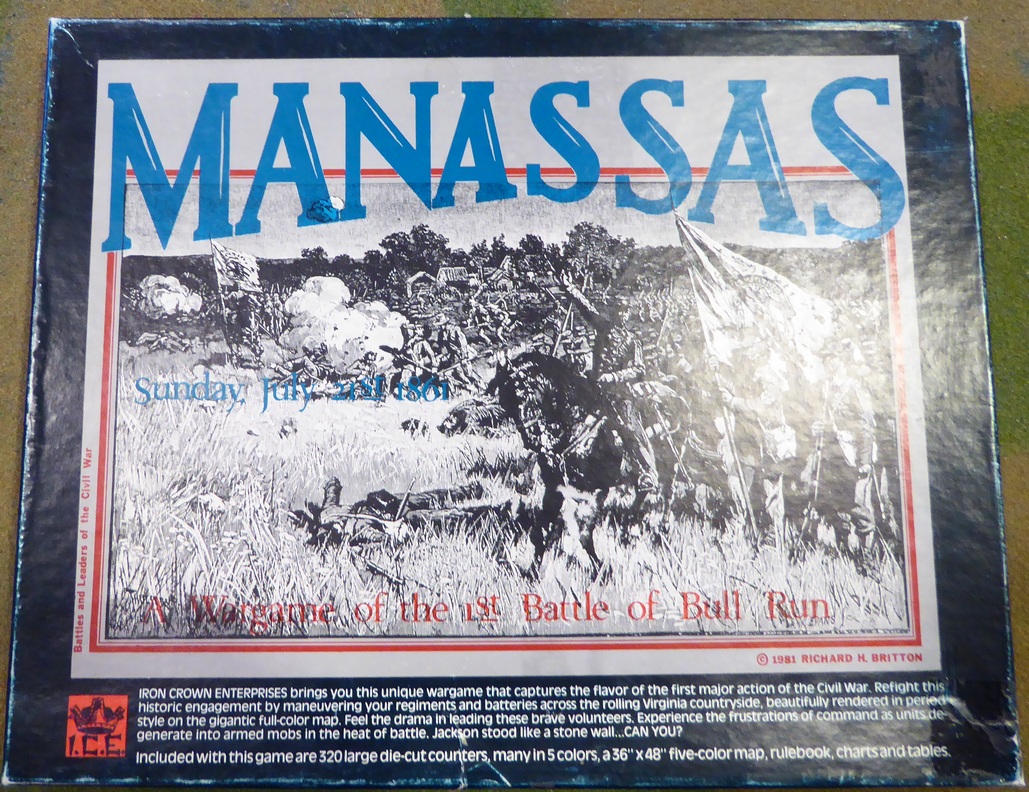
Good things come to those who wait.  That certainly rings true with the latest addition to the wargame collection.  That latest acquisition is Iron Crown Enterprises' (ICE) 1981 release of Manassas: A Wargame of the First Battle of Bull Run.  To my knowledge, Manassas was ICE's only historical release and being quite rare is highly sought by collectors.  Often asking prices for Manassas are in the USD$100 to USD$200 range.  For some ACW boardgame aficionados, Manassas is a game high on the list of Holy Grail games.
Coversheet from ziploc edition
From my research, Manassas came in three versions encompassing two editions.  The first edition initially sold as a ziplock with the coversheet shown above.  The second, first edition game boxed but having the same components as the ziplock version.  The second edition came boxed with double-sided counters and rules' clarifications.  I would like to get my hands on the second edition rules.  Neither Web-Grognards nor Boardgame Geek have these amendments.  

The Manassas is a regimental game recreating the First Battle of Bull Run containing 320 large, 5/8" x 3/4" counters and two wonderful, period-flavored maps making a 36" x 48" five-color playing area.  Rulebook, charts, and tables round out the components.  
Rulebook, charts, and tables
Game Counters
Given the map size and the low number of counters, the game looks imminently playable with low counter density.  Although the counters are slightly larger than the hex, this will not likely affect play due to the low counter density.  Counters appear hand drawn as do the charts and tables.  Very nice effect.  With units at the regiment and battery level, 15 minute turns, and 135 yards per hex, this is a true tactical refight.
Map section
The visual centerpiece of the game is the map.  Appearing had drawn like the counters, the map is a gorgeous rendition of the battlefield in a period evoking style.  At more than 35 years old, the game produces a visual treat for even today's most discerning eye.

Evidently, Manassas was once sold at the Visitor's Center at the Manassas National Battlefield Park.  Research suggests that a reduced game map is available for a sale in the bookshop.  Next trip to D.C., I will need to confirm such for myself.

Finding an unpunched copy of this rare game produces a conundrum for me. The difficult decision is whether or not to punch the game.  In my younger days, I would immediately open a game and set about punching and clipping the counters.  Today, I hold off until I am certain the game will see action on the table.  Well, that does not always hold true!  I often tear into a new game with great gusto with hopes of getting it onto the gaming table.  With a rare item such as this, perhaps a more deliberate approach is needed. 

Punch or not; that is the question. 

Thursday, June 2, 2016

140th NY Volunteer Infantry Rgt

In a radical and unexpected change of pace from recent painting efforts, two dozen Sash & Saber Federal troops were pushed into the painting queue.  Sash & Saber 28mm ACW range is a wonderful range with each figure showing great variety and character.  An entire army composed of these figures would be an impressive and attention drawing sight.
These figures muster out as the 140th New York and join the only other unit in this orphan project, Collis' Zouaves (see Collis' Zouaves).  The 28mm ACW project is orphaned in the sense that I had no real plan for a large collection.  At the outset, my goal was to field a small formation to fight alongside Scott's beautiful ACW project.
Picked up years ago when S&S offered a 40% discount, these figures represented a true bargain.  Although cast and sold by Old Glory, S&S figures do not fall under the Old Glory Army Card 40% discount.  Too bad!  What remains of these wonderful Sash & Saber figures in The Lead Pile?  Well, enough figures remain to field a second 24 figure Zouave regiment.  Still undecided on which unit to field and when to put the figures into the painting queue.
With the ease in painting, the second Zouave regiment should not linger in The Lead Pile for too long.