Wednesday, March 19, 2025

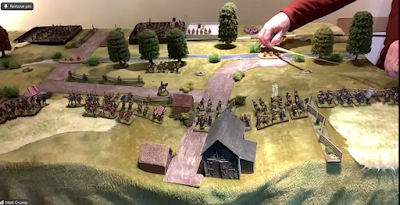
Po River 203 BCE in 28mm

After having no games on the table last week, this week sees two gaming sessions.  The first game of the week took place on Monday in a one-on-one contest to give my current work-in-progress WotR rules their first trial by fire.  The rules and I both survived first contact.  The game went well with a close-run decision but that account is for another time.

Wednesday saw Kevin and I make the 35-mile drive to Scott's in Coeur d'Alene for a session of Commands and Colors: Ancients (CCA).  The battle presented to us upon arrival is a battle Kevin and I have fought nine times now in 6mm.  For Wednesday's game, Scott increases both table and figure size to accommodate his beautiful 28mm Ancients collections.  All photos are of Scott's collection.
Besides the preliminaries of catching up and sharing latest figures painted and painting commissions to be worked, we adjourned to the game room.  Once play began, the action was fast and furious as we are all well-versed in the mechanisms of CCA.  As I played in the first two games and with the frenetic pace of play, there was little time to reflect on the battle action and sequencing for later chronicling.  
When we broke for lunch, Carthage had won both games.  Kevin fell to my Carthaginians in Game #1, 7-4, while I fell to Scott's Carthaginians in Game #2, 7-5.  Rome fell in both battles.  Two very exciting and action-packed games.  When we returned from a leisurely lunch, no time remained to get in one more game.  We called it a day with two games played but with talk of keeping the armies on the table to reconvene in a week or two.

As always, great fun and great lunch.  Scott, thanks for the games!  Kevin, thanks for picking up the lunch tab!   

Until next time.

Sunday, March 16, 2025

First Test of Battle

After sorting my thoughts on Dr. Jones' presentation of creating an "authentic" Medieval wargame and the prodigious and helpful reader commentary from the previous post (thank you, all!), I am ready to bring armies to the table.  Well, at least I think I am ready to bring my WotR collection to the table!
Interweaving all of the helpful suggestions and interesting points brought up in the last post's discussion, other Medieval rulesets, writings on wargaming the period, and my own goals for fighting Medieval battles, a version 1.0 of a working ruleset is in place for the first trial by fire.  That trial is set for Monday in a two-player gaming session as we put the rules through its paces.  No historical battle will be considered this time.  Monday's contest will see two armies of three Battles each face down across an open plain.  
Each army will field three Battles of three units each.  Each Battle will field one unit bow, bill, and Men-at-Arms.  Leadership and unit effectiveness will be set in a pregame phase as we roll for attributes.  Adding variation to Battle composition will provide some data in unequal contests as each pair of enemy combatants fight it out one-on-one.  As in most of my designs, emphasis is on leadership, combat effectiveness, and formation cohesion.
We find out Monday if these working rules survive first contact with the enemy.  With luck, the game will not go down hearing me mumbling the immortal words of Pogo,

Wednesday, March 12, 2025

Challenges to an "Authentic" Medieval Wargame

Back in October of last year, I attended one of Georgetown University Wargame Society's ongoing lecture series.  On tap for the October lecture was Robert W. Jones' talk on The Challenges and Pitfalls of an "Authentic" Medieval Wargame.   Dr. Jones, the author of the Medieval wargame rules Blood and Horse Droppings, brought up a number of interesting topics and points to ponder when creating a set of Medieval rules.  While I had planned on offering up a summary of the discussion much sooner, my motivation to re-address the presentation was triggered by a challenge to bring my yet unblooded Wars of the Roses collection to the gaming table.  With what I want in a Medieval wargame and rules of engagement still in the formative stage, I returned to my notes from Dr. Jones' presentation for inspiration and clarity.

Given the title of the talk, I was not surprised or disappointed in seeing Dr. Jones present a list of challenges and pitfalls to designing a Medieval wargame and how to address those challenges in game design.  The central theme of the lecture should not be foreign to any wargame designer.  That theme focused on the tug-of-war between playability and historical simulation.  Let's briefly reconsider the salient points on what Dr. Jones had to say on the topic of Medieval wargame challenges.
Medieval wargaming, like Ancients wargaming, often encompasses large chronological periods.  Medieval rules can cover nearly a millennium of military history from the fall of the Western Roman Empire to the Great Italian Wars.  Universal rules, using a common game engine, tend to categorize troops according to common criteria across several periods.  Players use the same mechanisms and nomenclature regardless of historical context.  Standardization allows players to switch between periods more readily but at the loss historical specificity over convenience and playability.

Having such breadth in Medieval rules suggests a lack of understanding regarding the technological and tactical evolution present throughout the period.  There is no equivalent descriptive label such as "Horse & Musket" or "Pike & Shot" to describe Medieval warfare's dominant military technologies.
The limited and unreliable historical sources available pose problems as well. Medieval chronicles lack tactical detail, exaggerate numbers, and prioritize political or religious narratives over complete and accurate battle accounting.  Administrative records focus on logistics, not battlefield behavior.  Troop types often reflect national myths ("rash" French knights or "unstoppable" English archers) rather than historical nuance.  Rules often impose 18th/19th-century concepts such as drilled units or hierarchical command onto Medieval armies.  Medieval armies often lacked standardized training and the leadership structure was primarily flat.

Finally, the most significant challenge for medieval wargaming is that historically accurate Medieval battles make for tedious games.  Medieval battles were static and chaotic by modern standards, making them less "fun" as games.  The limited command and control, lack of tactical flexibility, and inability to disengage and redeploy units means Medieval battles involve minimal maneuver once lines are engaged.  Commanders had few tactical decisions once battle was joined since they were often fighting in the front lines.  An historically accurate simulation would essentially line up armies, advance to contact, and watch the clash unfold with little player input.

Are these foreseen challenges to designing a Medieval ruleset correct?  Are there other considerations?  Do answers to these challenges depend upon level of abstraction modeled or the player’s role in the game?  Is designing/developing a "fun" set of Medieval rules even possible given these constraints?  Many reckon it is including Dr. Jones!

With the challenges as seen through Dr. Jones' eyes laid out, next I consider solutions and rules.  Something to dive into another time.

Monday, March 10, 2025

A Look at Some Akkadians

While time at the painting desk seems at a premium of late due to other distractions, work continues albeit at a slower pace.  What time I find, continues to be monopolized primarily by SYW/WAS units.  Still, my attention is turning back to Biblicals and today's entry illustrates one such diversion.
Out from the workbench today are 24 Akkadian spearmen deployed into two units.  Figures are 28mm Newline Designs.  Superb sculpts.  These Akkadians march out to reinforce the Sumerian project.  Remaining in The Lead Pile are enough Akkadians to form two more such 12-figure units. 
What other Biblicals are working through the painting queue?  Well, there are two bodies of Babylonian spear in progress at present.  Two dozen Hittite spear are being prepped for undercoating.  I would like to work more Biblicals into the painting queue in 2025.  Off to a good start in the New Year but the pace really needs to increase if March production is going to come anywhere close to totals seen in January and February.
Working up rules for an upcoming Wars of the Roses game is taking away time at the painting desk as I prepare to bring the WotR collection to the table for the first time.  Still, much to consider and refine as I wrestle with building something (hopefully) useful, enjoyable, and challenging.

Thursday, March 6, 2025

Archaeology In The Lead Pile

Digging down through the various strata of The Lead Pile recently, I came across several packs of horsemen for the 30mm ECW project.  Now, there remains not so many leftovers to paint in this project so I pulled out three packs and pushed the nine figures into the painting queue.  
From my perspective the ECW project is mostly complete.  Only some odds and ends and enough cavalry for one more body of horse.  Looking back at the Painting Log, the last time any units mustered out was December 2022, a little over two years ago.  Still, adding one horse unit and cleaning out a few packs of figures was worth the time and effort, I thought.
The figures are from The Assault Group and were picked up many, many years ago.  Many of these nine horsemen are wearing older style helmets more suitable to 30YW but they will do for service in my ECW battles.  Nice figures.

On the gaming front this week, Peter (Grid based Wargaming) hosted me in a remote, Medieval game using Arrowstorm.  My first time with the rules and I must admit I was soundly thrashed in Game #1 but made some progress in Game #2.  Still, in Game #2 I fell to Peter's clever tactics.  Perhaps I will get him next time?  We are discussing a rematch. 
Peter has also challenged me to bring my WotR collection to the table for its first outing.  Not able to resist a challenge, I am working on rules for the period for presentation soon(ish).  With some luck, I hope to see the collection on the table within a fortnight.

Monday, March 3, 2025

The Week That Was...

While not as vigorous as six games in seven days as seen a few weeks ago, I did manage four games over the past seven days.

Three of the games saw a return to the 203 BCE Battle of Po River using CCA and my 6mm armies.  Like the other two sessions (we fought the battle a total of nine times), Carthage came out the victor in two of the three battles.  Great fun although time to find another, equally entertaining scenario. Po River may be my favorite battle played.  Even though the Carthaginians wound up winning six games to three, the Romans seemed in the fight until the last banner fell.  Very well balanced and a fun challenge for both armies.

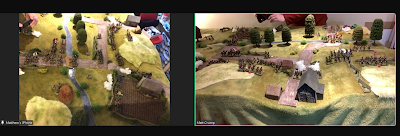
The fourth game of the week was a remote game with Matt (wargames in the dungeon) where we fought the opening moves of the AWI Battle of Brandywine Creek.  This session saw the British and Hessian attacks at Chadd and Brinton's Fords.  I only have screenshots but Matt will likely have a detailed expose of the battle soon.

I leave the battle account for Matt to spin!  This week, only one game on the docket for Wednesday.  Of course, that may change.

On the painting front, the brushes have been moderately busy with February seeing 70 figures cross the painting desk.  Weather has improved enough to prime figures too.  Painted units are stacking up at the light box so I need to get a move on.

First up are two British regiments for the SYW/WAS project.  These are the first of hopefully many British units to march out from the painting desk in 2025.

The two regiments muster out as the 1st and 2nd Foot Guards.  Each regiment has 22 Blue Moon foot figures led by a Eureka mounted colonel.  Only two regiments but it is a start.

Finally, weather improved enough to get out for a pleasant afternoon bike ride.  Oh, it is good to be back outside.  Very nice change of pace from a winter spent indoors on the trainer.  I am feeling the difference between trainer and actually cycling outside in the body today.  Still much grit and too many potholes to contend with on the road but things are looking up.

Friday, February 28, 2025

Wargaming Period Preference

In what seems to have become a biennial staple of the Wargames, Soldiers, and Strategy's Great Wargaming Survey (GWS) analysis, time to re-examine the topic of wargaming period (or era) preferences and see if survey respondents' preferences have changed since 2022 when we last visited this question.

Looking back to 2022, the survey allowed, at most, three choices in ranking period preferences but the rank order was not captured.  Respondents simply picked their Top 3 periods.   To investigate the overall popularity of a wargaming period, up to three choices per respondent are aggregated across all responses. The results from the 2022 GWS are shown in Figure 1.
Figure 1
In 2022, the Top 5 periods in rank order when aggregating the Top 3 choices were,
  1. World War 2
  2. Science Fiction (excl WH40k)
  3. Fantasy (excl. WH40k/Age of Sigmar)
  4. Warhammer 40k
  5. Napoleonics
World War II comes out at the head of pack followed by three non-historical periods with Napoleonics rounding out the top 5.

For the 2024 GWS, the question accepts rank order of choices.  Again, only the Top 3 choices are captured.  When these Top 3 choices are aggregated across all survey responses, do the results change from the results seen in 2022?  See Figure 2.
Figure 2

In the 2024 GWS, we find that the Top 5 periods are,
  1. World War 2
  2. Science Fiction (exc WH40k)
  3. Fantasy (exc WH Fantasy)
  4. Warhammer 40k
  5. Napoleonic Wars
Again, WW2 comes in at the top spot in the 2024 survey with non-historicals dominating ranks 2-4.  Even though total response counts were down about 40% from 2022, the Top 5 periods remain the same and in the same rank order.  Nothing has changed!

What if only the Top Period is examined and not an aggregation of the Top 3 choices?  Do results change materially?  Figure 3 shows that the Top 5 periods remain the same but Fantasy (exc WH Fantasy) falls to fifth place.
Figure 3
Can any useful inferences be made by examining period preference by a few select attributes?

Primary Interest
Primary gaming interest separates responses into three distinct categories.  These categories are Historical, Fantasy/Sci-Fi, and Mixed.  As we might expect, there is a clear demarcation in period preferences between historical and non-historical wargamers.  Also as expected, the gamers in the Mixed category are open to gaming most periods.  See Figure 4.
Figure 4
Age Group
As has been reported in other analyses repeatedly, period preference seems to be driven, in large part, by age. Here again (see Figure 5), there is a clear bifurcation between historical and non-historical wargamers. Historical periods tend to see heavier interest by older wargamers (51+) while non-historical periods are more likely to see a concentration of wargamers in younger age cohorts.  Notice that wargamers age 51+ comprise about 70% of the interest in 18th Century and Colonial Wars periods.  WW2, Ancients, Medievals, and Dark Ages, on the other hand, tend to see interest from all age groups.
Figure 5
Location
When the results are summarized respondent location, do any tendencies emerge?  Yes!  From Figure 6, location does seem to influence what wargamers play.  Just looking at the relationship between North American and UK/Ireland wargamers, North Americans favor ACW by better than a two-to-one ratio over UK/ Ireland while UK/Ireland favors Pike & Shotte by nearly a two-to-one advantage over their North American comrades.  North Americans tend to prefer non-historicals more than their UK/Ireland counterparts. 
Figure 6
WW2 continues to hold its place at the top of the charts with broad appeal among all survey respondents.  Even with a reduction in number of responses in 2024, the results remain stable.  For a number of periods, there remains a clear line between primarily historical and non-historical wargamers.  The lack of cross-over between these two preferences seems constant.

Next time the GWS analysis returns, I examine a follow-up question to wargaming period preference using cluster analysis.