Thursday, August 15, 2024

Dog Days of Summer

While we may in the Dog Days of Summer in the Northern Hemisphere, I continue working toward keeping the gears of hobby activities turning over.  Turning over slowly, perhaps.  Intermittent bouts of heatwaves have stifled some activities but the underground game room offers solace from the oppressive heat.

"Turning over slowly" is, indeed, correct regarding my output at the painting desk.  I have a number of units in work but few are making it out the other end.  Seems like the normal routine has become, cycle in the morning, take care of any domestic duties, catch up on email, and then go downstairs for a painting session.  What often happens is that the process gets derailed when I go downstairs to paint.  Fatigued from cycling, I sit down on the couch with a book in hand and cold drink on the table.  Before you know it, one or two hours have slipped by and I never made it to the painting desk.

Well, fighting that inertia, off the painting desk today is one 23-figure regiment of Spanish infantry for the 18mm SYW project.  Foot figures are Old Glory led by a Eureka mounted colonel.  Flags are David's from Not by Appointment.  Regiment is Granada. 

A number of other units are in progress including an early spurt of undercoating several batches of figures before the cold weather sets in.  Now, this is really planning ahead!

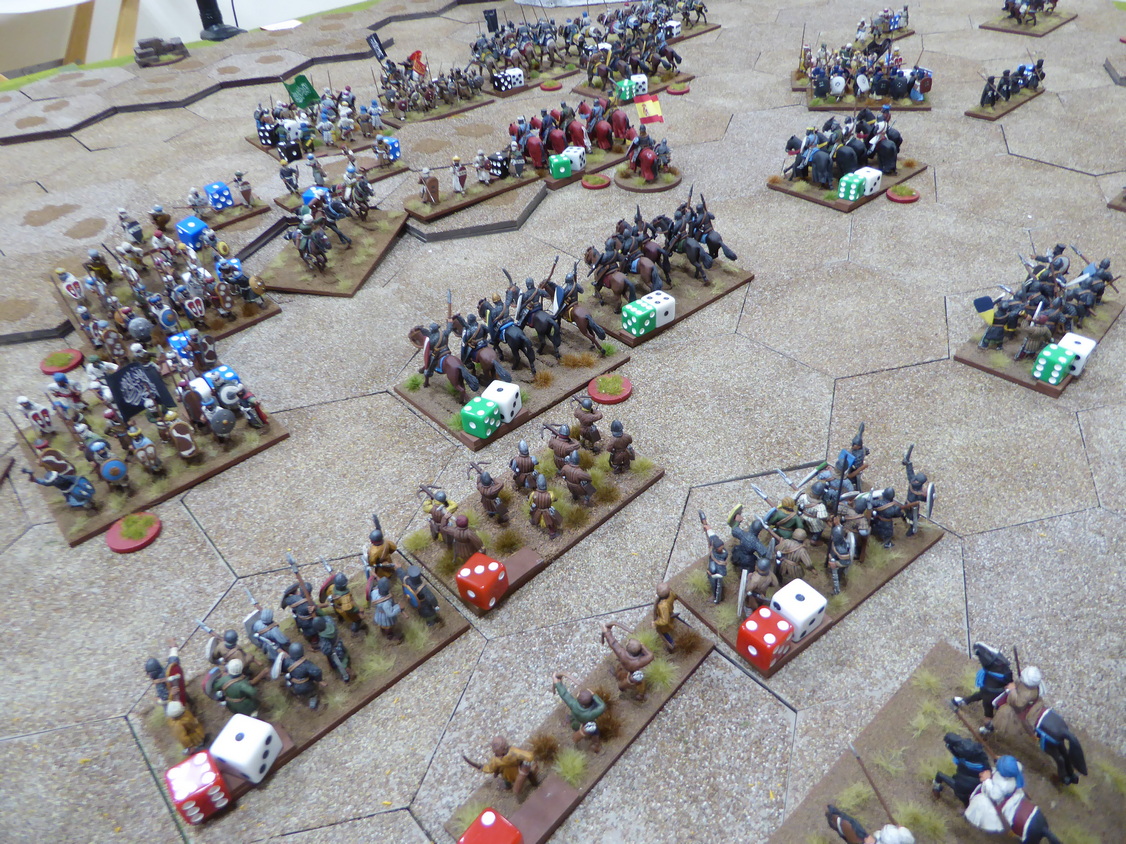
On the gaming front, two games are on the schedule for this week.  Both games feature the Battle of Cheriton in one-on-one games against a single opponent.  With the steady stream of hosting and umpiring games, I seldom actually get a chance to take command.  This week is different.  On Wednesday, I faced Mark in humiliating defeat.  Later this afternoon, I face Peter in our Home-and-Away series of Cheriton battles.  Below is one of the photos from Wednesday's game which sees both armies locked in combat along the hedge-lined lane.
With some luck, I can put a spin on this debacle after Mark's memory fades... 

Sunday, August 11, 2024

The Battle of Cheriton, Hopton vs Waller

Last Monday, four players logged in to refight the 1644 Battle of Cheriton remotely.  Players in attendance were Chris and David B. as Parliamentarians and Mark and David C. as Royalists.  In pre-battle possibilities, Waller (Chris) opted not to push a unit of commanded shot into Cheriton Woods.  Hopton (Mark) chose to follow suit.  Each army would add one more regiment of foot to the battle line in lieu of having the commanded shot. 

Waller's Army is drawn up along the high ground on the South Spur with Haselrigge's cavalry wing holding the left.  Opposing Waller sees Hopton's Army augmented by Lord Forth.  With Cheriton Woods and numerous hedge-lined lanes, this would pose difficult ground to fight over.
Army dispositions and initial deployments.
As the battle opens, Waller is content to hold his position on the South Spur.  Hopton has no such luxury.  He must bring the fight to the enemy.
Waller waits on the South Spur...
with Haselrigge's Lobsters supporting the left.
Hopton's Army deployed for battle.
Hopton prepares for battle...
before setting his army in to motion.
The hedge-lined lanes tend to funnel Hopton's attack.  Crossing the heavy hedges takes time.  As Hopton advances, Waller pushes one of his guns down off the South Spur.  Haselrigge's Left Wing advances to counter enemy movements.  On Waller's Right, Balfour's dragoons work their way through Cheriton woods.  In one of the early dramatic moments in battle, Haselrigge sends in one brigade of horse charging toward the enemy.  Forth orders one of his horse units to countercharge.  Rather than head off toward the enemy, Forth's horse break for the rear!  With many of Hopton's foot now lining the east-west hedged lane, Haselrigge pulls back his cavalry out of small arms' range. 
Waller puts his left into motion.
Hedges constrain and channel Hopton's advance.
Haselrigge retires his cavalry out of musket range.
Having overcome the hedges to his front, Hopton's foot drive on to the enemy still positioned upon South Spur.  The yellow coats are the first to reach the enemy line overrunning the gun and then pushing back the Roundhead foot to their front.  Now upon the spur, themselves, the yellow coats are counterattacked vigorously by two bodies of enemy foot.  The odds and pressure against the yellow coats are too much.  Like a wave crashing against a rocky shore, the Royalist foot is broken apart but the yellow coats take down one of Waller's regiments in the fight.
Waller holds the high ground...
but Hopton wants that ground too!
In the clash, the yellow coats are destroyed
but a Roundhead regiment is lost as well.
In the center, Hopton sends two foot regiments against the heights.  The leading red coated foot overruns the isolated gun followed up by a well-delivered volley up the slopes and into the enemy.  The musketry is too hot.  The Roundhead regiment in purple falls back from the exchange.  Having split his cavalry command, Stuart sends two of his three horse brigades over to support the attack in the center and to counter Haselrigge's horse.  Seeing this redeployment, Balfour sends two of his three horse brigades over to the left to support Haselrigge.  
Attack in the center...
and send the enemy back with a volley!
In the background, Royalist cavalry moving up on the right.
Stuart leads his remaining cavalry brigade forward on the left to support Hopton's blue coats.  A storm seems to be brewing on the Royalist Right as both armies bring up more cavalry to contest the ground.  Hopton continues to push his foot forward.  Many of his regiments have reached the foot of the spur.
While Hopton's blue coats advance on the South Spur...
Stuart leads his cavalry up in support.
Royalists press on toward the heights.
Can Hopton take the high ground?
On the Parliamentarian Left, the pressure continues to build until the valve finally bursts.  Mayhem is unleashed!  In a series of charges, counter charges, and pursuits, cavalry fight vigorously in an attempt to gain the upper hand.  While the Roundheads come out victorious in some of the clashes, the Royalist's dominate in others.  Haselrigge's lobsters are put to flight on the extreme left while Balfour's horse set off in pursuit of Stuart's retreating horse.  Commands are intermingled and horsemen find the enemy all around!  Chaos!  
Cavalry actions on the left.
Pursuit!
Bard's foot covering the cavalry retreat.
Bard standing like a stonewall.
With the cavalry battle swirling away on the Roundhead Left, Hopton pushes the enemy back as his blue coats advance up onto the spur.  After about four and a half hours of play and the ticks on the Breakpoint Clock showing neither has gained the upper hand, a short deliberation declares the battle a draw.  A reasonable result, I think.  Both armies fought hard but neither held an advantage with respect to breaking the other.
Very exciting battle with the quartet of players giving as well as they took.  Congratulations to all for a most enjoyable game.

Now, all had played these rules before but that was a long time ago.  Those earlier games were played out on an open field.  For this game, rules were translated to playing on a hex grid with units taking up two hexes each.  As expected, there was some confusion with the double hexes and the difficulty in crossing the numerous hedges on the battlefield.  Besides some confusion and errors, the game played well and produced another interesting contest. 

With Cheriton still on table, I expect to replay this battle a few more times.  Then, with rules still fresh in mind, perhaps moving on to a different ECW battle is in the cards.  We will see comes what may.

Thanks again, for a great game, guys!

Wednesday, August 7, 2024

What Do You Like Most About Miniatures Wargaming?

In a natural counterpoint and follow up to the earlier analysis that examined what survey respondents liked least about wargaming in Wargames, Soldiers, and Strategy's 2023 The Great Wargaming Survey (see What Do You Like Least About Miniatures Wargaming), today's installment focuses on responses to the question,

What do you like most about miniatures wargaming?  

As in the Least Liked question, responses were captured as unstructured text with about a 2,100 character limit.  Respondents could (and did) enter any text they wished.  For the Most Liked question, the survey received 7,438 non-blank responses in this field.  The total record count for Most Liked is slightly more than the 7,278 responses to the Least Liked question.  Perhaps the count increase reflects a bias toward positive commentary?  You know, if you have nothing nice to say, say nothing.  

To make sense out of these unstructured texts, machine learning techniques are employed.  Again, these text analytics techniques focus on cluster analysis and principal component analysis (PCA).  The goal of these techniques is to gain insight into the underlying data structure and reduce this large body of text down to a manageable number of associated "words" without losing the essential information contained within each response.

To begin analysis, a series of text transformations were applied to each response to standardize a collection of word tokens.  After word tokenization and preprocessing, 4,144 unique terms and counts of term frequencies were created for follow-on analysis steps.  By contrast, the Least Liked word tokenization resulted in 4,918 terms.  After removing terms having near-zero variance, these 4,144 terms were reduced down to only fourteen word tokens.  These remaining tokens are:
  • games
  • people
  • painting
  • miniatures
  • history
  • research
  • collect
  • model
  • terrain
  • table
  • fun
  • creative
  • army 
  • build
What is especially interesting about the final list of tokens presented here is that three of the tokens (people, painting, miniatures) made the final list in the Least Liked analysis as well.  What does this result suggest?  Well, there seems to be a love/hate relationship with other wargamers and painting miniatures.  Even without word association, this list of fourteen tokens paints an interesting snapshot of the factors enjoyed in miniatures wargaming.

Having reduced the tokens down from more than 4,000 to 14, time to examine the results from cluster analysis of categorical data.  The dendrogram produced by cluster analysis is shown below:

The results in the graphic above illustrate an interesting and intuitive clustering of the words.  Notice that "games" (and gaming) forms a cluster alone with all else falling into a second cluster.  Given that the hobby is "miniatures wargaming" in name, it is reassuring to see that gaming represents an important facet of the hobby.  The two-cluster solution with "gaming" and everything else is illustrated in the dendrogram below:
In the three-cluster solution, "people" spins off from the large, 13 token group identified in the two-cluster solution.  With three-clusters, "games" and "people" show the most separation from the remaining word tokens.  For most respondents, games and other wargamers are the most frequently liked facets of wargaming. 
While the cluster analysis iterations could keep slicing the dendrogram to increase the number of clusters, I stop at the four-cluster solution.  With four clusters, painting miniatures separates itself out from the pack.  From the survey, three universal drivers for wargaming happiness seem to fall to gaming, people, and painting miniatures.  Based upon my own experience, I agree with the survey results but, of course, opinions and rationales may differ.  The survey does produce intuitive results from all of these unstructured texts. 
One final point before moving on to principal component analysis.  Notice how the tokens, research/collect, terrain/table, fun/creative, and army/build pair up within the clustering?  Very interesting and intuitive given the nearly 7,500 responses and the 4,100 unique terms.  In the prior cluster analysis of Least Liked, some have suggested this is akin to magic.  
Now we examine PCA.  As in the Least Liked analysis, details for the technique are left for the reader.  One useful visualization tool is PCA Variable Plotting which illustrates the relative importance (loadings) of each of the fourteen variables in 2D space.  Color and length of each vector denotes its contribution to the PCA analysis.
Graphical analysis of PCA results tends to lend itself (in most cases) to inferences that are easier to interpret.  While only two of the dimensional plots are illustrated here, only one of these dimensions lends itself to easy interpretation.

When considering the DIM1 (x-axis) in the graph below, there is no clear interpretation of the yellow and green semicircles.  Only the "creative" token projects into the negative (yellow) space of DIM1.  With all other tokens in the positive (green) space of DIM1, inferences are fuzzy. 
When examining the PCA Variables plot in the DIM2 (y-axis) space, meaningful inferences regarding the underlying classification are easier to distinguish.  In this case, the sign of loadings suggests a contrast between the Social (positive) and Solo (negative) principal components.
Another visualization technique in the PCA toolkit focuses on examining scree plots.  Scree plots allow a quick visual assessment of the relative importance of factors and principal components as well as suggesting an underlying classification or interpretation of each principal component.  Interpreting scree plots can be subjective but assigning a classification to each of the first three principal components, in this exercise, seems straightforward.

Results from PCA on the Most Liked unstructured text responses suggest that the principal components separate into three classifications of respondents.  These classifications I label as Craftsman, Gamer, and Historian.  The scree plots for each of these principal components and their contributing factors are illustrated below:


The significant factors comprising the Craftsman principal component are painting, miniatures, build, terrain, collect.  The factors driving the Gamer principal component are people, games, fun.  Finally, the Historian principal component sees history and research as the significant factors.  Now these are remarkable results in that we can transform roughly 7,500 unstructured text responses, reduce the dimensionality of the data (from 4,144 word tokens down to 14) while retaining sufficient information to assign meaningful classifications to the principal components. 

Do these 14 Most Liked factors reflect your own wargaming preferences?  If so, does the dendrogram hierarchy for the survey population fit your experience?  If not, what is your Most Liked factor?  Finally, do the classifications of Social/Solo and Craftsman/Gamer/Historian fit your own profile? 

In the Least Liked and Most Liked analyses, there were many insights to uncover from very large bodies of unstructured texts.  For me, these exercises have been a fascinating glimpse behind the curtain.

Sunday, August 4, 2024

Battle of Ucles 1108

Today's battle report is long overdue.  Fought in the middle of July, I am only just now getting around to chronicling this great battle.  Besides fighting other battles, I have been at work on developing a scenario for the Battle of Cheriton and wrangling survey data for the next Great Wargaming Survey analysis.  Toss in a little painting, some steady yard work, a minor injury or two, and a lot of cycling (logged a tad under 600 miles for July) and time slips by faster than I realize.  Perhaps the hot weather takes its toll as well in making everything take a little bit longer.  Either that or age is catching up with me.  I lobby for the former.  Anyway, back to today's battle report.

On 18th July, the Battle of Ucles was on the docket with four players lined up to participate.  At the last minute one player bowed out leaving a planned four-player game with three players.  Being the Acceptor of All Challenges, Doug volunteered to command the Almoravid Army alone.  Stephen and Colin split the Spanish command with Stephen taking both wings while Colin commanded the heavy cavalry and reserve infantry in the center.
Initial dispositions
After three weeks, let's see how much of this battle I recall.

With the Almoravid Army besieging Ucles, word arrives that a Spanish relief force under Sancho Alfonsez is on its way to break the siege.  Calling his army to the colors, Ibn Yusef deploys his army to face the enemy in front of the gates of Ucles.  Yusef places his medium cavalry in the center of his battle line.  Sancho deploys his Spanish Army with his heavy knights in the center
Ibn Yusef draws up his army at the gates of Ucles.
As the battle begins, both armies advance their wings while the center cavalry remain still.  Almost still.  Yusef turns his two horse units about to face the rear.  The camels remain in place facing the enemy.
The wings probe forward while the centers holds.
Skirmishing on the flanks.
Almoravid cavalry about face.
Sancho can restrain his knights no longer.  In they all go into the awaiting enemy hordes!  Sancho leads a charge up the hill and into the Muslim mixed foot unit.  The Muslims are driven back in retreat.  Sancho pursues but his pursuit crashes into a veteran body of spearmen.  The spearmen stand their ground and Sancho falls back.  A second body of knights to the right of Sancho charge into another body of spearmen.  Yusef's heavy infantry fall back from the weight of the charge.  

A third body of Christian knights charges into the Almoravid camelry.  They too are drive away in disorder!  These knights refuse to pursue but Sancho has cut a wide swath through the Almoravid line!  The Christians cheer!  Yusef brings up a body of mixed infantry in an attempt to drive off the knights isolated in the center.  The Almoravid infantry is driven off.        
Charge!
Where is the Almoravid Center?
Seeing a gaping hole where his center was moments before, Yusef, advances against both wings to relieve pressure on the center.  These advances on the flanks see success in that the Spanish Right is turned and Yusef's light cavalry is able to swing around the enemy flank and threaten the Spanish rear.  Sancho sends his red knights in again against the Almoravid Center.  Repulsed!  
Yusef attacks against the Spanish Right...
and against the Spanish Left.
The isolated Spanish knights are attacked again.
Yusef working to turn the Spanish Right.
Driven off a second time,
Almoravid infantry is in full retreat!
At this point in the battle, the Spanish cavalry have driven all before them.  Yusef was not done for yet!  

With his medium horsemen returning to the battle, Yusef begins to execute his plan.  First, the isolated Spanish knights in the center are driven back with heavy casualties.  The attacking Muslim horsemen follow up in pursuit.  The Spanish are caught and dispatched.  The Almoravid horsemen continue to pursue.  The Muslim cavalry reach the red knights and cut them down.  Sancho is lucky to escape!  
Counterattack...
and pursuit...
and pursuit.
Sancho barely escapes with his life.
Against the Spanish Left, Yusef orders his heavy infantry down from the heights to engage the enemy.  In supported attacks, the Almoravids strike with a vengeance.  Spanish infantry and Spanish cavalry are driven off in retreat.  Although Muslim casualties are heavy in these clashes, the Spanish Left collapses.  
Almoravids on the attack!
Spanish Left is shredded!
Almoravids control the battlefield.
With the Spanish center gone, his right turned, and his left now in flight, Sancho puts an end to his attempt to relieve the siege at Ucles.  The occupants must fend for themselves.

After watching Colin rip apart the Almoravid Center, I figured this battle might be a short one.  Once these massive Spanish cavalry charges ran their course, exhausted, they were vulnerable.  Doug did not allow this opportunity to slip away.  He counterattacked vigorously everywhere.  Where moments before, it looked like a Spanish steamroller crushing everything in its path, Doug struck back and turned the tables.  Impressive comeback and another very exciting game.

Thank you all for another, most entertaining session.  Great fun!

Yeah, I think this is how the battle unfolded…